
Penny Dreadfuls, 1856 · page 63 of 399
Ellen Percy; or, The Memoirs of an Actress — page 63: what you’re looking at
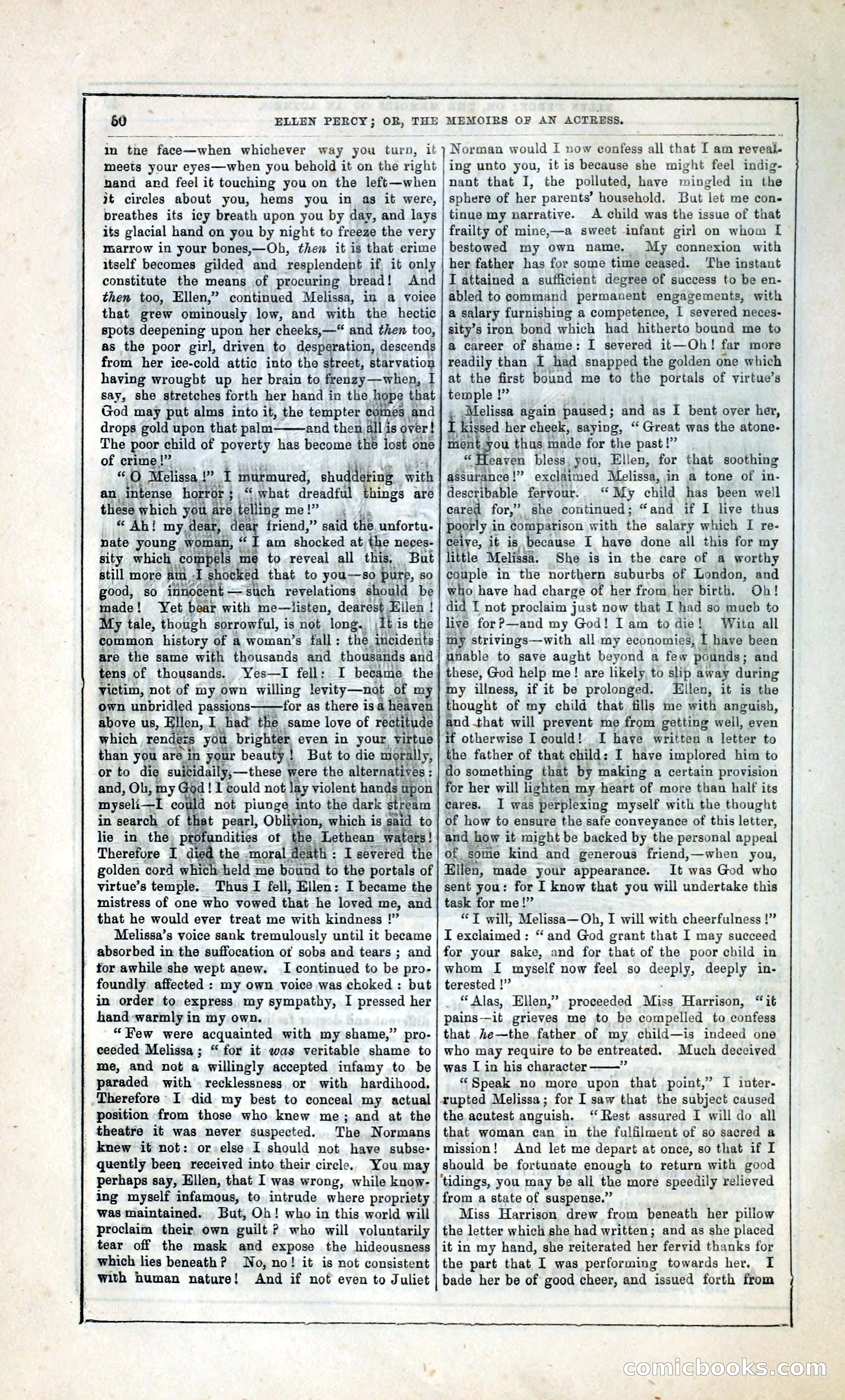
A restored page from Penny Dreadfuls, 1856. Page through the whole issue in the reader above.
📄 Transcribed text from this page (OCR, searchable)
Machine-transcribed from the original scan — historical spelling and the odd misread are preserved.
Eee 60 ELLEN PERCY; OR, THE in the face—when whichever. way you turn, it meets your eyes—when you behold it on the right nand ard feel it touching you on the left—when 1& circles about you, hems you in as it were, breathes its icy breath upon you by day, and lays its glacial hand on you by night to freeze the very marrow in your bones,—Oh, ¢hen it is that crime itself becomes gilded and resplendent if it only constitute the means of procuring bread! And then too, Ellen,” continued Melissa, in a voice that grew ominously low, and with the hectic spots deepening upon her cheeks,—* and then too, as the poor girl, driven to i 2 ration, descends from her ice-cold attic into the street, starvation having wrougbt up her brain to fronzy—when,, I say, she stretches forth her hand in the hope that God may put alms into it, the tempter rr nes and drops gold upon that palm- and then all 4 is ver! The poor child of poverty has oe the lo At one of crime!” r he Melissa ! Aa I murmured, shu doting with an intense hort F}. “what dreadfu Things are these which you. are 3 telli ling me!” “« Ah! my. dear, i friend,” said the. unfortu- nate young compel am shocked at the neces- sity bar | co ppl s me to reveal all this, But still more & T sok ef that to you—so pure, s good, so aisha ich revelations shouk made! Yet bear with me—listen, dedtort Mick i y tale, though sorrowful, is not long. RS is the common history of a woman’s fall: the incidents are the same with thousands and thousands and tens of thousands. Yes—I fell: I became the bs Victim, not of my own willing levity —noat of m my own unbridled passions for as there isa heave above us, Hilen, I had the same love of rectitude which rendezs you brighter, even in your a than you are in your beau i But to die moral ly, or to die suicidaily,—these ¥ yere the alkene and, Ol, my God! I could not ay violent hands i myseli— co a not piunge into the dark a m in search of that pearl, Oblivion, which is aid fe lie in the. pr fundities of ae Lethean _ waters Therefore I died the ‘moral, ath : I severed golden cord which-held me noand to the portals a virtue’s temple. Thus I fell, Ellen: I became the mistress of one who vowed that he loved me, and that he would ever treat me with kindness !” Melissa’s voice sank tremulously until it became absorbed in the suffocation of sobs and tears ; and for awhile she wept anew. I continued to be pro- foundly affected : my own voice was choked : but in order to express my sympathy, I pressed her hand -warmly in my own. “Few were acquainted with my shame,” pro- ceeded Melissa ; “ for it was veritable shame to me, and not a willingly accepted infamy to be _ paraded with recklessness or with hardihood. Therefore I did my best to conceal my actual position from those who knew me; and at the theatre it was never suspected. The Normans knew it not: or else I should not have subse- quently been received into their circle. You may perhaps say, Ellen, that I was wrong, while know- ing myself infamous, to intrude where propriety. was maintained. But, Oh! who in this world will proclaim their, own guilt ? who will voluntarily tear off the mask and expose the hideousness which lies beneath? No, no! it is not consistent with human nature! And if nof even to Juliet ab’ MEMOIRS OF AN ACTRESS. — a re Norman would I now confess all that [ am reveai- ing unto you, it is because she might feel indig- nant that I, the polluted, have mingled in the sphere of her parents’ household. But let me cons tinue my narrative. A child was the issue of that frailty of mine,—a sweet infant girl on whom [ bestowed my own name. My connexion with her father has for some time ceased. ‘The instant IT attained a sufficient degree of success to be en- abled to command permanent engagements, with a salary furnishing a competence, I severed neces- sity’s iron bond which had hitherto bound me to a career of shame: I severed it—Oh! far more readily than I had snapped the golden one which at the first bound me to the portals of virtue’s temple !” Melissa again paused ; and as I bent over her, Tiki 1 ssed her cheek, saying, “‘ Great was the atone- Haus ou thus made for the past!” « Heaven bless, you, Ellen, for that soothing assurance |” exclaimed Melissa, in a tone of in- desctibable fervour. “My child has been well caret for,” she continued; “and if I liye thus poorly in comparison with the salary which I re- eive, it is because I have done all this for my ittle Melissa. She is in the care of a worthy 9 | ule in the northern suburbs of London, and o have had charge of her from her birth. Oh! ai I not proclaim just now that I had so mucb to live for?—and my God! Iam to die! Witn all my strivings—with all my economies, I have been nable to save aught beyond a few ‘pounds and these, God help me ! are likely, to slip away during my illness, if it be prolonged. Tllen, it is the thought of my child that fills me with anguish, and that will prevent me from getting well, even otherwise I could! I have written a letter to the father of that child: I have implored him to o something that by making a certain provision for her will lighten my heart of more than half its cares. I was perplexing myself with the thought of how to ensure the safe conveyance of this letter, an how it might be backed by the personal appeal some kind and generous friend,—when you, Bilen, made your appearance. It was God who sent you: for I know that you will undertake this task for me!” * T will; Melissa—Oh, I will with cheerfulness !” I exclaimed: “and God grant that I may succeed for your sake, and for that of the poor child in whom I myself now feel so deeply, deeply in- terested !” _ “Alas, Ellen,” proceeded Miss Harrison, “it pains—it grieves me to be compelled to confess that AHe—the father of my child—is indeed one who may require to be entreated. Much deceived was [ in his character ra “Speak no more upon that point,’ I inter- xupted Melissa; for I saw that the subject caused the acutest anguish. ‘“ Rest assured I will do all that woman can in the fulfilment of so sacred a mission! And let me depart at once, so that if I should be fortunate enough to return with good ‘tidings, you may be all the more speedily relieved from a state of suspense.” Miss Harrison drew from beneath her piliow the letter which she had written; and as she placed it in my hand, she reiterated her fervid thanks for the part that I was performing towards her. I bade her be of good cheer, and issued forth from CoOnniclooolx (ECON