
Penny Dreadfuls, 1856 · page 42 of 399
Ellen Percy; or, The Memoirs of an Actress — page 42: what you’re looking at
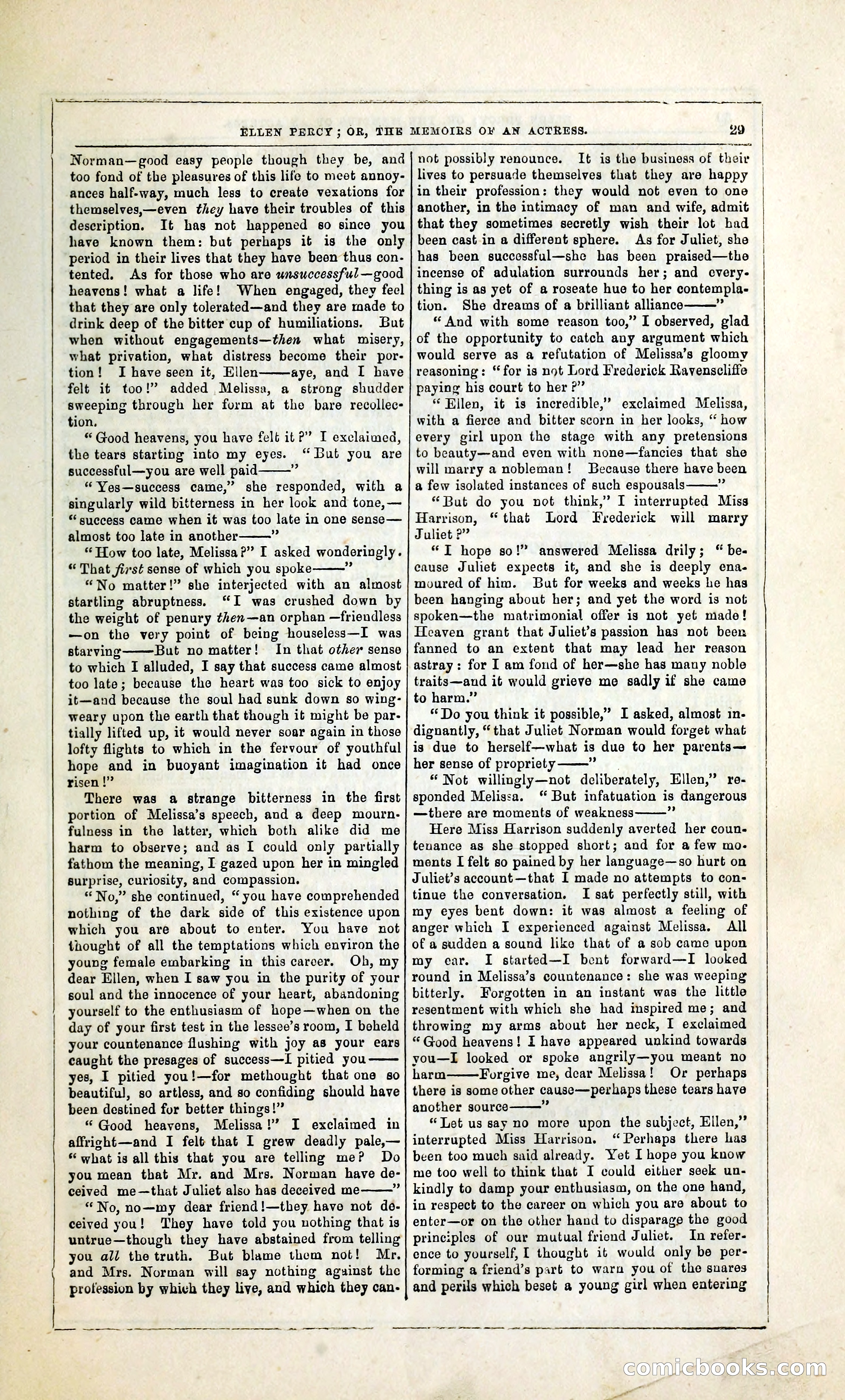
A restored page from Penny Dreadfuls, 1856. Page through the whole issue in the reader above.
📄 Transcribed text from this page (OCR, searchable)
Machine-transcribed from the original scan — historical spelling and the odd misread are preserved.
~‘ | em we ee we ae ee ee ’ ELLEN PERCY; OR, THE MEMOIRS OF AN ACTRESS. v9 Norman—good easy people though they be, and too fond of the pleasures of this life to meet annoy- ances half-way, much less to create vexations for themselves,—even they have their troubles of this description. It has not happened so since you have known them: but perhaps it is the only period in their lives that they have been thus con- tented. As for those who are unsuccessful —good heavens! what a life! When engaged, they feel that they are only tolerated—and they are made to drink deep of the bitter cup of humiliations. But when without engagements—then what misery, what privation, what distress become their por- tion! JI have seen it, Ellen aye, and I have felt if too!” added Melissa, a strong shudder sweeping through her form at the bare recollec- tion. “ Good heavens, you have felt it P’ I exclaimed, the tears starting into my eyes. “ But you are successful—you are well paid . “ Yos—success came,” she responded, with a singularly wild bitterness in her look and tone, — ‘success came when it was too late in one sense— almost too late in another i “ How too late, Melissa?” I asked wonderingly. “ That first sense of which you spoke - “No matter!” she interjected with an almost startling abruptness. “I was crushed down by the weight of penury then—an orphan —friendless —on the very point of being houseless—I was starving But no matter! In that other sense to which I alluded, I say that success came almost too late; because the heart was too sick to enjoy it—and because the soul had sunk down so wing: weary upon the earth that though it might be par- tially lifted up, it would never soar again in those lofty flights to which in the fervour of youthful hope and in buoyant imagination it had once risen !” There was a strange bitterness in the first portion of Melissa’s speech, and a deep mourn- fulness in the latter, which both alike did me harm to observe; and as I could only partially fathom the meaning, I gazed upon her in mingled surprise, curiosity, and compassion. “No,” she continued, “ you have comprehended nothing of the dark side of this existence upon which you are about to enter. You have not thought of all the temptations which environ the young female embarking in this career. Oh, my dear Ellen, when I saw you in the purity of your soul and the innocence of your heart, abandoning yourself to the enthusiasm of hope—when on the day of your first test in the lessee’s room, I beheld your countenance flushing with joy as your ears caught the presages of success—I pitied you—— yes, I pitied you!—for methought that one so beautiful, so artless, and so confiding should have been destined for better things!” “ Good heavens, Melissa!’ I exclaimed in affricht—and I felt that 1 grew deadly pale,— * what is all this that you are telling meP Do you mean that Mr. and Mrs. Norman have de- ceived me—that Juliet also has deceived me # “No, no—my dear friend!—they have not do- ceived you! They have told you nothing that is untrue—though they have abstained from telling you ali the truth. But blame them not! Mr. and Mrs. Norman will say nothing aguinst the profession by which they live, and which they can- se ee ay not possibly renounce. It is the business of their lives to persuade themselves that they are happy in their profession: they would not even to one another, in the intimacy of man and wife, admit that they sometimes secretly wish their lot had been cast in a different sphere. As for Juliet, she has been successful—she has been praised—the incense of adulation surrounds her; and cvery- thing is as yet of a roseate hue to her contempla- tion. She dreams of a brilliant alliance r? “ And with some reason too,” I observed, glad of the opportunity to catch any argument which would serve as a refutation of Melissa’s gloomy reasoning: “for is not Lord Frederick Ravenscliffe paying his court to her ?” Eilen, i¢ is incredible,” exclaimed Melissa, with a fierce and bitter scorn in her looks, “ how every girl upon the stage with any pretensions to beauty—and even with none—fancies that she will marry a nobleman! Because there have been a few isolated instances of such espousals o * But do you not think,’ I interrupted Miss Harrison, “that Lord Frederick will marry Juliet ?” * I hope so!” answered Melissa drily; “ be- cause Juliet expects it, and she is deeply ena- moured of him. But for weeks and weeks he has been hanging about her; and yet the word is not spoken—the matrimonial offer is not yet made! Heaven grant that Juliet’s passion has not been fanned to an extent that may lead her reason astray: for I am fond of her—she has many noble traits—and it would grieve me sadly if she came to harm.” * Do you think it possible,” I asked, almost in- dignantly, “that Juliet Norman would forget what is due to herself—what is due to her parents— her sense of propriety ay” “ Not willingly—not deliberately, Ellen,” re- sponded Melissa. “ But infatuation 1s dangerous —there are moments of weakness ‘* Here Miss Harrison suddenly averted her coun- teuance as she stopped short; and for afew mo- ments I felt so pained by her language—so hurt on Juliet’s account—that I made no attempts to con- tinue the conversation. I sat perfectly still, with my eyes bent down: it was almost a feeling of anger which I experienced against Melissa. All of a sudden a sound like that of a sob came upon my ear. I started—I bent forward—I looked round in Melissa’s countenance: she was weeping bitterly. Forgotten in an instant was the little resentment with which she had inspired me; and throwing my arms about her neck, I exclaimed “Good heavens! I have appeared unkind towards you—I looked or spoke angrily—you meant no harm Forgive me, dear Melissa! Or perhaps there is some other cause—perhaps these tears have another source 4 “Tet us say no more upon the subject, Ellen,” interrupted Miss Harrison. “Perhaps there has been too much said already. Yet I hope you know me too well to think that I could either seek un- kindly to damp your enthusiasm, on the one hand, in respect to the career on which you are about to enter—or on the other hand to disparage the good principles of our mutual friend Juliet. In refer- ence to yourself, [ thought it would only be per- forming a friend’s part to warn you of the suares and perils which beset a young girl when eatering — Eboo CS €oim Com ~ a