
Penny Dreadfuls, 1856 · page 397 of 399
Ellen Percy; or, The Memoirs of an Actress — page 397: what you’re looking at
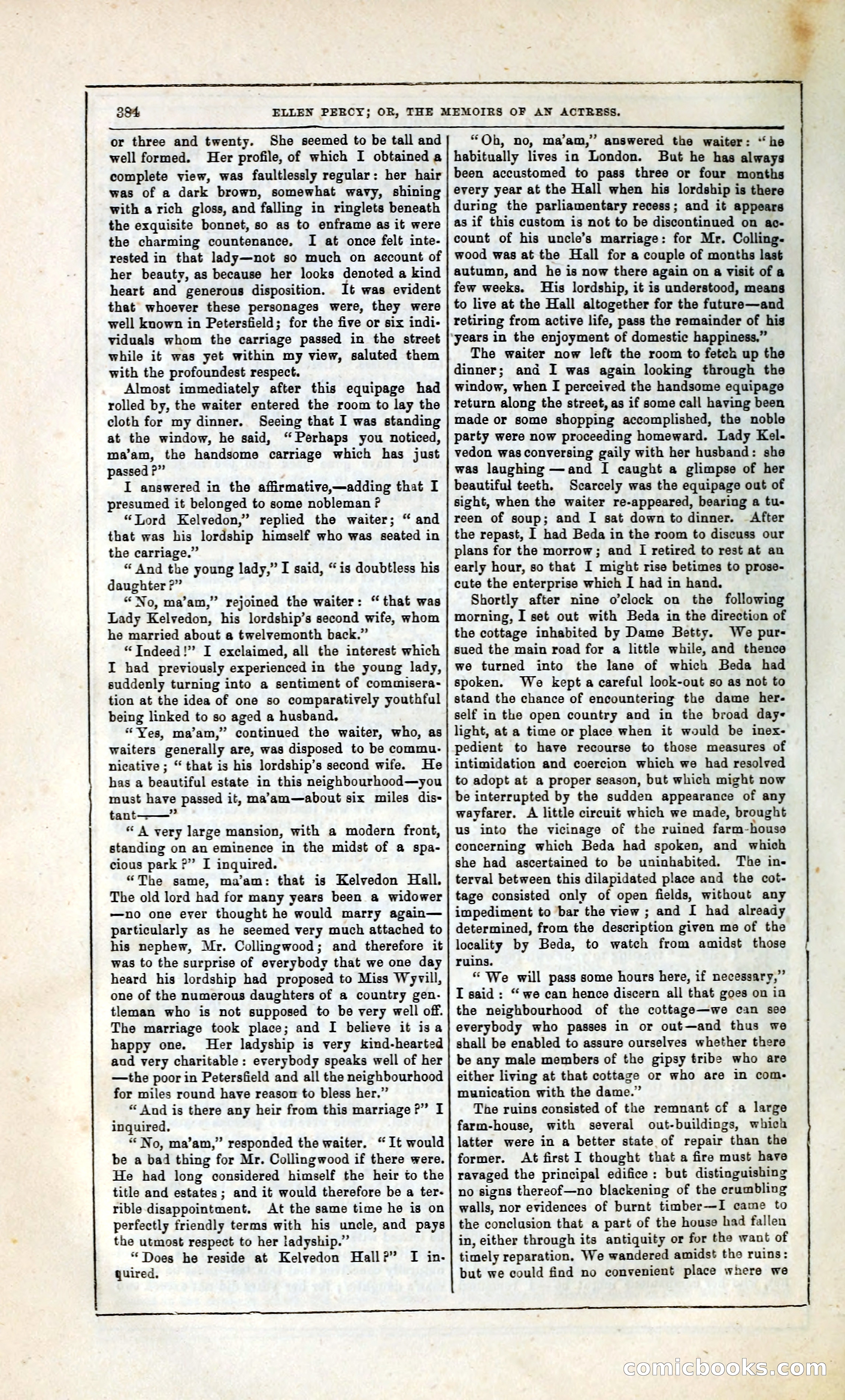
A restored page from Penny Dreadfuls, 1856. Page through the whole issue in the reader above.
📄 Transcribed text from this page (OCR, searchable)
Machine-transcribed from the original scan — historical spelling and the odd misread are preserved.
384 ELLEN PERCY; OR, THE MEMOIRS OF AN ACTRESS. or three and twenty. She seemed to be tall and well formed. Her profile, of which I obtained a complete view, was faultlessly regular: her hair was of a dark brown, somewhat wavy, shining with a rich gloss, and falling in ringlets beneath the exquisite bonnet, so as to enframe as it were the charming countenance. I at once felt inte- rested in that lady—not so much on aecount of her beauty, as because her looks denoted a kind heart and generous disposition. It was evident that whoever these personages were, they were well known in Petersfield; for the five or six indi- viduals whom the carriage passed in the street while it was yet within my view, saluted them with the profoundest respect. Almost immediately after this equipage had rolled by, the waiter entered the room to lay the cloth for my dinner. Seeing that I was standing at the window, he said, “ Perhaps you noticed, ma’am, the handsome carriage which has just passed P”’ I answered in the affirmative,—adding that I presumed it belonged to some nobleman? “Tord Kelvedon,” replied the waiter; “ and that was his lordship himself who was seated in the carriage.” “ And the young lady,” I said, “is doubtless his daughter ?” “No, ma’am,” rejoined the waiter: “that was Lady Kelvedon, his lordship’s second wife, whom he married about a twelvemonth back.” “ Tndeed!’’ I exclaimed, all the interest which I had previously experienced in the young lady, suddenly turning into a sentiment of commisera- tion at the idea of one so comparatively youthful being linked to so aged a husband. “Yes, ma’am,” continued the waiter, who, as waiters generally are, was disposed to be commu- nicative ; “ that is his lordship’s second wife. He has a beautiful estate in this neighbourhood—you must have passed it, ma’am—about six miles dis- tant——” “ A very large mansion, with a modern front, standing on an eminence in the midst of a spa- cious park ?” I inquired. “The same, ma’am: that is Kelvedon Hall. The old lord had for many years been a widower —no one ever thought he would marry again— particularly as he seemed very much attached to his nephew, Mr. Collingwood; and therefore it was to the surprise of everybody that we one day heard his lordship had proposed to Miss Wyvill, one of the numerous daughters of a country gen- tleman who is not supposed to be very well off. The marriage took place; and I believe it isa happy one. Her ladyship is very kind-hearted aud very charitable: everybody speaks well of her —the poor in Petersfield and all the neighbourhood for miles round have reason to bless her.” “ And is there any heir from this marriage ?” I inquired. ‘No, ma’am,” responded the waiter. “It would be a bad thing for Mr. Collingwood if there were. He had long considered himself the heir to the title and estates; and it would therefore be a ter- rible disappointment. At the same time he is on perfectly friendly terms with his uncle, and pays the utmost respect to her ladyship.” “Does he reside at Kelvedon Hall?” quired. I in- “Oh, no, ma’am,” answered the waiter: “he habitually lives in London. But he has always been accustomed to pass three or four months every year at the Hall when his lordship is there during the parliamentary recess; and it appears as if this custom is not to be discontinued on ac- count of his uncle’s marriage: for Mr. Colling- wood was at the Hall for a couple of months last autumn, and he is now there again on a visit of a few weeks. His lordship, it is understood, means to live at the Hall altogether for the future—and retiring from active life, pass the remainder of his ‘years in the enjoyment of domestic happiness,” The waiter now left the room to fetch up the dinner; and I was again looking through the window, when I perceived the handsome equipage return along the street, as if some call having been made or some shopping accomplished, the noble party were now proceeding homeward. Lady Kel- vedon was conversing gaily with her husband: she was laughing —and I caught a glimpse of her beautiful teeth. Scarcely was the equipage out of sight, when the waiter re-appeared, bearing a tu- reen of soup; and I sat downtodinner. After the repast, I had Beda in the room to discuss our plans for the morrow; and I retired to rest at an early hour, so that I might rise betimes to prose- cute the enterprise which I had in hand. Shortly after nine o’clock on the following morning, I set out with Beda in the direction of the cottage inhabited by Dame Betty. We pur- sued the main road for a little while, and thence we turned into the lane of which Beda had spoken. We kept a careful look-out so as not to stand the chance of encountering the dame her- self in the open country and in the broad day- light, at a time or place when it would be inex- pedient to have recourse to those measures of intimidation and coercion which we had resolved to adopt at a proper season, but which might now be interrupted by the sudden appearance of any wayfarer. A little circuit which we made, brought us into the vicinage of the ruined farm-house concerning which Beda had spoken, and which she had ascertained to be uninhabited. The in- terval between this dilapidated place and the cot- tage consisted only of open fields, without any impediment to bar the view ; and I had already determined, from the description given me of the locality by Beda, to watch from amidst those ruins. “ We will pass some hours here, if necessary,” I said : “ we can hence discern all that goes on ia the neighbourhood of the cottage—we can see everybody who passes in or out—and thus we shall be enabled to assure ourselves whether there be any male members of the gipsy tribe who are either living at that cottage or who are in com- munication with the dame.” The ruins consisted of the remnant cf a large farm-house, with several out-buildings, which latter were in a better state of repair than the former. At first I thought that a fire must have ravaged the principal edifice: but distinguishing no signs thereof—no blackening of the crumbling walls, nor evidences of burnt timber—I came to the conclusion that a part of the house had fallen in, either through its antiquity or for the want of timely reparation, We wandered amidst tho ruins: but we could find no convenient place where we On JOO Eolim <S ¢€oMm