
Penny Dreadfuls, 1856 · page 385 of 399
Ellen Percy; or, The Memoirs of an Actress — page 385: what you’re looking at
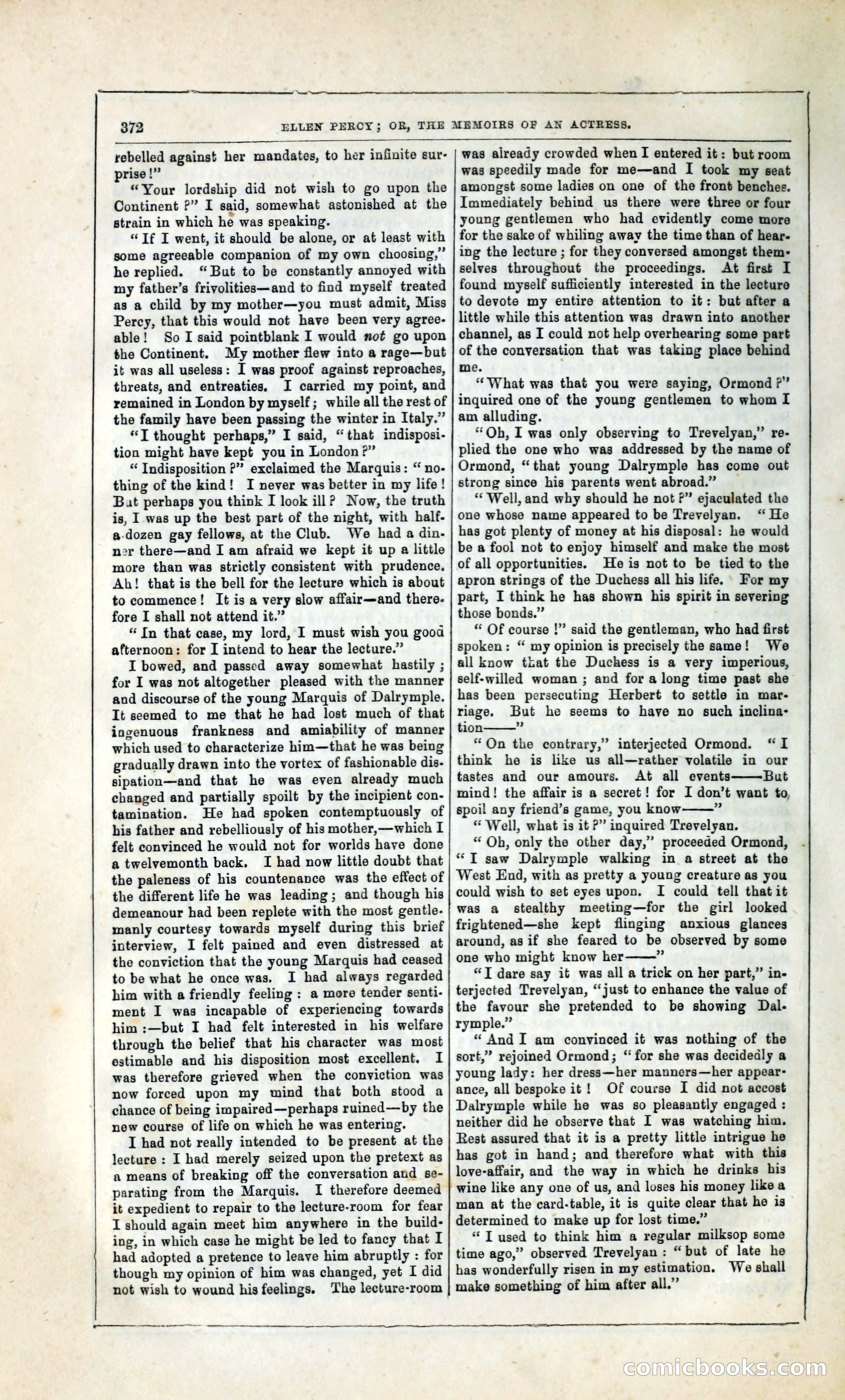
A restored page from Penny Dreadfuls, 1856. Page through the whole issue in the reader above.
📄 Transcribed text from this page (OCR, searchable)
Machine-transcribed from the original scan — historical spelling and the odd misread are preserved.
vr eo eee ene een 372 ELLEN PERCY; OR, THE MEMOIRS OF AN ACTRESS. rebelled against her mandates, to her infinite sur- prise !” “Your lordship did not wish to go upon the Continent P” I said, somewhat astonished at the strain in which he was speaking. “If I went, it should be alone, or at least with some agreeable companion of my own choosing,” he replied. “But to be constantly annoyed with my father’s frivolities—and to find myself treated as a child by my mother—you must admit, Miss Percy, that this would not have been very agree- able! So I said pointblank I would mot go upon the Continent. My mother flew into a rage—but it was all useless: I was proof against reproaches, threats, and entreaties. I carried my point, and remained in London by myself; while all the rest of the family have been passing the winter in Italy.” “T thought perhaps,” I said, “that indisposi- tion might have kept you in London ?” “ Indisposition P” exclaimed the Marquis: “ no- thing of the kind! I never was better in my life! Bat perhaps you think I look ill? Now, the truth is, I was up the best part of the night, with half- a-dozen gay fellows, at the Club. We had a din- ner there—and I am afraid we kept it up a little more than was strictly consistent with prudence, Ah! that is the bell for the lecture which is about to commence! It is a very slow affair—and there- fore I shall not attend it.” “In that case, my lord, I must wish you good afternoon: for I intend to hear the lecture.” I bowed, and passed away somewhat hastily ; for I was not altogether pleased with the manner and discourse of the young Marquis of Dalrymple. It seemed to me that he had lost much of that ingenuous frankness and amiability of manner which used to characterize him—that he was being gradually drawn into the vortex of fashionable dis- sipation—and that he was even already much changed and partially spoilt by the incipient con- tamination. He had spoken contemptuously of his father and rebelliously of his mother,—which I felt convinced he would not for worlds have done a twelvemonth back, I had now little doubt that the paleness of his countenance was the effect of the different life he was leading; and though his demeanour had been replete with the most gentle- manly courtesy towards myself during this brief interview, I felt pained and even distressed at the conviction that the young Marquis had ceased to be what he once was. I had always regarded him with a friendly feeling : a more tender senti- ment I was incapable of experiencing towards him :—but I had felt interested in his welfare through the belief that his character was most estimable and his disposition most excellent. I was therefore grieved when the conviction was now forced upon my wind that both stood a chance of being impaired—perhaps ruined-—by the new course of life on which he was entering. I had not really intended to be present at the lecture : I had merely seized upon the pretext as a means of breaking off the conversation and se- parating from the Marquis. I therefore deemed it expedient to repair to the lecture-room for fear I should again meet him anywhere in the build- ing, in which case he might be led to fancy that I had adopted a pretence to leave him abruptly : for though my opinion of him was changed, yet I did not wish to wound his feelings. The lecture-room was already crowded when I entered it: but room was speedily made for me—and I took my seat amongst some ladies on one of the front benches. Immediately behind us there were three or four young gentlemen who had evidently come more for the sake of whiling away the time than of hear- ing the lecture ; for they conversed amongst them- selves throughout the proceedings. At first I found myself sufficiently interested in the lecture to devote my entire attention to it: but after a little while this attention was drawn into another channel, as I could not help overhearing some part of the conversation that was taking place behind me. “What was that you were saying, Ormond ?” inquired one of the young gentlemen to whom I am alluding. “Oh, I was only observing to Trevelyan,” re- plied the one who was addressed by the name of Ormond, “that young Dalrymple has come out strong since his parents went abroad.” “Well, and why should he not ?” ejaculated the one whose name appeared to be Trevelyan. “ He has got plenty of money at his disposal: he would be a fool not to enjoy himself and make the most of all opportunities. He is not to be tied to the apron strings of the Duchess all his life. For my part, I think he has shown his spirit in severing those bonds.” * Of course !” said the gentleman, who had first spoken: “ my opinion is precisely the same! We all know tkat the Duchess is a very imperious, self-willed woman ; and for a long time past she has been persecuting Herbert to settle in mar- riage. But he seems to have no such inclina- tion ie “On the contrary,” interjected Ormond. “I think he is like us all—rather volatile in our tastes and our amours. At all events But mind! the affair is a secret! for I don’t want to, spoil any friend’s game, you know * * Well, what is it P” inquired Trevelyan. * Oh, only the other day,” proceeded Ormond, “T saw Dalrymple walking in a street at the West End, with as pretty a young creature as you could wish to set eyes upon. I could tell that it was a stealthy meeting—for the girl looked frightened—she kept flinging anxious glances around, as if she feared to be observed by some one who might know ker ? “JT dare say it was all a trick on her part,” in- terjected Trevelyan, ‘just to enhance the value of the favour she pretended to be showing Dal- rymple.” “ And I am convinced it was nothing of the sort,” rejoined Ormond; “ for she was decidedly a young lady: her dress—her manners—her appear- ance, all bespoke it! Of course I did not accost Dalrymple while he was so pleasantly engaged : neither did he observe that I was watching him. Rest assured that it is a pretty little intrigue he has got in hand; and therefore what with this love-affair, and the way in which he drinks his wine like any one of us, and loses his money like a man at the card-table, it is quite clear that he is determined to make up for lost time.” “T used to think him a regular milksop some time ago,” observed Trevelyan : “but of late he has wonderfully risen in my estimation. We shall make something of him after all.” CONNIE DOOKS Com