
Penny Dreadfuls, 1856 · page 381 of 399
Ellen Percy; or, The Memoirs of an Actress — page 381: what you’re looking at
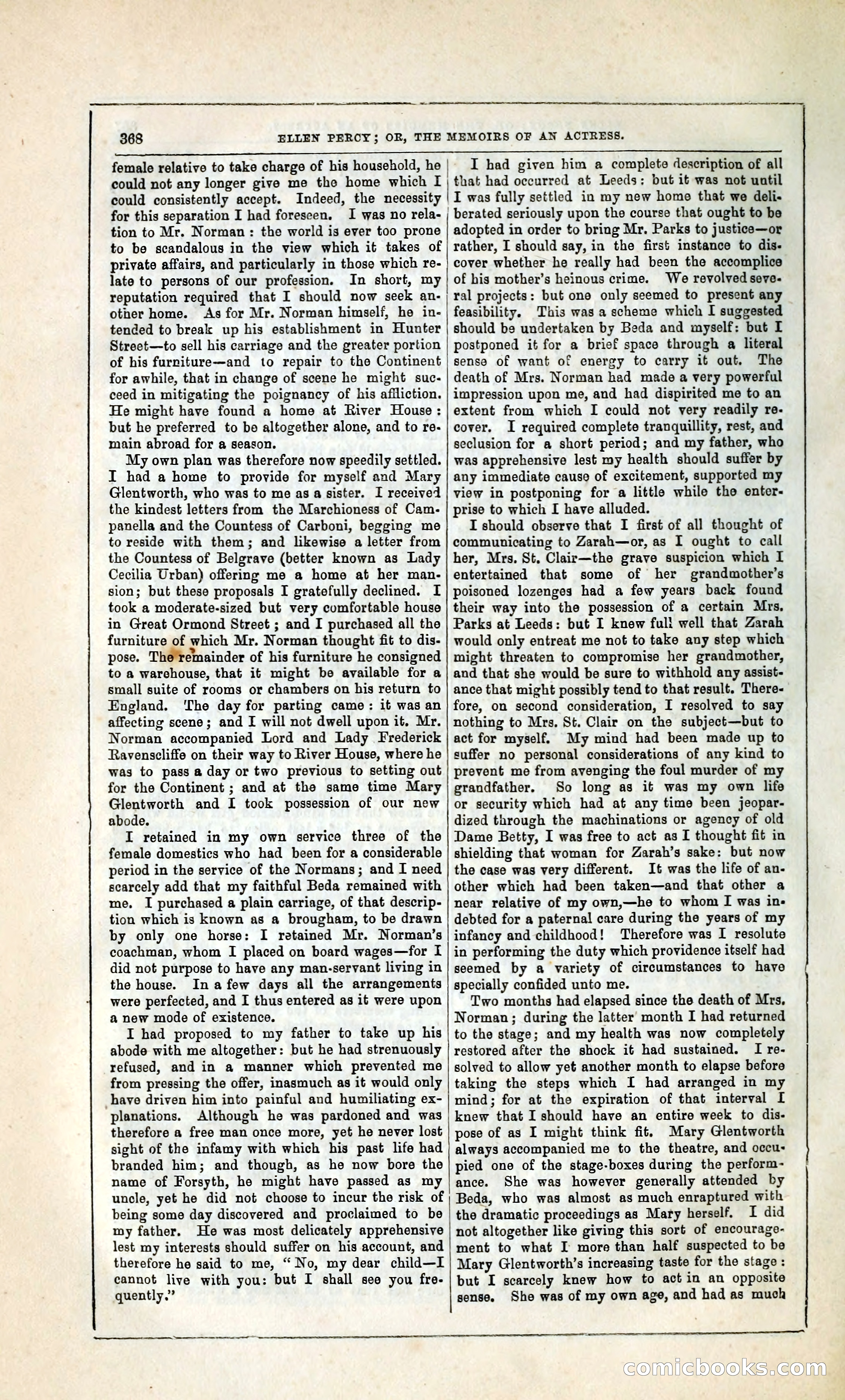
A restored page from Penny Dreadfuls, 1856. Page through the whole issue in the reader above.
📄 Transcribed text from this page (OCR, searchable)
Machine-transcribed from the original scan — historical spelling and the odd misread are preserved.
368 female relative to take charge of his household, he could not any longer give me the home which I could consistently accept. Indeed, the necessity for this separation I had foreseen. I was no rela- tion to Mr. Norman: the world is ever too prone ELLEN PERCY; OR, THE MEMOIRS OF AN ACTRESS. | | te om ne me see we I had given him a complete description of all that had occurred at Leeds: but it was not until I was fully settled in my new home that we deli- | berated seriously upon the course that ought to be to be scandalous in the view which it takes of | private affairs, and particularly in those which re- late to persons of our profession. In short, my reputation required that I should now seek an- other home. As for Mr. Norman himself, he in- tended to break up his establishment in Hunter Street—to sell his carriage and the greater portion of his furriture—and to repair to the Continent for awhile, that in change of scene he might suc- ceed in mitigating the poignancy of his affliction. He might have found a home at River House: but he preferred to be altogether alone, and to re- main abroad for a season. My own plan was therefore now speedily settled. I had a home to provide for myself and Mary Glentworth, who was to me as a sister. I received the kindest letters from the Marchioness of Cam- panella and the Countess of Carboni, begging me to reside with them; and likewise a letter from the Countess of Belgrave (better known as Lady Cecilia Urban) offering me a home at her man- sion; but these proposals I gratefully declined. I took a moderate-sized but very comfortable house in Great Ormond Street ; and I purchased all the furniture of which Mr. Norman thought fit to dis- pose. The remainder of his furniture he consigned to a warehouse, that if might be available for a small suite of rooms or chambers on bis return to England. ‘The day for parting came: it was an affecting scene; and I will not dwell upon it. Mr. Norman accompanied Lord and Lady Frederick Ravenscliffe on their way to River House, where he was to pass a day or two previous to setting out for the Continent ; and at the same time Mary Glentworth and I took possession of our new abode. I retained in my own service three of the female domestics who had been for a considerable period in the service of the Normans; and I need scarcely add that my faithful Beda remained with me. I purchased a plain carriage, of that descrip- tion which is known as a brougham, to be drawn by only one horse: I retained Mr. Norman’s coachman, whom I placed on board wages—for I did not purpose to have any man-servant living in the house. Ina few days all the arrangements were perfected, and I thus entered as it were upon a new mode of existence. I had proposed to my father to take up his abode with me altogether: but he had strenuously refused, and in a manner which prevented me from pressing the offer, inasmuch as it would only have driven him into painful and humiliating ex- planations. Although he was pardoned and was therefore a free man once more, yet he never lost sight of the infamy with which his past life had branded him; and though, as he now bore the name of Forsyth, he might have passed as my uncle, yet he did not choose to incur the risk of being some day discovered and proclaimed to be my father. He was most delicately apprehensive lest my interests should suffer on his account, and therefore he said to me, “No, my dear child—I cannot live with you: but I shall see you fre- quently.” ge een peg en eT I Tn ttt LLL ————— nt adopted in order to bring Mr. Parks to justice—or rather, I should say, in the first instance to dis- cover whether he really had been the accomplice of his mother’s heinous crime. We revolved seve- ral projects: but one only seemed to present any feasibility. This was a scheme which I suggested should be undertaken by Beda and myself: but I postponed it for a brief space through a literal sense of want of energy to carry it out. The death of Mrs. Norman had made a very powerful impression upon me, and had dispirited me to an extent from which I could not very readily re- cover. I required complete tranquillity, rest, and seclusion for a short period; and my father, who was apprehensive lest my health should suffer by any immediate cause of excitement, supported my view in postponing for a little while the enter- prise to which I have alluded. I should observe that I first of all thought of communicating to Zarah—or, as I ought to call her, Mrs. St, Clair—the grave suspicion which I entertained that some of her grandmother’s poisoned lozenges had a few years back found their way into the possession of a certain Mrs, Parks at Leeds: but I knew ful! well that Zarah would only entreat me not to take any step which might threaten to compromise her grandmother, and that she would be sure to withhold any assist- ance that might possibly tend to that result. There- fore, on second consideration, I resolved to say nothing to Mrs, St. Clair on the subject—but to act for myself. My mind had been made up to suffer no personal considerations of any kind to prevent me from avenging the foul murder of my grandfather. So long as it was my own life or security which had at any time been jeopar- dized through the machinations or agency of old Dame Betty, I was free to act as I thought fit in shielding that woman for Zarah’s sake: but now the case was very different. It was the life of an- other which had been taken—and that other a near relative of my own,—he to whom I was in- debted for a paternal care during the years of my infancy and childhood! Therefore was I resolute in performing the duty which providence itself had seemed by a variety of circumstances to have specially confided unto me. Two months had elapsed since the death of Mrs, Norman; during the latter month I had returned to the stage; and my health was now completely restored after the shock it had sustained. [I re- solved to allow yet another month to elapse before taking the steps which I had arranged in my mind; for at the expiration of that interval I knew that I should have an entire week to dis- pose of as I might think fit. Mary Glentworth always accompanied me to the theatre, and occu- pied one of the stage-boxes during the perform- ance. She was however generally attended by Beda, who was almost as much enraptured with the dramatic proceedings as Mary herself. I did not altogether like giving this sort of encourage- ment to what I more than half suspected to be Mary Glentworth’s increasing taste for the stage: but I scarcely knew how to actin an opposite sense. She was of my own age, and had as much GomicbooksneGom