
Penny Dreadfuls, 1856 · page 379 of 399
Ellen Percy; or, The Memoirs of an Actress — page 379: what you’re looking at
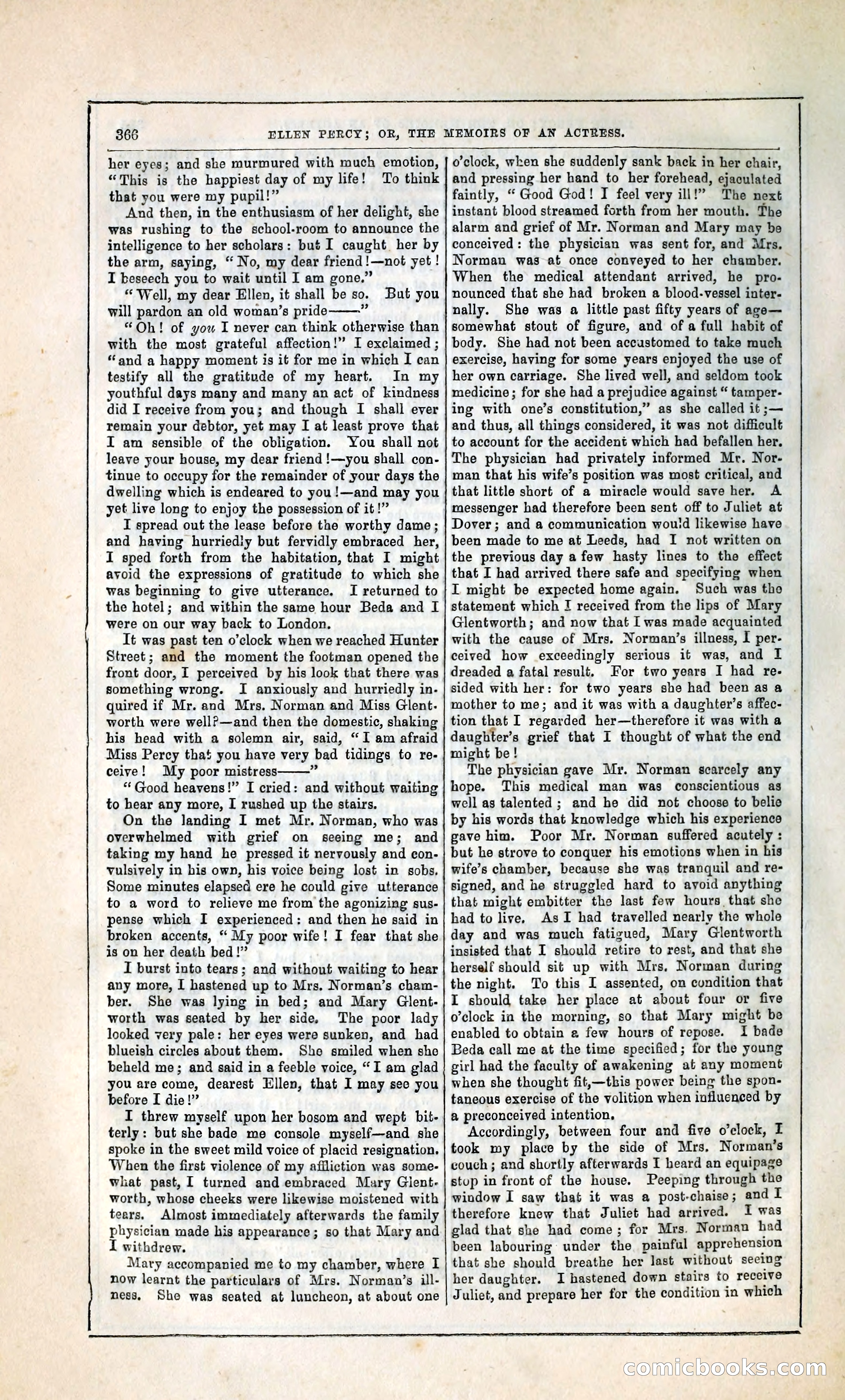
A restored page from Penny Dreadfuls, 1856. Page through the whole issue in the reader above.
📄 Transcribed text from this page (OCR, searchable)
Machine-transcribed from the original scan — historical spelling and the odd misread are preserved.
Sa ee ee ee ee 366 —— her eyes; and she murmured with much emotion, “This is the happiest day of my life! To think that you were my pupil!” And then, in the enthusiasm of her delight, she was rushing to the school-room to announce the intelligence to her scholars: but I caught. her by the arm, saying, “ No, my dear friend!—not yet ! I beseech you to wait until I am gone.” “Well, my dear Ellen, it shall be so. will pardon an old woman’s pride vs “Oh! of you I never can think otherwise than with the most grateful affection!” I exclaimed ; “and a happy moment is it for me in which I can testify all the gratitude of my heart. In my youthful days many and many an act of kindness did I receive from you; and though I shall ever remain your debtor, yet may I at least prove that I am sensible of the obligation. You shall not leave your house, my dear friend !—you shall con- tinue to occupy for the remainder of your days the dwelling which is endeared to you!—and may you yet live long to enjoy the possession of it!” I spread out the lease before the worthy dame; and having hurriediy but fervidly embraced her, I sped forth from the habitation, that I might avoid the expressions of gratitude to which she was beginning to give utterance. I returned to the hotel; and within the same hour Beda and I were on our way back to London, It was past ten o’clock when we reached Hunter Street; and the moment the footman opened the front door, I perceived by his look that there was something wrong. I anxiously and hurriedly in- quired if Mr. and Mrs, Norman and Miss Glent- worth were well?—and then the domestic, shaking his head with a solemn air, said, “I am afraid Miss Percy that you have very bad tidings to re- ceive! My poor mistress “7 “Good heavens!” I cried: and without waiting to hear any more, I rushed up the stairs. On the landing I met Mr. Norman, who was overwhelmed with grief on seeing me; and taking my hand he pressed it nervously and con- vulsively in his own, his voice being lost in sobs, Some minutes elapsed ere he could give utterance to a word to relieve me from the agonizing sus- pense which I experienced: and then he said in broken accents, “‘ My poor wife! I fear that she is on her death bed!” I burst into tears; and without waiting to hear any more, I hastened up to Mrs, Norman’s cham- ber. She was lying in bed; and Mary Glent- worth was seated by her side, The poor lady looked very pale: her eyes were sunken, and had blueish circles about them. She smiled when she beheld me; and said in a feeble voice, “I am glad you are come, dearest Hllen, that I may see you before I die!” I threw myself upon her bosom and wept bit- terly: but she bade me console myself—and she spoke in the sweet mild voice of placid resignation. When the first violence of my afiliction was some- what past, I turned and embraced Mary Gient- worth, whose cheeks were likewise moistened with tears. Almost immediately afterwards the family But you physician made his appearance; so that Mary and I withdrew. Mary accompanied me to my chamber, where I now learnt the particulars of Mrs. Norman’s ill- She was seated at luncheon, at about one ness, ELLEN PERCY; OR, THE MEMOIRS OF AN ACTRESS. o'clock, wken she suddenly sank back in her chair, and pressing her hand to her forehead, ejaculated faintly, “ Good God! I feel very ill!” The next instant blood streamed forth from her mouth. The alarm and grief of Mr. Norman and Mary may be conceived: the physician was sent for, and Mrs, Norman was at once conveyed to her chamber. When the medical attendant arrived, he pro- nounced that she had broken a blood-vessel inter- nally. She was a little past fifty years of asce— somewhat stout of figure, and of a full habit of body. She had not been accustomed to take much exercise, having for some years enjoyed the use of her own carriage. She lived well, and seldom took medicine; for she had a prejudice against “ tamper- ing with one’s constitution,” as she called it ;— and thus, all things considered, it was not difficult to account for the accident which had befallen her. The physician had privately informed Mr. Nor- man that his wife’s position was most critical, and that little short of a miracle would save her. A messenger had therefore been sent off to Juliet at Dover; and a communication wouid likewise have been made to me at Leeds, had I not written on the previous day a few hasty lines to the effect that I had arrived there safe and specifying when I might be expected home again. Such was tho statement which I received from the lips of Mary Glentworth; and now that I was made acquainted with the cause of Mrs. Norman’s illness, I per- ceived how exceedingly serious it was, and I dreaded a fatal result. For two years I had re- sided with her: for two years she had been asa . mother to me; and it was with a daughter’s affec- tion that I regarded her—therefore it was with a daughter’s grief that I thought of what the end might be! The physician gave Mr. Norman scarcely any hope. This medical man was conscientious as well as talented ; and he did not choose to belie by his words that knowledge which his experience gave him. Poor Mr. Norman suffered acutely : but he strove to conquer his emotions when in his wife’s chamber, because she was tranquil and re- signed, and he struggled hard to ayoid anything that might embitter the last few hours that she had to live, AsI had travelled nearly the whole day and was much fatigued, Mary Glentworth insisted that I should retire to rest, and that she herself should sit up with Mrs, Norman during the night. To this I assented, on condition that I should take her place at about four or five o’clock in the morning, so that Mary might be enabled to obtain 2 few hours of repose. I bade Beda call me at the time specified; for the young girl had the faculty of awakening al any moment when she thought fit,—tbis power being the spon- taneous exercise of the volition when influenced by & preconceived intention. Accordingly, between four and five o'clock, I took my place by the side of Mrs, Norman’s couch; and shortly afterwards I heard an equipage stup in front of the house. Peeping through the window I saw that it was a post-chaise; and I therefore knew that Juliet had arrived. I was glad that she had come; for Mrs. Norman had been labouring under the painful apprehension that she should breathe her last without secing her daughter. I hastened down stairs to receive Juliet, and prepare her for the condition in which CORNICE OOKS Com