
Penny Dreadfuls, 1856 · page 368 of 399
Ellen Percy; or, The Memoirs of an Actress — page 368: what you’re looking at
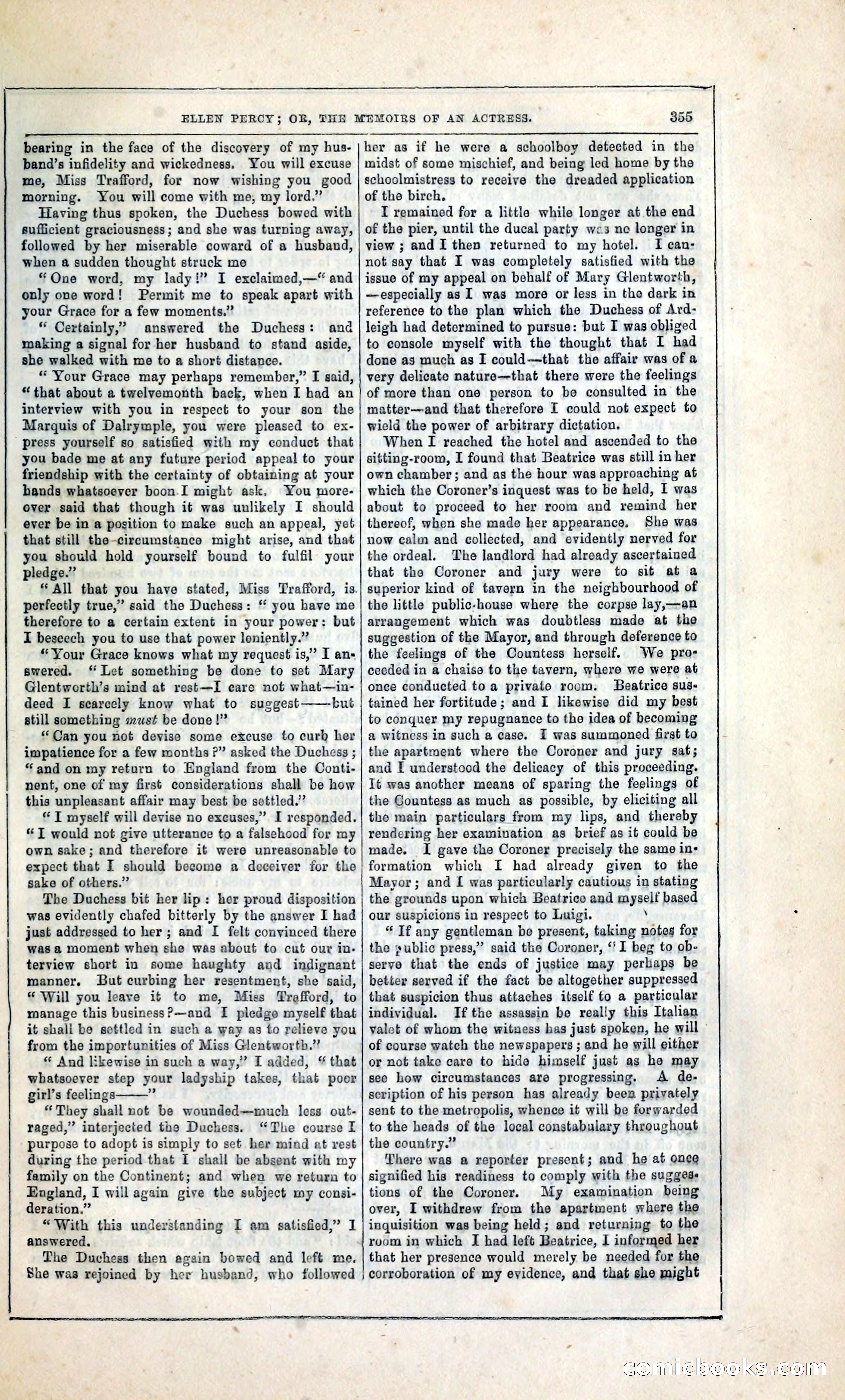
A restored page from Penny Dreadfuls, 1856. Page through the whole issue in the reader above.
📄 Transcribed text from this page (OCR, searchable)
Machine-transcribed from the original scan — historical spelling and the odd misread are preserved.
ELLEN PERCY; OR, THE MEMOIRS OF AN ACTRESS. 355 bearing in the face of the discovery of my hus- band’s infidelity and wickedness. You will excuse me, Miss Trafford, for now wishing you good morning. You will come with me, my lord.” Having thus spoken, the Duchess bowed with sufficient graciousness; and she was turning away, followed by her miserable coward of a husband, when a sudden thought struck me * One word, my lady!” I exclaimed,—“ and only one word! Permit me to speak apart with your Grace for a few moments,” * Certainly,” answered the Duchess: and making a signal for her husband to stand aside, she walked with me to a short distance. “Your Grace may perhaps remember,” I said, “that about a twelvemonth back, when I had an interview with you in respect to your son the Marquis of Dalrymple, you were pleased to ex- press yourself so satisfied with my conduct that you bade me at any future period appeal to your friendship with the certainty of obtaining at your hands whatsoever boon. I might ask. You more- over said that though it was unlikely I should ever be in a position to make such an appeal, yet that still the-circumstance might arise, and that you should hold yourself bound to fulfil your pledge.” * All that you have stated, Miss Trafford, is. perfectly true,” said the Duchess: ‘ you have me therefore to a certain extent in your power: but I beseech you to use that power leniently.” “Your Grace knows what my request is,” I an- swered. ‘“ Let something be done to set Mary Glentworth’s mind at rest—I care not what—in- deed I scarcely know what to suggest——but still something must be done !” Can you not devise some excuse to curb her impatience for a few months ?” asked the Duchess ; ‘and on my return to England from the Conti- nent, one of my first considerations shall be how this unpleasant affair may best be settled.” * T myself will devise no excuses,’ I responded. TI would not give utterance to a falsehood for my own sake; and therefore it were unreasonable to expect that I should become a deceiver for the sake of others.” The Duchess bit her lip: her proud disposition was evidently chafed bitterly by the answer I had just addressed to her; and I felt convinced there was a moment when she was about to cut our in- terview short in some haughty and indignant manner. But curbing her resentment, she said, * Will you leave it to me, Miss Prafford, to manage this business?—and I pledge myself that it shall be settled in such a way as fo relieve you from the importunities of Miss Glentworth.” * And likewise in such a way,” I added, “ that whatsoever step your ladyship takes, that poor girl’s feelings " * They shall not be wounded—much less out- raged,” interjected tho Duchess. “The course I purpose to adopt is simply to set her mind at rest during the period that I shall be absent with my family on the Continent; and when we retura to England, I will again give the subject my consi- deration.” “With this understanding I am satisfied,” I answered. The Duchess then again bowed and left me. She was rejoined by her husband, who followed midst of some mischief, and being led home by the schoolmistress to receive the dreaded application of the birch. I remained for a little while longer at the end of the pier, until the ducal party wes ne longer in view ; aud I then returned to my hotel. I can: not say that I was completely satisfied with the issue of my appeal on behalf of Mary Glentworth, —especially as I was more or less in the dark in reference to the plan which the Duchess of Ard- leigh had determined to pursue: but I was obliged to console myself with the thought that I had done as much as I could—that the affair was of a very delicate nature—that there were the feelings of more than one person to be consulted in the matter—and that therefore I could not expect to wield the power of arbitrary dictation. When I reached the hotel and ascended to the sitting-room, I found that Beatrice was still in her own chamber; and as the hour was approaching aft which the Coroner’s inquest was to be held, I was about to proceed to her room and remind her thereof, when she made her appearance, She was now calm and collected, and evidently nerved for the ordeal. The landlord had already ascertained that the Coroner and jury were to sit at a superior kind of tavern in the neighbourhood of the little public-house where the corpse lay,—an arrangement which was doubtless made at the suggestion of the Mayor, and through deference to the feelings of the Countess herself. We pro- ceeded in a chaise to the tavern, where we were at once conducted toa private room. Beatrice sus- tained her fortitude; and I likewise did my best to conquer my repugnance to the idea of becoming @ witness in such a case. I was summoned first to the apartment where the Coroner and jury sat; and I understood the delicacy of this proceeding. It was another means of sparing the feelings of the Gountess as much as possible, by eliciting all the main particulars from my lips, and thereby rendering her examination as brief as it could be made. I gave the Coroner precisely the same ins formation which I had already given to the Mayor; and [ was particularly cautious in stating the grounds upon which Beatrice and myself based our suspicions in respect to Luigi. ' “ If any gentleman be present, taking notes for the »ublic press,” said the Coroner, “I beg to ob- serve that the ends of justice may perhaps be better served if the fact be altogether suppressed that suspicion thus attaches itself to a particular individual. If the assassin be really this Italian valet of whom the witness has just spoken, he will © of course watch the newspapers ; and he will either or not take care to hide himself just as he may see how circumstances are progressing. <A de- scription of his person has already been privately sent to the metropolis, whence it will be forwarded to the heads of the local constabulary throughout the country.” There was a reporter present; and he at onee signified his readiness to comply with the suggeds tions of the Coroner. My examination being over, I withdrew from the apartment where the inquisition was being held; and returning to the room in which I had left Beatrice, I informed her that her presence would merely be needed for the corroboration of my evidence, and that she might Conniclooolkx her as if he were a schoolboy detected in the Com