
Penny Dreadfuls, 1856 · page 362 of 399
Ellen Percy; or, The Memoirs of an Actress — page 362: what you’re looking at
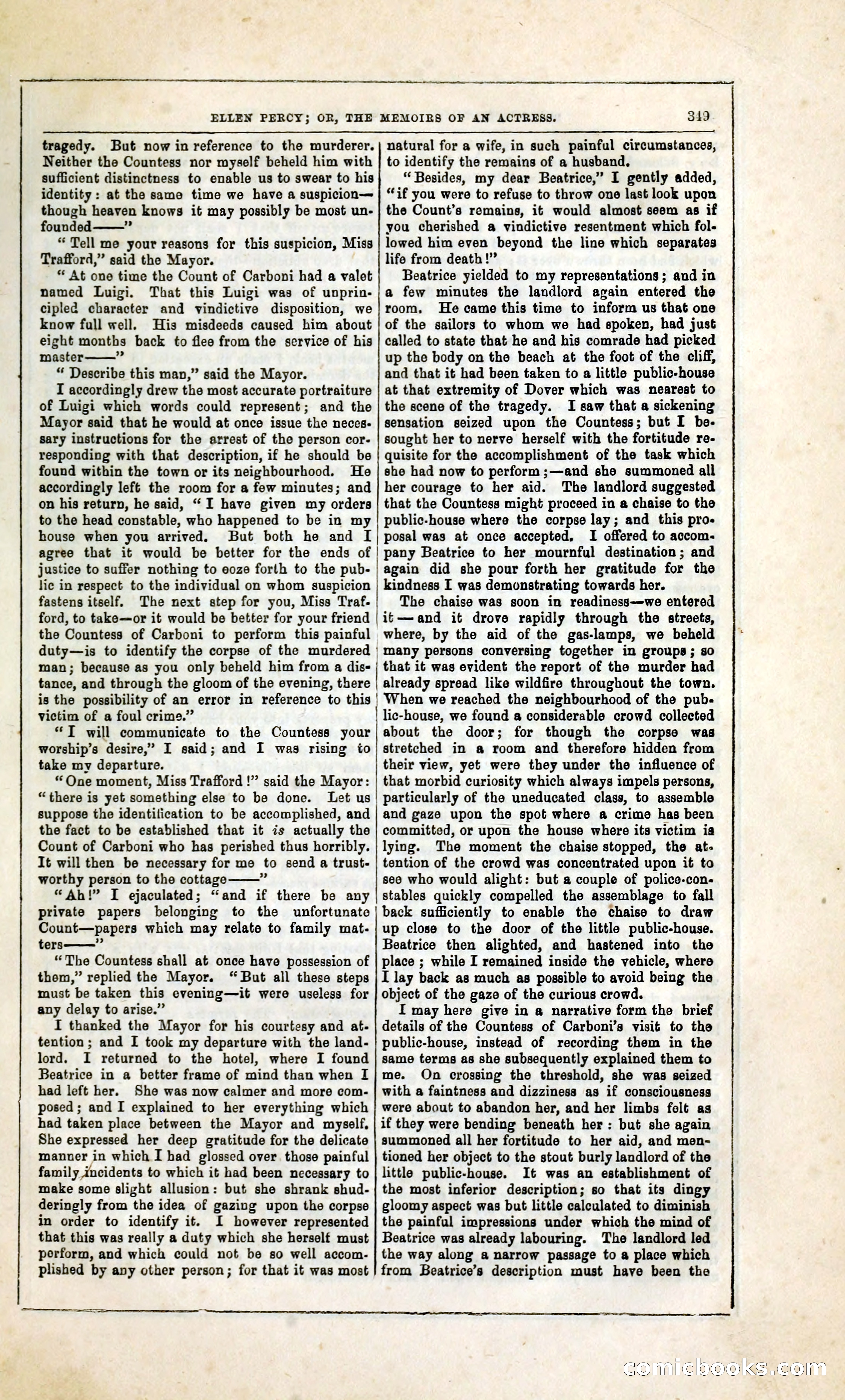
A restored page from Penny Dreadfuls, 1856. Page through the whole issue in the reader above.
📄 Transcribed text from this page (OCR, searchable)
Machine-transcribed from the original scan — historical spelling and the odd misread are preserved.
ELLEN PERCY; OR, THE MEMOIRS OF AN ACTRESS. 349 tragedy. But now in reference to the murderer. Neither the Countess nor myself beheld him with sufficient distinctness to enable us to swear to his identity: at the same time we have a suspicion— though heaven knows it may possibly be most un- founded———” “ Tell me your reasons for this suspicion, Miss Trafford,” said the Mayor. * At one time the Count of Carboni had a valet named Luigi. That this Luigi was of unprin- cipled character and vindictive disposition, we know full well. His misdeeds caused him about eight months back to flee from the service of his master - “ Describe this man,” said the Mayor. I accordingly drew the most accurate portraiture of Luigi which words could represent; and the Mayor said that he would at once issue the neces- sary instructions for the arrest of the person cor- responding with that description, if he should be found within the town or its neighbourhood. He accordingly lefé the room for a few minutes; and on his return, he said, “ I have given my orders to the head constable, who happened to be in my house when you arrived. But both he and [ agree that it would be better for the ends of justice to suffer nothing to eoze forth to the pub- hic in respect to the individual on whom suspicion fastens itself. The next step for you, Miss Traf- ford, to take—or it would be better for your friend the Countess of Carboni to perform this painful duty—is to identify the corpse of the murdered | man; because as you only beheld him from a dis- tance, and through the gloom of the evening, there natural for a wife, in such painful circumstances, to identify the remains of a husband. “ Besides, my dear Beatrice,” I gently added, “if you were to refuse to throw one last look upon the Count’s remains, it would almost seem as if you cherished a vindictive resentment which fol- lowed him even beyond the line which separates life from death!” Beatrice yielded to my representations; and in a few minutes the landlord again entered the room. He came this time to inform us that one of the sailors to whom we had spoken, had just called to state that he and his comrade had picked up the body on the beach at the foot of the cliff, and that it had been taken to a little public-house at that extremity of Dover which was nearest to the scene of the tragedy. I saw that a sickening sensation seized upon the Countess; but I be- sought her to nerve herself with the fortitude ree quisite for the accomplishment of the task which she had now to perform ;—and she summoned all her courage to her aid. The landlord suggested that the Countess might proceed in a chaise to the public-house where the corpse lay; and this pro- posal was at once accepted, I offered to accom: pany Beatrice to her mournful destination; and again did she pour forth her gratitude for the kindness I was demonstrating towards her. The chaise was soon in readiness-we entered ig —-and it drove rapidly through the streets, where, by the aid of the gas-lamps, we beheld many persons conversing together in groups; so that it was evident the report of the murder had already spread like wildfire throughout the town. is the possibility of an error in reference to this | When we reached the neighbourhood of the pub- victim of a foul crime.’ “T will inadi to the Countess your worship’s desire,” I said; and I was rising to take my departure. * One moment, Miss Trafford !” said the Mayor: “there is yet something else to be done. Let us suppose the identilication to be accomplished, and the fact to be established that it is actually the Count of Carboni who has perished thus horribly. It will then be necessary for me to send a trust- worthy person to the cottage ¥ “Ah!” I ejaculated; “and if there be any private papers belonging to the unfortunate Count—papers which may relate to family mat- ters 4 “The Countess shall at once have possession of them,” replied the Mayor. “But all these steps must be taken this evening—it were useless for any delay to arise.” I thanked the Mayor for his courtesy and at- tention; and I took my departure with the land- lord. I returned to the hotel, where I found Beatrice in a better frame of mind than when I had left her. She was now calmer and more com- posed; and I explained to her everything which had taken place between the Mayor and myself, She expressed her deep gratitude for the delicate manner in which I had glossed over those painful family incidents to which it had been necessary to make some slight allusion: but she shrank shud- deringly from the idea of gazing upon the corpse in order to identify it. I however represented that this was really a duty which she herself must perform, and which could not be so well accom- plished by any other person; for that it was most es a ee lic-house, we found a considerable crowd collected about the door; for though the corpse was stretched in a room and therefore hidden from their view, yet were they under the influence of that morbid curiosity which always impels persons, particularly of the uneducated class, to assemble and gaze upon the spot where a crime has been committed, or upon the house where its victim ia lying. The moment the chaise stopped, the at- tention of the crowd was concentrated upon it to see who would alight: but a couple of police-con- stables quickly compelled the assemblage to fall back sufficiently to enable the chaise to draw up close to the door of the little public-house. Beatrice then alighted, and hastened into the place ; while I remained inside the vehicle, where I lay back as much as possible to avoid being the object of the gaze of the curious crowd. I may here give in a narrative form the brief details of the Countess of Carboni’s visit to the public-house, instead of recording them in the same terms as she subsequently explained them to me. On crossing the threshold, she was seized with a faintness and dizziness as if consciousness were about to abandon her, and her limbs felt as if they were bending beneath her: but she again summoned all her fortitude to her aid, and men- tioned her object to the stout burly landlord of the little public-house. It was an establishment of the most inferior description; so that its dingy gloomy aspect was but little calculated to diminish the painful impressions under which the mind of Beatrice was already labouring. The landlord led the way along a narrow passage to a place which from Beatrice’s description must have been the COMMUC 6)(6\(6) “S Com