
Penny Dreadfuls, 1856 · page 36 of 399
Ellen Percy; or, The Memoirs of an Actress — page 36: what you’re looking at
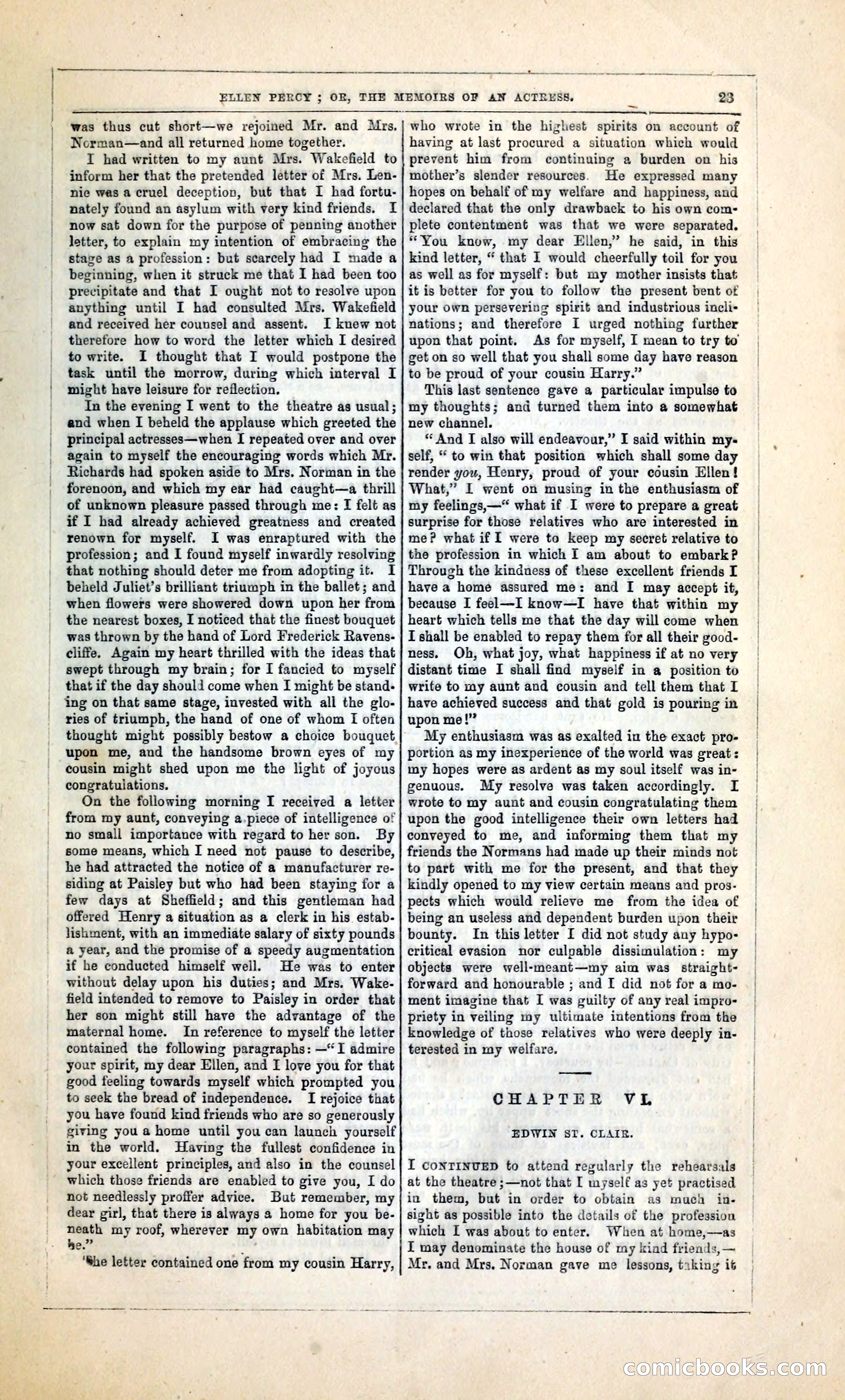
A restored page from Penny Dreadfuls, 1856. Page through the whole issue in the reader above.
📄 Transcribed text from this page (OCR, searchable)
Machine-transcribed from the original scan — historical spelling and the odd misread are preserved.
| | ’ ELLEN PERCY ; OR, THE MEMOIRS OF AN ACTRESS. was thus cut short—we rejoined Mr. and Mrs, Norman—and all returned home together. I had written to my aunt Mrs. Wakefield to inform her that the pretended letter of Mrs. Len- nie was a cruel deception, but that I had fortu- nately found an asylum with very kind friends. I now sat down for the purpose of penning another letter, to explain my intention of embracing the stave as a profession: but scarcely had I made a beginning, when it struck me that I had been too precipitate and that I ought not to resolve upon anything until I had consulted Mrs. Wakefield and received her counsel and assent. I knew not therefore how to word the letter which I desired to write. I thought that I would postpone the task until the morrow, during which interval I might have leisure for reflection. In the evening I went to the theatre as usual; and when I beheld the applause which greeted the principal actresses—when I repeated over and over again to myself the encouraging words which Mr. Richards had spoken aside to Mrs. Norman in the forenoon, and which my ear had caught—a thrill of unknown pleasure passed through me: If felt as if I had already achieved greatness and created renown for myself. I was enraptured with the profession; and I found myself inwardly resolving that nothing should deter me from adopting it. I beheld Juliet’s brilliant triumph in the ballet; and when flowers were showered down upon her from the nearest boxes, I noticed that the finest bouquet was thrown by the hand of Lord Frederick Ravens- cliffe. Again my heart thrilled with the ideas that swept through my brain; for I fancied to myself that if the day should come when I might be stand. ‘ing on that same stage, invested with all the glo- ries of triumph, the hand of one of whom I often thought might possibly bestow a choice bouquet upon me, and the handsome brown eyes of my cousin might shed upon me the light of joyous congratulations. On the following morning I received a letter from my aunt, conveying a.piece of intelligence of no small importance with regard to her son. By some means, which I need not pause to describe, he had attracted the notice of a manufacturer re- siding at Paisley but who had been staying for a few days at Sheffield; and this gentleman had offered Henry a situation as a clerk in his estab- lishment, with an immediate salary of sixty pounds a year, and the promise of a speedy augmentation if he conducted himself well. He was to enter without delay upon his duties; and Mrs. Wake- field intended to remove to Paisley in order that her son might still have the advantage of the maternal home. In reference to myself the letter contained the following paragraphs: —“I admire your spirit, my dear Ellen, and I love you for that good feeling towards myself which prompted you to seek the bread of independence. [I rejoice that you have found kind friends who are so generously giving you a home until you can launch yourself in the world. Having the fullest confidence in your excellent principles, and also in the counsel which those friends are enabled to give you, I do not needlessly proffer advice. But remember, my dear girl, that there is always a2 home for you be- aaa my roof, wherever my own habitation may e,” ; ‘She letter contained one from my cousin Harry, a 23 who wrote in the highest spirits on account of having at last procured a situation which would prevent him from continuing a burden on his mother’s slender resources. He expressed many hopes on behalf of my welfare and happiness, and declared that the only drawback to his own com- plete contentment was that we were separated. ‘You know, my dear Ellen,” he said, in this kind letter, “ that I would cheerfully toil for you as well as for myself: but my mother insists that it is better for you to follow the present bent of your own persevering spirit and industrious incli- nations; and therefore I urged nothing further upon that point. As for myself, I mean to try to get on so well that you shall some day have reason to be proud of your cousin Harry.” This last sentence gave a particular impulse to my thoughts; and turned them into a somewhat new channel. * And I also will endeavour,” I said within my- self, “ to win that position which shall some day render you, Henry, proud of your cousin Ellen! What,” I went on musing in the enthusiasm of my feelings,—* what if I were to prepare a great surprise for those relatives who are interested in me? what if I were to keep my secret relative to the profession in which I am about to embark? Through the kindness of these excellent friends I have a home assured me: and I may accept it, because I feel—I know—I have that within my heart which tells me that the day will come when I shall be enabled to repay them for all their good- ness. Oh, what joy, what happiness if at no very distant time I shall find myself in a position to wrife to my aunt and cousin and tell them that I have achieved success and that gold is pouring in upon me!” My enthusiasm was as exalted in the exact pro- portion as my inexperience of the world was great: my hopes were as ardent as my soul itself was in- genuous. My resolve was taken accordingly. I wrote to my aunt and cousin congratulating them upon the good intelligence their own letters had conveyed to me, and informing them that my friends the Normans had made up their minds not to part with me for the present, and that they kindly opened to my view certain means and pros- pects which would relieve me from the idea of being an useless and dependent burden upon their bounty. In this letter I did not study any hypo- critical evasion nor culpable dissimulation: my objects were well-meant—my aim was straight- forward and honourable ; and [ did noé for a mo- ment imagine that I was guilty of any real impro- priety in veiling my ultimate intentions from the knowledge of those relatives who were deeply in- terested in my welfare. = CHAPTER VL EDWIN ST. CLAIR. I CONTINUED to attend regularly the rehearsals at the theatre ;—not that [ myself as yet practised in them, but in order to obtain as much in- sight as possible into the details of the profession which I was about to enter. When at home,—as I may denominate the house of my kiad friends, — Mr. and Mrs. Norman gave me lessons, taking it ee ee eee ew we Gomicboo lh eset (ECON