
Penny Dreadfuls, 1856 · page 359 of 399
Ellen Percy; or, The Memoirs of an Actress — page 359: what you’re looking at
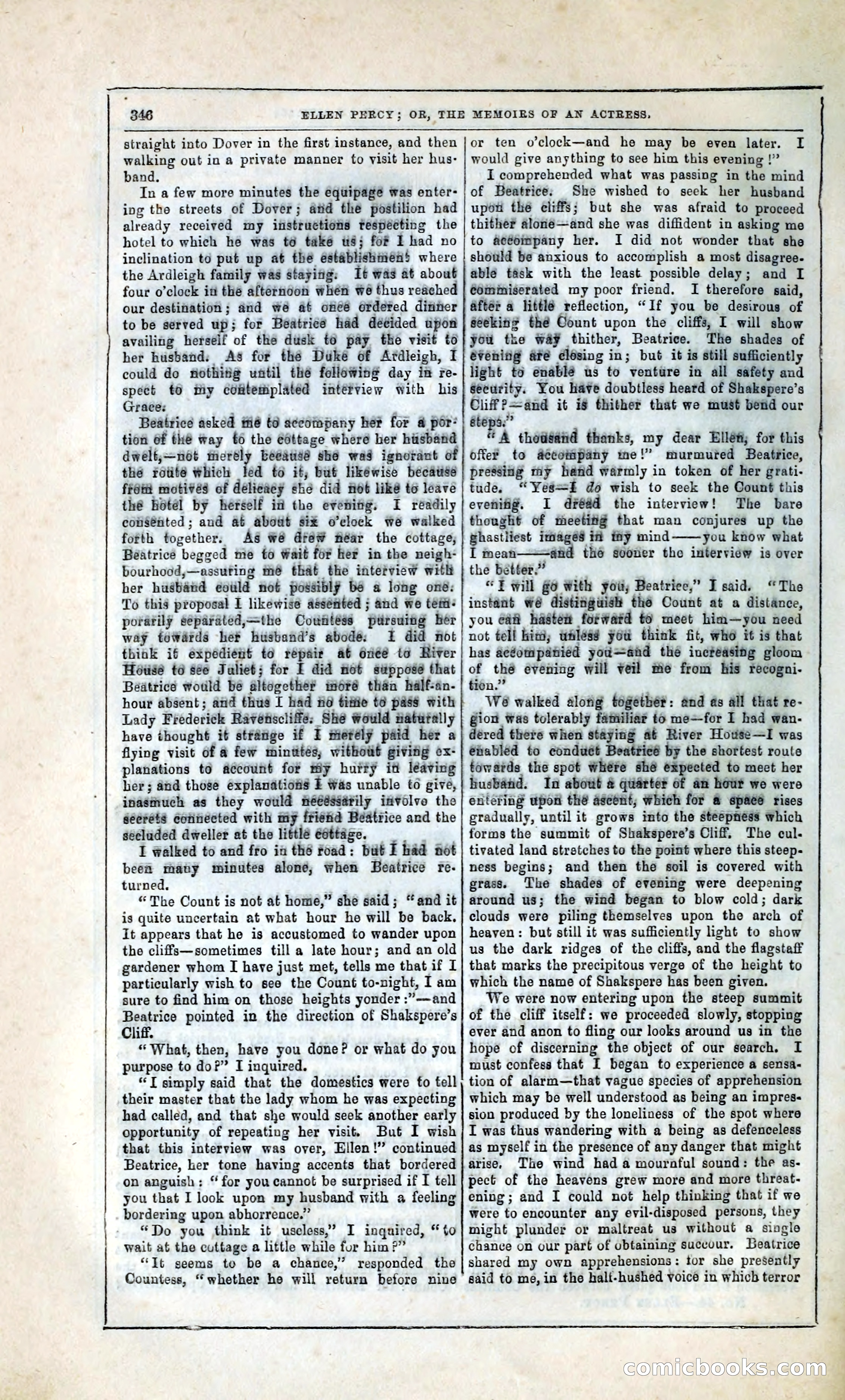
A restored page from Penny Dreadfuls, 1856. Page through the whole issue in the reader above.
📄 Transcribed text from this page (OCR, searchable)
Machine-transcribed from the original scan — historical spelling and the odd misread are preserved.
rl Ss SSS SSSA SS 346 ELLEN PERCY; OR, THE MEMOIRS OF AN ACTRESS, straight into Dover in the first instance, and then walking out in a private manner to visit her hus- band. In a few more minutes the equipage was enter- ing the streets of Dover; atid the postilion had already received my instructions respecting the hotel to which he was to také tt; fof I had no inclination to put up at thé establishment where the Ardleigh family was staying: It Wag at about four o’clock ia the afternoon When wé thus reaehe our destination; and wé at ofeé érdered dither to be served up; for Beatrice had dééided upon availing herself of the dusk te pay the visit to her husband: As for thé Duké of Afdleigh, I could do nothitg until thé following day in re- spect €0 iy céfteniplated intéfview with his Grace: : | . Beatrice asked mé td accompany her for a@ por? tion 6f thé way #6 the edttage where her husband dwélt;not merély beekude she wad ignorant thé fotite Which led to if, but likéwise becatse frit motives of délieaey she did fob like to leave thé Hetél by herself i the evening, I readily conséated ; and at about sit o’elock we walked fotth together. As #@ Gféw# Héar the cottage, Béatrice begged me to Wait for her in the neigh- bourhodd,—assuting mé that the interview with her husband eoiilé not ‘possibly bé a long one: To this proposal I likewise assénted ; and we teiti- poratily separated,=the Cowfitéss ptirsuing bér way towards het husbend’s abode: did fot think if expedient to répair ab Griéé to River Heise to se Juliet; for E did net sipposé that Béatrice would be altogether imoré than half-an- hour absent; aiid thus I had #6 tiie te pase with Lady Frederick Ravéenscliffé: She would natutally have thought it stf@iige if I merély paid her a flying visit of & few mintités, withowt giving ex- planations to account for my hurty if leaving her; and those explandtio#ig E Was unable to give, inasmuch as they would mé€éssatily ifvolve the séeréts cotnécted with my friéid Bédtiice and the secluded dweller at the littlé ééttage. 3 a I walked to and fro in thé road: bat I had aot bee many minutes aloné; when Beatrice re- turned. “The Count is not at home,” she said; “and it is quite uncertain at what hour he will be back. it appears that he is accustomed to wander upon the cliffs—sometimes till a late hour; and an old gardener whom I have just met, tells me that if I particularly wish to see the Count to-night, I am sure to find him on those heights yonder :”—and Beatrice pointed in the direction of Shakspere’s Cliff. “What, then, have you done? or what do you purpose to do?” I inquired. “T simply said that the domestics were fo fell their master that the lady whom he was expecting had called, and that she would seek another early opportunity of repeating her visit. But I wish that this interview was over, Ellen!” continued Beatrice, her tone having accents that bordered on anguish: “ for you cannot be surprised if I tell you that I look upon my husband with a feeling bordering upon abhorrence.” “Do you think it useless,’ I inquired, “ to wait at the cuttage a little while fur him?” “Tt seems to be a chance,’ responded the Countess, “whether he will return before nine or ten o’clock—and he may be even later. I would give anything to see him this evening !” I comprehended what was passing in the mind of Beatrice: She wished to seek her husband upot the eliffs; but she was afraid to proceed thither aloné—and she was diffident in asking me to aeéompany her. I did not wonder that she should be anxious to accomplish a most disagree. able task with the least possible delay; and I eomimiserated my poor friend. I therefore said, after a littlé reflection, “If you be desirous of seekin thé Count upon the cliffs, I will show you tke wa¥ thither, Beatrice. The shades of evening aré closing in; but it is still sufficiently light to enablé us to venture in all safety and security. You have doubtless heard of Shakspere’s Cliff?=and it if thither that we must betid our éteps.” 7 A thowsand thanks, my dear Elléti; for this offer to aecoiipany me!” murmuted Beattice, pressing my hand warmly in token of her grati- tude, “¥es=£ do wish to seek the Count this evenifi@. I dré#d the interview! The bare thought of meetifig that man conjures up the ghastliest images tft ry mind you know what I meanh——and thé sooner tho interview is over the better” “TF will #0 With you, Beatrice,” I said. “The instant wé distingaish thé Count at a distance, you caf hasten forward to meet him—you need not tell hind, walésd yoti think fit, who if is that has aedotmpatied you=ahd thé incteasing gloom of thé evening will veil mie from his recogni- tien.” We walked aloria togethe?: and ds all that re- Zion was tolerably faniiliat to me=for I had wan- éred there when staying at River Hovte—I was éhabled to conduét eé by the shortest route towards the spot Whére shé expected to meet her husband. In about & quartet of an hour we were entering upon thé ageént; which for @ spaeé rises gradually, until it grows into the steepnéss which forms the summit of Shakspere’s Cliff. The cul. tivated land stretches to the point where this steep- ness begins; and then the soil is covered with grass. The shades of evening were deepening around us; the wind began to blow cold; dark clouds were piling themselves upon the arch of heaven: but still it was sufficiently light to show us the dark ridges of the cliffs, and the flagstaff that marks the precipitous verge of the height to which the name of Shakspere has been given. We were now entering upon the steep summit of the cliff itself: we proceeded slowly, stopping ever and anon to fling our looks around us in the hope of discerning the object of our search. I must confess that I began to experience a sensa- tion of alarm—that vague species of apprehension which may be well understood as being an impres- sion produced by the loneliness of the spot where I was thus wandering with a being as defenceless as myself in the presence of any danger that might arise. The wind had a mouraoful sound: the as- pect of the heavens grew more and more threat- ening; and I could not help thinking that if we were to encounter any evil-disposed persons, they might plunder or maltreat us without a single chance on our part of obtaining succour. Beatrice shared my own apprehensions: for she presently said to me, in the half-hushed voice in which terror Connicloool< <¢om