
Penny Dreadfuls, 1856 · page 340 of 399
Ellen Percy; or, The Memoirs of an Actress — page 340: what you’re looking at
A restored page from Penny Dreadfuls, 1856. Page through the whole issue in the reader above.
📄 Transcribed text from this page (OCR, searchable)
Machine-transcribed from the original scan — historical spelling and the odd misread are preserved.
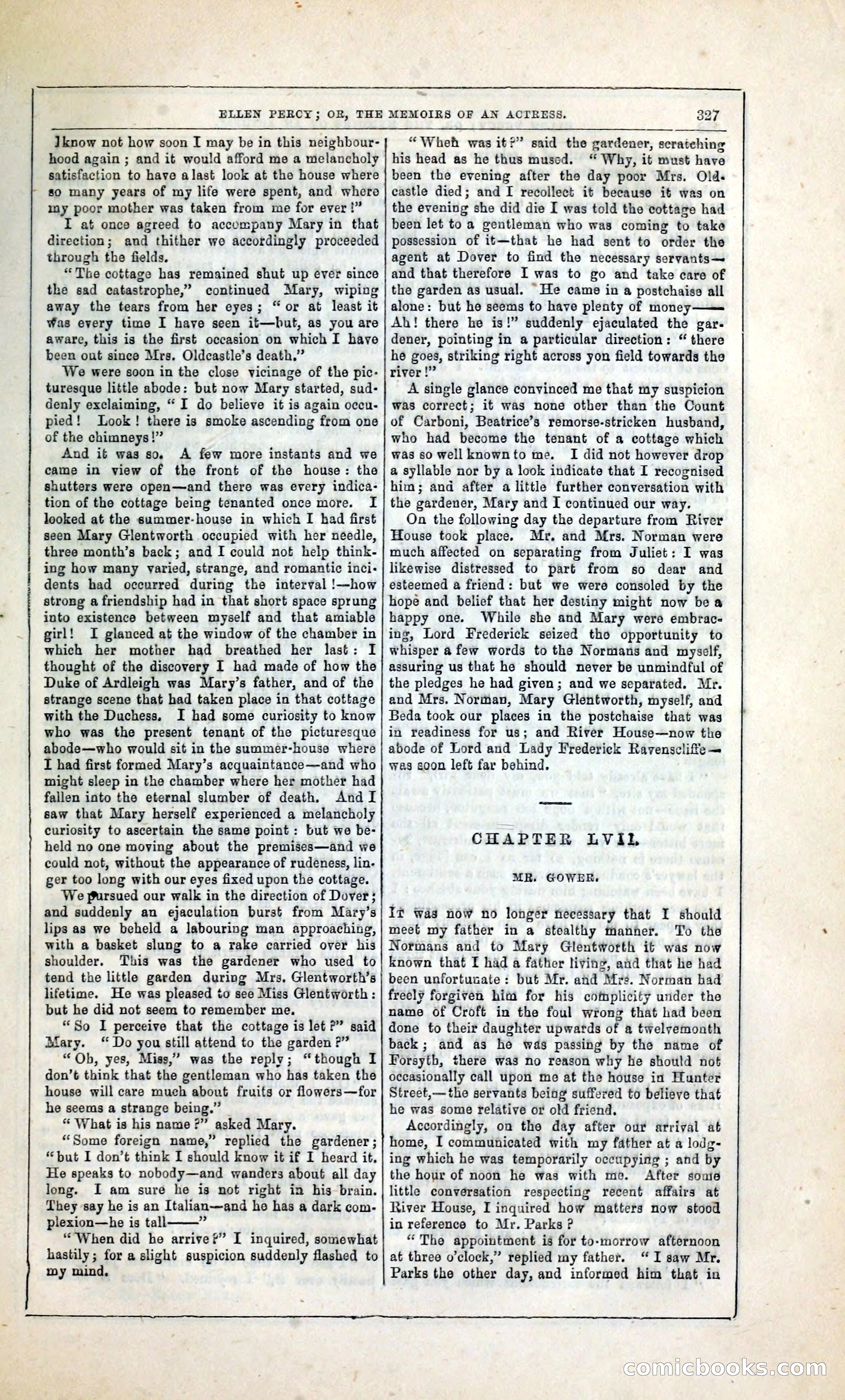
ELLEN PERCY; OR, THE MEMOIRS OF AN ACTRESS. Jknow not how soon I may be in this neighbour- hood again ; and it would afford me a melancholy satisfaction to have alast look at the house where so many years of my life were spent, and where my poor mother was taken from me for ever !” I at once agreed to accompany Mary in that direction; and thither we accordingly proceeded through the fields. “The cottage has remained shut up ever since the sad catastrophe,” continued Mary, wiping away the tears from her eyes; “or at least it Was every time I have seen it—but, as you are aware, this is the first occasion on which I have been out since Mrs. Oldcastle’s death,” We were soon in the close vicinage of the pic- turesque little abode: but now Mary started, sud- denly exclaiming, “I do believe it is again occu- pied! Look! there is smoke ascending from one of the chimneys!” And if was so. A few more instants and we came in view of the front of the house: the shutters were open—and there was every indica- tion of the cottage being tenanted once more. I looked at the summer-house in which I had first seen Mary Glentworth occupied with her needle, three month’s back; and I could not help think- ing how many varied, strange, and romantic inci- dents had occurred during the interval !—how strong a friendship had in that short space sprung into existence between myself and that amiable girl! I glanced at the window of the chamber in which her mother had breathed her last: I thought of the discovery I had made of how the Duke of Ardleigh was Mary’s father, and of the strange scene that had taken place in that cottage with the Duchess. I had some curiosity to know who was the present tenant of the picturesque abode—who would sit in the summer-house where I had first formed Mary’s acquaintance—and who might sleep in the chamber where her mother had fallen into the eternal slumber of death. And I saw that Mary herself experienced a melancholy curiosity to ascertain the same point: but we be- held no one moying about the premises—and we could not, without the appearance of rudeness, lin- ger too long with our eyes fixed upon the cottage. We pursued our walk in the direction of Dover; and suddenly an ejaculation burst from Mary’s lips as we beheld a labouring man approaching, with a basket slung to a rake carried over his shoulder. This was the gardener who used to tend the little garden during Mrs. Glentworth’s lifetime. He was pleased to see Miss Glentworth: but he did not seem to remember me. “So I perceive that the cottage is let ?” said Mary. “Do you still attend to the garden ?” “Ob, yes, Miss,” was the reply; “though I don’t think that the gentleman who has taken the house will care much about fruits or flowers—for he seems a strange being.” “ What is his name ?” asked Mary. “Some foreign name,” replied the gardener; “but I don’t think I should know it if I heard it. He speaks to nobody—and wanders about all day long. I am sure he is not right in his brain. They say he is an I[talian—and he has a dark com- plexion—he is tall cs “When did he arrive?” I inquired, somewhat hastily; for a slight suspicion suddenly flashed to my mind. 327 “Wheh was it?” said the gardener, scratching his head as he thus mused. “ Why, it must have been the evening after the day poor Mrs. Old. castle died; and I recollect it because it was on the evening she did die I was told the cottage had been let to a gentleman who was coming to take possession of it—that he had sent to order the agent at Dover to find the necessary seryants— and that therefore I was to go and take care of the garden as usual. “He came in a postchaise all alone: but he seems to have plenty of money Al! there he is!” suddenly ejaculated the gar. dener, pointing in a particular direction: “ there he goes, striking right across yon field towards the river !” A single glance convinced me that my suspicion was correct; it was none other than the Count of Carboni, Beatrice’s remorse-stricken husband, who had become the tenant of a cottage which was so wellknownto me. I did not however drop a syllable nor by a look indicate that I recornised him; and after a little further conversation with the gardener, Mary and I continued our way. On the following day the departure from River House took place. Mr. and Mrs. Norman were much affected on separating from Juliet: I was likewise distressed to part from so dear and esteemed a friend: but we were consoled by the hope and belief that her destiny might now be a happy one. While she and Mary were embrac- ing, Lord Frederick seized tho opportunity to whisper afew words to the Normans and myself, assuring us that he should never be unmindful of the pledges he had given; and we separated. Mr. and Mrs. Norman, Mary Glentworth, myself, and Beda took our places in the postchaise that was in readiness for us; and River House—now the abode of Lord and Lady Frederick Ravenscliffe— was goon left far behind. CHAPTER LVIiL MR. GOWER. It Was now no longer necessary that I should meet my father in a stealthy manher. To the Normans and to Mary Glentworth if was now known that I had a father living, and that he had been unfortunate: but Mr. and Mre. Norman had freely forgiven him for his complicity under the name of Croft in the foul wrong that had been done fo their daughter upwards of a twelyemonth back; and as he was passing by the name of Forsyth, there was no reason why he should not occasionally call upon me at the house in Hunter Street,—the servants being suffered to believe that he was some relative or old friend. Accordingly, on the day after our arrival at home, I communicated with my father at a lodg- ing which he was temporarily occupying ; and by the hour of noon he was with me. After sonie little conversation respecting recent affairs at River House, I inquired how matters now stood in reference to Mr. Parks P “ The appointment is for to-morrow afternoon at three o’clock,” replied my father. “I saw Mr. Parks the other day, and informed him that in COnnicloool< e¢om