
Penny Dreadfuls, 1856 · page 235 of 399
Ellen Percy; or, The Memoirs of an Actress — page 235: what you’re looking at
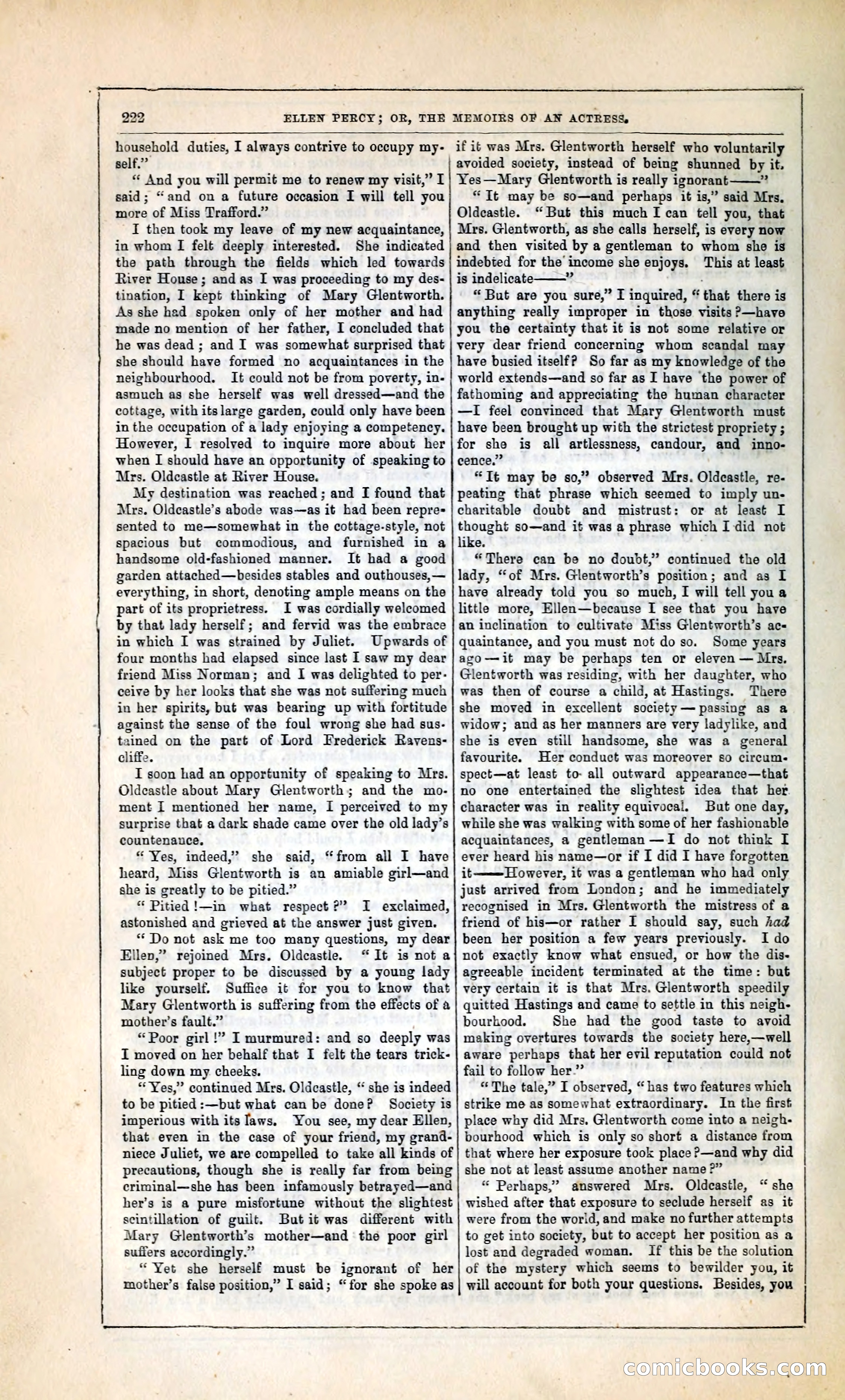
A restored page from Penny Dreadfuls, 1856. Page through the whole issue in the reader above.
📄 Transcribed text from this page (OCR, searchable)
Machine-transcribed from the original scan — historical spelling and the odd misread are preserved.
222 ELLEN PERCY; OR, THE MEMOIRS OF AN ACTRESS household duties, I always contrive to occupy my- self.” «« And you will permit me to renew my visit,” I said; “and on a future occasion I will tell you more of Miss Trafford.” I then took my leave of my new acquaintance, in whom I felt deeply interested. She indicated the path through the fields which led towards River House ; and as I was proceeding to my des- tination, I kept thinking of Mary Glentworth. As she had spoken only of her mother and had made no mention of her father, I concluded that he was dead ; and I was somewhat surprised that she should have formed no acquaintances in the neighbourhood. It could not be from poverty, in- asmuch as she herself was well dressed—and the cottage, with its large garden, could only have been in the occupation of a lady enjoying a competency. However, I resolved to inquire more about her when I should have an opportunity of speaking to Mrs. Oldcastle at River House. My destination was reached; and I found that Mrs. Oldcastle’s abode was~as it had been repre- sented to me—somewhat in the cottage-style, not spacious but commodious, and furnished in a handsome old-fashioned manner. It had a good garden attached—besides stables and outhouses,— everything, in short, denoting ample means on the part of its proprietress. I was cordially welcomed by that lady herself; and fervid was the embrace in which I was strained by Juliet. Upwards of four months had elapsed since last I saw my dear friend Miss Norman; and I was delighted to per- ceive by her looks that she was not suffering much in her spirits, but was bearing up with fortitude against the sense of the foul wrong she had sus- tained on the part of Lord Frederick Ravens- cliffe. I soon had an opportunity of speaking to Mrs. Oldcastle about Mary Glentworth; and the mo- ment I mentioned her name, I perceived to my surprise that a dark shade came over the old lady’s countenance, “Yes, indeed,’ she said, “from all I have heard, Miss Glentworth is an amiable girl—and she is greatly to be pitied.” “ Pitied !—in what respect?” I exclaimed, astonished and grieved at the answer just given. ** Do not ask me too many questions, my dear Ellen,” rejoined Mrs. Oldcastle. “It is not a subject proper to be discussed by a young lady like yourself. Suffice it for you to know that Mary Glentworth is suffering from the effects of 4 mother’s fault.” “Poor girl!” I murmured: and so deeply was I moved on her behalf that I felt the tears trick- ling down my cheeks. “Yes,” continued Mrs. Oldcastle, ‘‘ she is indeed to be pitied :—but what can be done? Society is imperious with its laws, You see, my dear Ellen, that even in the case of your friend, my grand- niece Juliet, we are compelled to take all kinds of precautions, though she is really far from being criminal—she has been infamously betrayed—and her’s is a pure misfortune without the slightest scintillation of guilt. Butit was different with Mary Glentworth’s mother—and the poor girl sufiers accordingly.” “Yet she herself must be ignorant of her mother’s false position,” I said; “for she spoke as character was in reality equivocal. if it was Mrs. Glentworth herself who voluntarily avoided society, instead of being shunned by it. Yes—Mary Glentworth is really ignorant . * It may be so—and perhaps it is,” said Mrs. Oldcastle. “But this much I can tell you, that Mrs. Glentworth, as she calls herself, is every now and then visited by a gentleman to whom she is indebted for the income she enjoys. This at least is indelicate ¥ “ But are you sure,” I inquired, “ that there is anything really improper in those visits ?—have you the certainty that it is not some relative or very dear friend concerning whom scandal may have busied itself? So far as my knowledge of the world extends—and so far as I have the power of fathoming and appreciating the human character —I feel convinced that Mary Glentworth must have been brought up with the strictest propriety ; for she is all artlessness, candour, and inno- cence.” “It may be so,” observed Mrs. Oldcastle, re- peating that phrase which seemed to imply un- charitable doubt and mistrust: thought so—and it was a phrase which I did not like. or at least I “There can be no doubt,” continued the old lady, “of Mrs. Glentworth’s position; and as I have already told you so much, I will tell youa little more, Ellen—because I see that you have an inclination to cultivate Miss Glentworth’s ac- quaintance, and you must not do so. aco—it may be perhaps ten or eleven — Mrs, Some years Glentworth was residing, with her daughter, who was then of course a child, at Hastings. There she moved in excellent society — passing as a widow; and as her manners are very ladylike, and she is even still handsome, she was a general favourite. Her conduct was moreover so circum. spect—at least to- all outward appearance—that no one entertained the slightest idea that her. But one day, while she was walking with some of her fashionable acquaintances, a gentleman —I do not think I ever heard his name—or if I did I have forgotten it However, it was a gentleman who had only just arrived from London; and he immediately recognised in Mrs. Glentworth the mistress of a friend of his—or rather I should say, such had been her position a few years previously. Ido not exactly know what ensued, or how the dis- agreeable incident terminated at the time: but very certain it is that Mrs. Glentworth speedily quitted Hastings and came to settle in this neigh- bourhood. She had the good taste to avoid making overtures towards the society here,—well aware perhaps that her evil reputation could not fail to follow her.” “The tale,” I observed, “has two features which strike me as somewhat extraordinary. In the first place why did Mrs, Glentworth come into a neigh- bourhood which is only so short a distance from that where her exposure took place ?—and why did she not at least assume another name?” “ Perhaps,” answered Mrs. Oldcastle, “ she wished after that exposure to seclude herself as it were from the world, and make no further attempts to get into society, but to accept her position as a lost and degraded woman. If this be the solution of the mystery which seems to bewilder you, it will account for both your questions. Besides, you Gomicbook com