
Penny Dreadfuls, 1856 · page 225 of 399
Ellen Percy; or, The Memoirs of an Actress — page 225: what you’re looking at
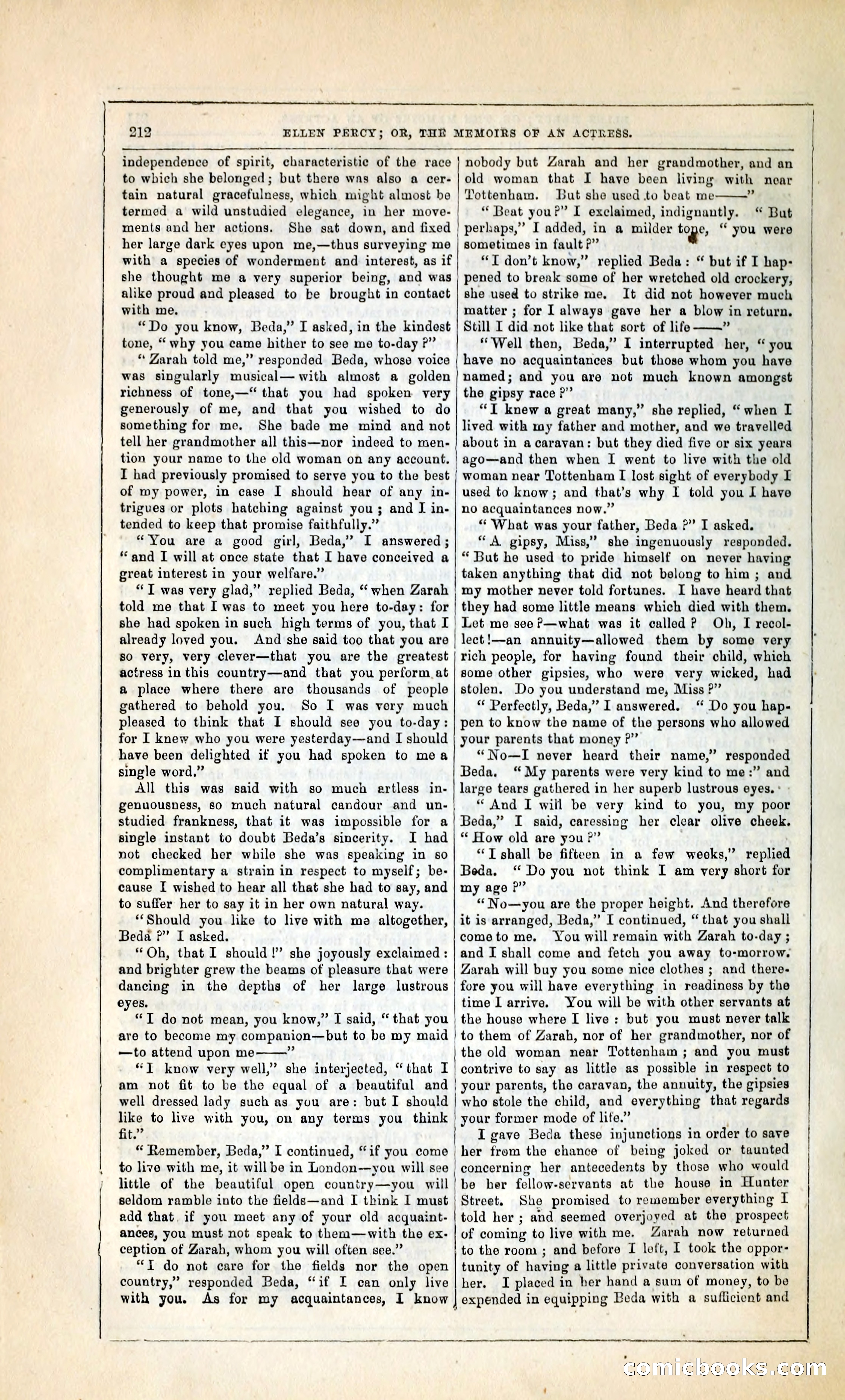
A restored page from Penny Dreadfuls, 1856. Page through the whole issue in the reader above.
📄 Transcribed text from this page (OCR, searchable)
Machine-transcribed from the original scan — historical spelling and the odd misread are preserved.
ee 212 independence of spirit, characteristic of the race to which she belonged; but there was also a cer- tain natural gracefulness, which might almost be termed a wild unstudied elegance, in her move- ments and her actions. She sat down, and fixed her large dark eyes upon me,—thus surveying me with a species of wonderment and interest, as if she thought me a very superior being, and was alike proud and pleased to be brought in contact with me. “Do you know, Beda,” I asked, in the kindest tone, “ why you came hither to see me to-day P” “ Zarah told me,” responded Beda, whose voice was singularly musical— with almost a golden richness of tone,—“ that you had spoken very generously of me, and that you wished to do something for me. She bade me mind and not tell her grandmother all this—nor indeed to men- tion your name to the old woman on any account. I had previously promised to serve you to the best of my power, in case I should hear of any in- trigues or plots hatching against you; and J in- tended to keep that promise faithfully.” “You are a good girl, Beda,’ I answered ; ‘and I will at once state that I have conceived a great interest in your welfare.” “T was very glad,” replied Beda, “ when Zarah told me that I was to meet you here to-day: for she had spoken in such high terms of you, that I already loved you. And she said too that you are so very, very clever—that you are the greatest actress in this country—and that you perform. at a place where there are thousands of people gathered to behold you. So I was very much pleased to think that I should see you to-day: for I knew who you were yesterday—and I should have been delighted if you had spoken to mea single word.” All this was said with so much artless in- genuousness, so much natural candour and un- studied frankness, that it was impossible for a single instant to doubt Beda’s sincerity. I had not checked her while she was speaking in so complimentary a strain in respect to myself; be- cause I wished to hear all that she had to say, and to suffer her to say it in her own natural way. “Should you like to lve with me altogether, Beda ?” I asked. “Oh, that I should!” she joyously exclaimed : and brighter grew the beams of pleasure that were dancing in the depths of her large lustrous eyes. “T do not mean, you know,” I said, “ that you are to become my companion—but to be my maid —to attend upon me oe “JT know very well,” she interjected, “that I am not fit to be the equal of a beautiful and well dressed lady such as you are: but I should like to live with you, on any terms you think fit.” “ Remember, Beda,” I continued, “if you come to live with me, it willbe in London—you will see little of the beautiful open country—you will seldom ramble into the fields—and I think I must add that. if you meet any of your old acquaint- ances, you must not speak to them—with the ex- ception of Zarah, whom you will often see.” “I do not care for the fields nor the open country,” responded Beda, “if I can only live with you. As for my acquaintances, I know ELLEN PERCY; OR, THE MEMOIRS OF AN ACTRESS. nobody but Zarah and her grandmother, and an old woman that I have been living with near Tottenham. But she used .to beat me - ‘Beat youP” I exclaimed, indignantly. “ But perhaps,” I added, in a milder tope, “ you were sometimes in fault?” “T don’t know,” replied Beda: “ but if I hap- pened to break some of her wretched old crockery, she used to strike me. It did not however much matter ; for I always gave her a blow in return. Still I did not like that sort of life-——-” “Well then, Beda,” I interrupted her, “ you have no acquaintances but those whom you have named; and you are not much known amongst the gipsy race P” “T knew a great many,” she replied, “when I lived with my father and mother, and we travelled about in a caravan: but they died five or six years ago—and then when I went to live with the old woman near Tottenham I lost sight of everybody I used to know; and that’s why I told you I have no acquaintances now.” “What was your father, Beda P” I asked. * A gipsy, Miss,” she ingenuously responded. “ But he used to pride himself on never having taken anything that did not belong to him; and my mother never told fortunes. I have heard that they had some little means which died with them. Let me see ?—what was it called P Oh, I recol- lect!—an annuity—allowed them by some very rich people, for having found their child, which some other gipsies, who were very wicked, had stolen. Do you understand me, Miss ?” Perfectly, Beda,” I answered. ‘“ Do you hap- pen to know the name of the persons who allowed your parents that money P” ““No—I never heard their namo,” responded Beda. “My parents were very kind to me:” and large tears gathered in her superb lustrous eyes. ° | ‘And I will be very kind to you, my poor Beda,” I said, caressing her clear olive cheek. * How old are you P” “JT shall be fifteen in a few weeks,” replied Beda. “ Do you not think I am very short for my age P” * No—you are the proper height. And therefore it is arranged, Beda,” I continued, “ that you shall cometo me. You will remain with Zarah to-day ; and I shall come and fetch you away to-morrow. Zarah will buy you some nice clothes ; and there- fore you will have everything in readiness by the time I arrive. You will be with other servants at the house where I live : but you must never talk to them of Zarah, nor of her grandmother, nor of the old woman near Tottenham ; and you must contrive to say as little as possible in respect to your parents, the caravan, the annuity, the gipsies who stole the child, and everything that regards your former mode of life.” I gave Beda these injunctions in order to save her from the chance of being joked or taunted concerning her antecedents by those who would be her fellow-servants at the house in Hunter Street. She promised to remember everything I told her ; and seemed overjoyed at the prospect of coming to live with me. Zarah now returned to the room ; and before I left, I took the oppor- tunity of having a little private conversation with her. I placed in ber hand a sum of money, to be expended in equipping Beda with a suflicient and Gomicbook ¢om