
Penny Dreadfuls, 1856 · page 19 of 399
Ellen Percy; or, The Memoirs of an Actress — page 19: what you’re looking at
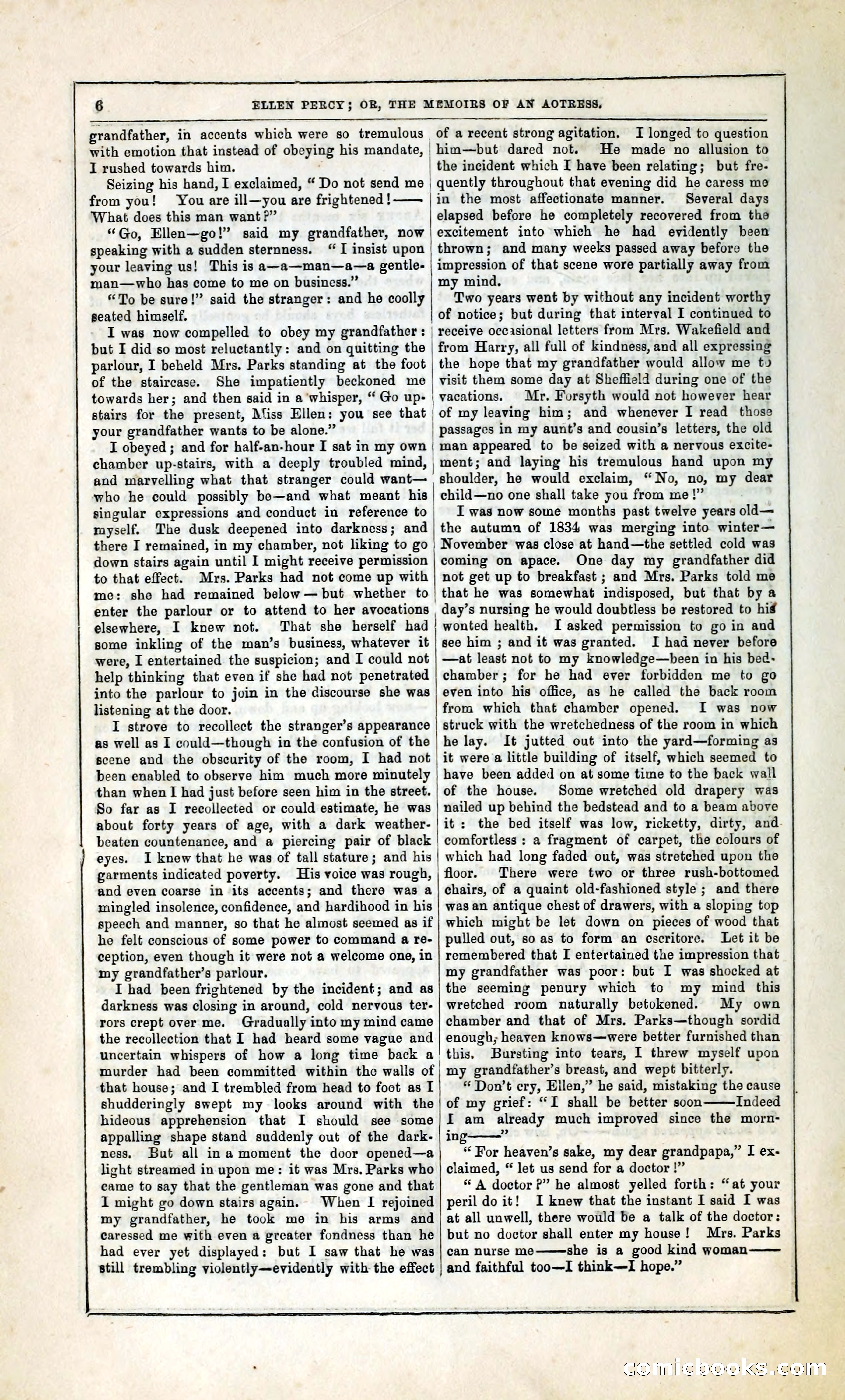
A restored page from Penny Dreadfuls, 1856. Page through the whole issue in the reader above.
📄 Transcribed text from this page (OCR, searchable)
Machine-transcribed from the original scan — historical spelling and the odd misread are preserved.
6 ELLEN PERCY; OR, THE MEMOIRS OF AN AOTRESS, grandfather, in accents which were so tremulous of a recent strong agitation. I longed to question with emotion that instead of obeying his mandate, | I rushed towards him. Seizing his hand, I exclaimed, “ Do not send me from you! You are ill—you are frightened !—— ‘What does this man want P” “Go, Ellen—go!” said my grandfather, now speaking with a sudden sternness. “I insist upon your leaving us! This is a~a—man—a—a gentle- man—who has come to me on business.” “To be sure!” said the stranger: and he coolly seated himself. I was now compelled to obey my grandfather : but I did so most reluctantly: and on quitting the parlour, I beheld Mrs. Parks standing at the foot of the staircase. She impatiently beckoned me towards her; and then said in a ‘whisper, “‘ Go up- | vacations. him—but dared not. He made no allusion to the incident which I have been relating; but fre- quently throughout that evening did he caress me in the most affectionate manner. Several days elapsed before he completely recovered from the excitement into which he had evidently been thrown; and many weeks passed away before the impression of that scene wore partially away from my mind. Two years went by without any incident worthy of notice; but during that interval I continued to receive occasional letters from Mrs. Wakefield and from Harry, all full of kindness, and all expressing the hope that my grandfather would allow me tv visit them some day at Sheffield during one of the Mr. Forsyth would not however hear stairs for the present, Miss Ellen: you see that | of my leaving him; and whenever I read those your grandfather wants to be alone.” passages in my aunt’s and cousin’s letters, the old I obeyed; and for half-an-hour I sat in my own | man appeared to be seized with a nervous excite- chamber up-stairs, with a deeply troubled mind, | ment; and laying his tremulous hand upon my and marvelling what that stranger could want— shoulder, he would exclaim, “No, no, my dear who he could possibly be—and what meant his | child—no one shall take you from me!” singular expressions and conduct in reference to myself. The dusk deepened into darkness; and there I remained, in my chamber, not liking to go down stairs again until I might receive permission to that effect. Mrs. Parks had not come up with me: she had remained below — but whether to enter the parlour or to attend to her avocations elsewhere, I knew not. That she herself had some inkling of the man’s business, whatever it were, I entertained the suspicion; and I could not help thinking that even if she had not penetrated into the parlour to join in the discourse she was listening at the door. I strove to recollect the stranger’s appearance as well as I could—though in the confusion of the scene and the obscurity of the room, I had not been enabled to observe him much more minutely than when I had just before seen him in the street. So far as I recollected or could estimate, he was about forty years of age, with a dark weather- beaten countenance, and a piercing pair of black eyes. I knew that he was of tall stature; and his garments indicated poverty. His voice was rough, and even coarse in its accents; and there was a mingled insolence, confidence, and hardihood in his speech and manner, so that he almost seemed as if he felt conscious of some power to command a re- ception, even though it were not a welcome one, in my grandfather’s parlour. I had been frightened by the incident; and as darkness was closing in around, cold nervous ter- rors crept over me. Gradually into my mind came the recollection that I had heard some vague and uncertain whispers of how a long time back a I was now some months past twelve years old— the autumn of 1834 was merging into winter— November was close at hand—the settled cold was coming on apace. One day my grandfather did not get up to breakfast ; and Mrs. Parks told me | that he was somewhat indisposed, but that by a murder had been committed within the walls of | that house; and I trembled from head to foot as I shudderingly swept my looks around with the hideous apprehension that I should see some appalling shape stand suddenly out of the dark- ness. But all ina moment the door opened—a light streamed in upon me: it was Mrs. Parks who came to say that the gentleman was gone and that I might go down stairs again. When I rejoined my grandfather, he took me in his arms and caressed me with even a greater fondness than he had ever yet displayed: but I saw that he was still trembling violently—evidently with the effect day’s nursing he would doubtless be restored to hid wonted health. I asked permission to go in and see him ; and it was granted. I had never before —at least not to my knowledge—been in his bed- chamber; for he had ever forbidden me to go even into his office, as he called the back room from which that chamber opened. I was now struck with the wretchedness of the room in which he lay. It jutted out into the yard—forming as it were a little building of itself, which seemed to have been added on at some time to the back wall of the house. Some wretched old drapery was nailed up behind the bedstead and to a beam above it: the bed itself was low, ricketty, dirty, and- comfortless : a fragment of carpet, the colours of which had long faded out, was stretched upon the floor. There were two or three rush-bottomed chairs, of a quaint old-fashioned style ; and there was an antique chest of drawers, with a sloping top which might be let down on pieces of wood that pulled out, so as to form an escritore. Let it be remembered that I entertained the impression that my grandfather was poor: but I was shocked at the seeming penury which to my mind this wretched room naturally betokened. My own chamber and that of Mrs. Parks—though sordid enough; heaven knows—were better furnished than this. Bursting into tears, I threw myself upon my grandfather’s breast, and wept bitterly. * Don’t cry, Hilen,” he said, mistaking the cause of my grief: “I shall be better soon Indeed I am already much improved since the morn- “ For heaven’s sake, my dear grandpapa,” I ex- claimed, “ let us send for a doctor !” “ A doctor P” he almost yelled forth: “at your peril do it! I knew that the instant I said I was at all unwell, there would be a talk of the doctor: but no doctor shall enter my house! Mrs. Parks can nurse me she is a good kind woman and faithful too—I think—TI hope.” COMMUC NOOLKS (ECOL