
Penny Dreadfuls, 1856 · page 178 of 399
Ellen Percy; or, The Memoirs of an Actress — page 178: what you’re looking at
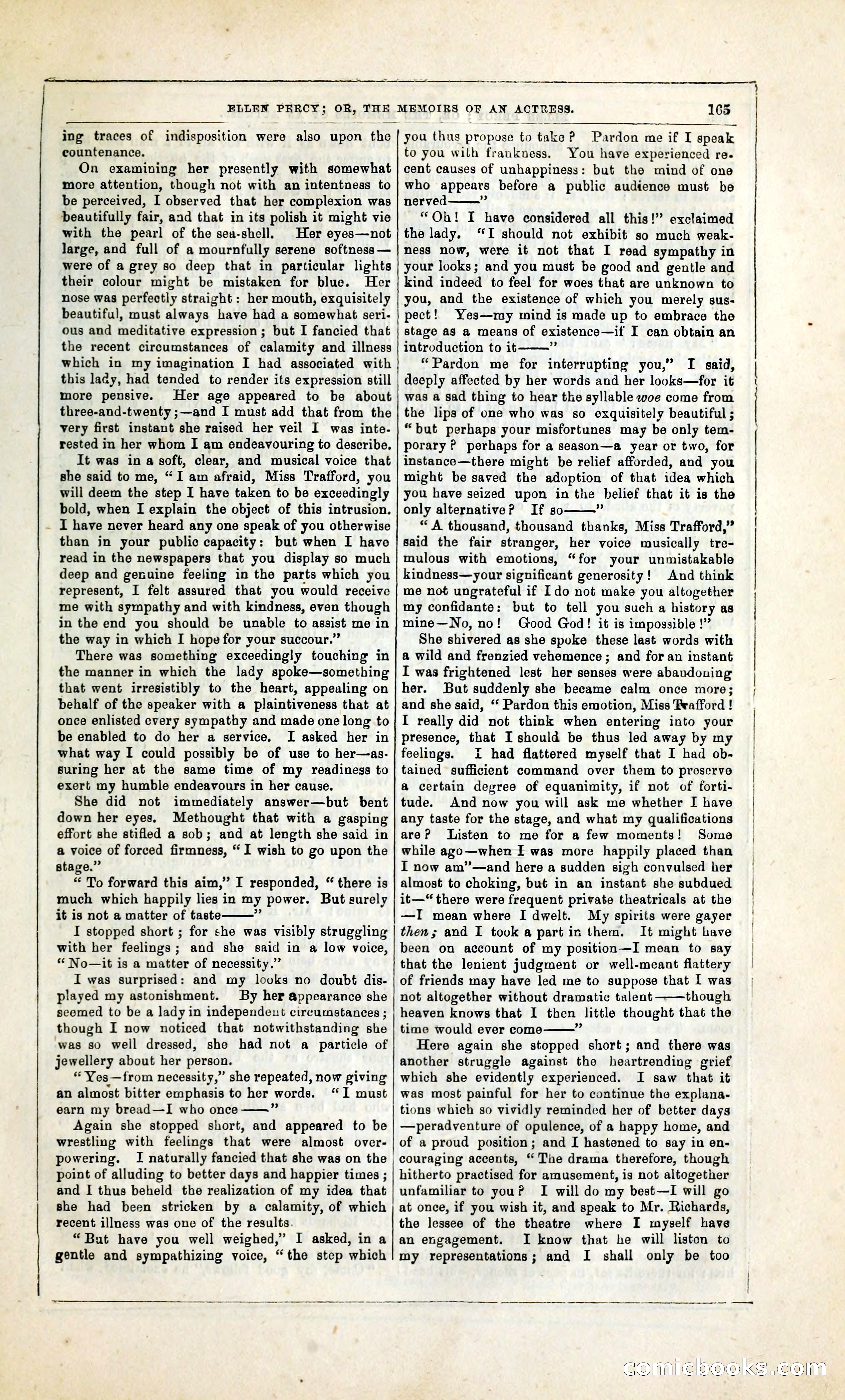
A restored page from Penny Dreadfuls, 1856. Page through the whole issue in the reader above.
📄 Transcribed text from this page (OCR, searchable)
Machine-transcribed from the original scan — historical spelling and the odd misread are preserved.
. aes - : ELLEN PERCY; OB, THE MEMOIRS OF AN ACTRESS. ing traces of indisposition were also upon the countenance. On examining her presently with somewhat more attention, though not with an intentness to be perceived, I observed that her complexion was beautifully fair, and that in its polish it might vie with the pearl of the sea-shell. Her eyes—not large, and full of a mournfully serene softness — were of a grey so deep that in particular lights their colour might be mistaken for blue. Her nose was perfectly straight: her mouth, exquisitely beautiful, must always have had a somewhat seri- ous and meditative expression; but I fancied that the recent circumstances of calamity and illness which in my imagination I had associated with this lady, had tended to render its expression still more pensive. Her age appeared to be about three-and-twenty ;—and I must add that from the very first instant she raised her veil I was inte. rested in her whom I am endeavouring to describe. It was in a soft, clear, and musical voice that she said to me, “I am afraid, Miss Trafford, you will deem the step I have taken to be exceedingly bold, when I explain the object of this intrusion. I have never heard any one speak of you otherwise than in your public capacity: but when I have read in the newspapers that you display so much deep and genuine feeling in the parts which you represent, I felt assured that you would receive me with sympathy and with kindness, even though in the end you should be unable to assist me in the way in which I hope for your succour.” There was something exceedingly touching in the manner in which the lady spoke—something that went irresistibly to the heart, appealing on behalf of the speaker with a plaintiveness that at once enlisted every sympathy and made one long to be enabled to do her a service. I asked her in what way I could possibly be of use to her—as- suring her at the same time of my readiness to exert my humble endeavours in her cause. She did not immediately answer—but bent down her eyes. Methought that with a gasping effort she stifled a sob; and at lergth she said in a voice of forced firmness, “ I wish to go upon the stage.” “ To forward this aim,” I responded, “ there is much which happily lies in my power. But surely it is not a matter of taste im I stopped short ; for she was visibly struggling with her feelings; and she said in a low voice, ** No—it is a matter of necessity.” I was surprised: and my looks no doubt dis- played my astonishment. By her appearance she seemed to be a lady in independeut circumstances ; though I now noticed that notwithstanding she was so well dressed, she had not a particle of jewellery about her person. “ Yes—from necessity,” she repeated, now giving an almost bitter emphasis to her words. “I must earn my bread—I who once —~—” Again she stopped short, and appeared to be wrestling with feelings that were almost over- powering. I naturally fancied that she was on the point of alluding to better days and happier times ; and I thus beheld the realization of my idea that 8he had been stricken by a calamity, of which recent illness was one of the results. “But have you well weighed,” I asked, in a gentle and sympathizing voice, “the step which 165 you thus propose to take? Pardon me if I speak to you with frankness. You have experienced re. cent causes of unhappiness: but the mind of one who appears before a public audience must be nerved ¥ “Oh! I have considered all this!” exclaimed the lady. ‘I should not exhibit so much weak- ness now, were it not that I read sympathy in your looks; and you must be good and gentle and kind indeed to feel for woes that are unknown to you, and the existence of which you merely sus- pect! Yes—my mind is made up to embrace the stage as a means of existence—if I can obtain an introduction to it + “Pardon me for interrupting you,” I said, deeply affected by her words and her looks—for it was a sad thing to hear the syllable woe come from the lips of one who was so exquisitely beautiful ; “but perhaps your misfortunes may be only tem- porary P perhaps for a season—a year or two, for instance—there might be relief afforded, and you might be saved the adoption of that idea which you have seized upon in the belief that it is the only alternative? If so . “ A thousand, thousand thanks, Miss Trafford,” said the fair stranger, her voice musically tre- mulous with emotions, “for your unmistakable kindness—your significant generosity! And think me not ungrateful if Ido not make you altogether my confidante: but to tell you such a history as mine—No, no! Good God! it is impossible !” She shivered as she spoke these last words with a wild and frenzied vehemence ; and for an instant I was frightened lest her senses were abandoning her. But suddenly she became calm once more; and she said, “ Pardon this emotion, Miss Feafford ! I really did not think when entering into your presence, that I should be thus led away by my feelings. I had flattered myself that I had ob- tained sufficient command over them to preserve a certain degree of equanimity, if not of forti- tude. And now you will ask me whether I have any taste for the stage, and what my qualifications areP Listen to me for a few moments! Some while ago—when I was more happily placed than I now am’’—and here a sudden sigh convulsed her almost to choking, but in an instant she subdued it—“ there were frequent private theatricals at the —I mean where I dwelt. My spirits were gayer then; and I took a part in them. It might have been on account of my position—I mean to say that the lenient judgment or well-meant flattery of friends may have led me to suppose that I was not altogether without dramatic talent though heaven knows that I then little thought that the time would ever come “ Here again she stopped short; and there was another struggle against the heartrending grief which she evidently experienced. I saw that it was most painful for her to continue the explana- tions which so vividly reminded her of better days —peradventure of opulence, of a happy home, and of a proud position; and I hastened to say in en- couraging accents, ‘ The drama therefore, though hitherto practised for amusement, is not altogether unfamiliar to youP I will do my best—I will go at once, if you wish it, and speak to Mr. Richards, the lessee of the theatre where I myself have an engagement. I know that he will listen to my representations; and I shall only be too ee, Guage Gatien — so a ‘ i enter, — i a ECOMEE 6)(6\(6) <S) Com