
Penny Dreadfuls, 1856 · page 168 of 399
Ellen Percy; or, The Memoirs of an Actress — page 168: what you’re looking at
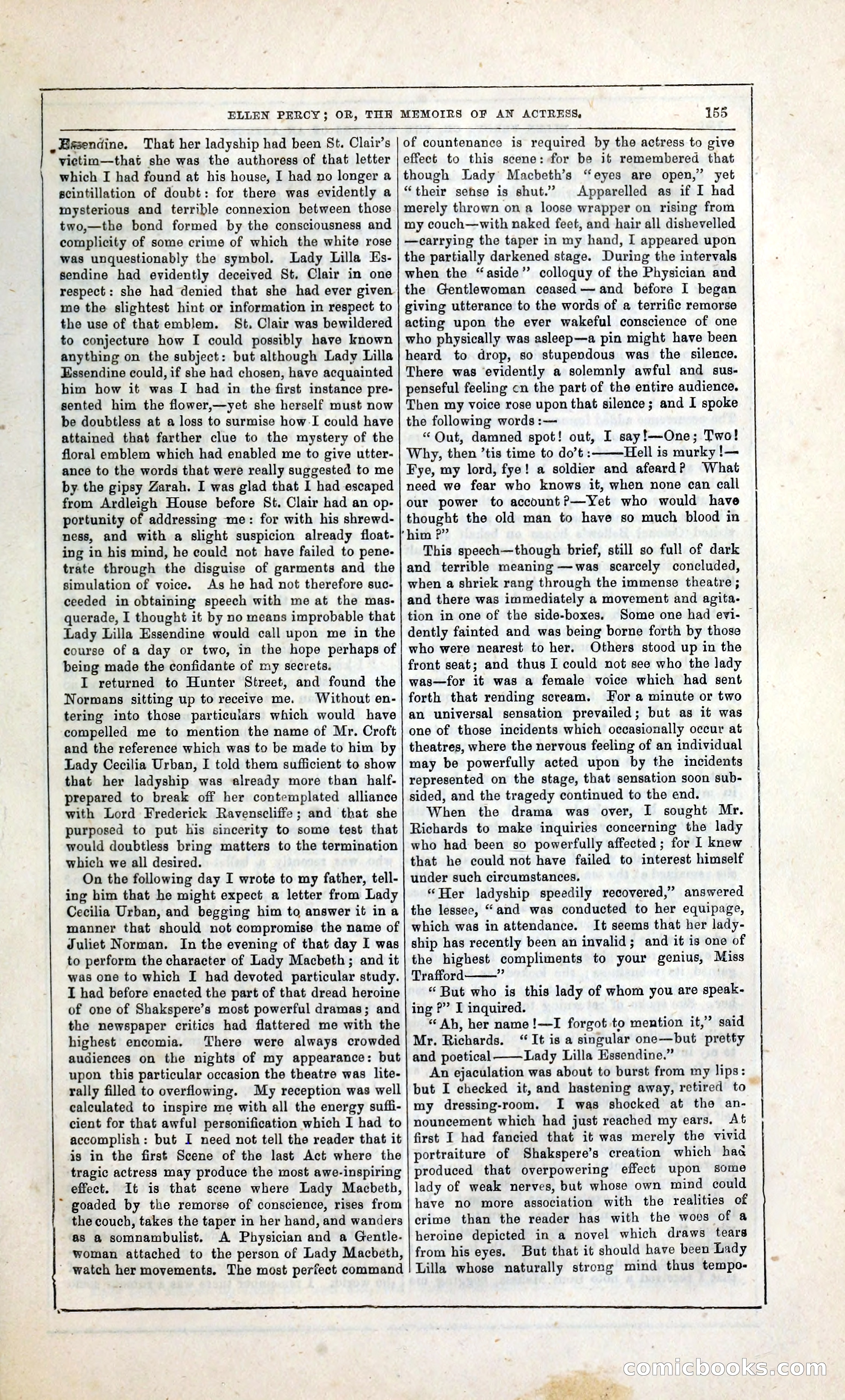
A restored page from Penny Dreadfuls, 1856. Page through the whole issue in the reader above.
📄 Transcribed text from this page (OCR, searchable)
Machine-transcribed from the original scan — historical spelling and the odd misread are preserved.
eS ELLEN PERCY; OR, THE _Hasendine. That her ladyship had been St. Clair’s victim—that she was the authoress of that letter which I had found at his house, I had no longer a scintillation of doubt: for there was evidently a mysterious and terrible connexion between those two,—the bond formed by the consciousness and complicity of some crime of which the white rose was unquestionably the symbol. Lady Lilla Es- sendine had evidently deceived St. Clair in one respect: she had denied that she had ever given me the slightest hint or information in respect to the use of that emblem. St. Clair was bewildered to conjecture how I could possibly have known anything on the subject: but although Lady Lilla Essendine could, if she had chosen, have acquainted him how it was I had in the first instance pre- sented him the flower,—yet she herself must now be doubtless at a loss to surmise how I could have attained that farther clue to the mystery of the floral emblem which had enabled me to give utter- ance to the words that were really suggested to me by the gipsy Zarah. I was glad that I had escaped from Ardleigh House before St. Clair had an op- portunity of addressing me: for with his shrewd- ness, and with a slight suspicion already float- ing in his mind, he could not have failed to pene- trate through the disguise of garments and the simulation of yoice. As he had not therefore suc- ceeded in obtaining speech with me at the mas- querade, I thought it by no means improbable that Lady Lilla Essendine would call upon me in the course of a day or two, in the hope perhaps of being made the confidante of my secrets. I returned to Hunter Street, and found the Normans sitting up to receive me. Without en- tering into those particuiars which would have compelled me to mention the name of Mr. Croft and the reference which was to be made to him by Lady Cecilia Urban, I told them sufficient to show that her ladyship was already more than half- prepared to break off her contemplated alliance with Lord Frederick Ravenscliffe; and that she purposed to put his sincerity to some test that would doubtless bring matters to the termination which we all desired. On the following day I wrote to my father, tell- ing him that he might expect a letter from Lady Cecilia Urban, and begging him to answer it ina manner that should not compromise the name of Juliet Norman. In the evening of that day I was to perform the character of Lady Macbeth; and it was one to which I had devoted particular study. I had before enacted the part of that dread heroine of one of Shakspere’s most powerful dramas; and the newspaper critics had flattered me with the highest encomia. There were always crowded audiences on the nights of my appearance: but upon this particular occasion the theatre was lite- rally filled to overflowing. My reception was well calculated to inspire me with all the energy sufli- cient for that awful personification which I had to accomplish: but I need not tell the reader that it is in the first Scene of the last Act where the tragic actress may produce the most awe-inspiring effect. It is that scene where Lady Macbeth, goaded by the remorse of conscience, rises from the couch, takes the taper in her hand, and wanders as @ somnambulist. A Physician and a Gentle- woman attached to the person of Lady Macbeth, - watch her movements. The most perfect command MEMOIRS OF AN ACTRESS, 155 of countenance is required by the actress to give effect to this scene: for be 16 remembered that though Lady Macbeth’s “eyes are open,’ yet “their sehse is shut.” Apparelled as if I had merely thrown on a loose wrapper on rising from my couch—with naked feet, and hair all dishevelled —carrying the taper in my hand, I appeared upon the partially darkened stage. During the intervals when the “aside” colloquy of the Physician and the Gentlewoman ceased —~and before I began giving utterance to the words of a terrific remorse acting upon the ever wakeful conscience of one who physically was asleep—a pin might have been heard to drop, so stupendous was the silence. There was evidently a solemnly awful and sus- penseful feeling cn the part of the entire audience. Then my voice rose upon that silence; and I spoke the following words :— “ Out, damned spot! out, I say!—One; Two! Why, then ’tis time to do’t: Hell is murky !— Fye, my lord, fye! a soldier and afeard? What need we fear who knows it, when none can call our power to accountP—Yet who would have thought the old man to have so much blood in "him P” This speech—though brief, still so full of dark and terrible meaning —was scarcely concluded, when a shriek rang through the immense theatre ; and there was immediately a movement and agita- tion in one of the side-boxes. Some one had evi- — dently fainted and was being borne forth by those who were nearest to her. Others stood up in the front seat; and thus I could not see who the lady was—for it was a female voice which had sent forth that rending scream. For a minute or two an universal sensation prevailed; but as it was one of those incidents which occasionally occur at theatres, where the nervous feeling of an individual may be powerfully acted upon by the incidents represented on the stage, that sensation soon sub- sided, and the tragedy continued to the end. When the drama was over, I sought Mr. Richards to make inquiries concerning the lady who had been so powerfully affected; for I knew that he could not have failed to interest himself under such circumstances. “Her ladyship speedily recovered,” answered the lessee, “and was conducted to her equipage, which was in attendance. It seems that her lady- ship has recently been an invalid; and it is one of the highest compliments to your genius, Miss Trafford % “ But who is this lady of whom you are speak- ing P” I inquired. “ Ah, her name !—I forgot to mention it,” said Mr. Richards. “It is a singular one—but pretty and poetical Lady Lilla Essendine.” An ejaculation was about to burst from my lips: but I checked it, and hastening away, retired to — my dressing-room. I was shocked at the an- | nouncement which had just reached my ears. At first I had fancied that it was merely the vivid portraiture of Shakspere’s creation which hac produced that overpowering effect upon some lady of weak nerves, but whose own mind could have no more association with the realities of crime than the reader has with the woos of a heroine depicted in a novel which draws tears from his eyes. But that it should have been Lady Lilla whose naturally strong mind thus tempo- a a a ae EloOOKS Com Coim a alt -