
Penny Dreadfuls, 1856 · page 16 of 399
Ellen Percy; or, The Memoirs of an Actress — page 16: what you’re looking at
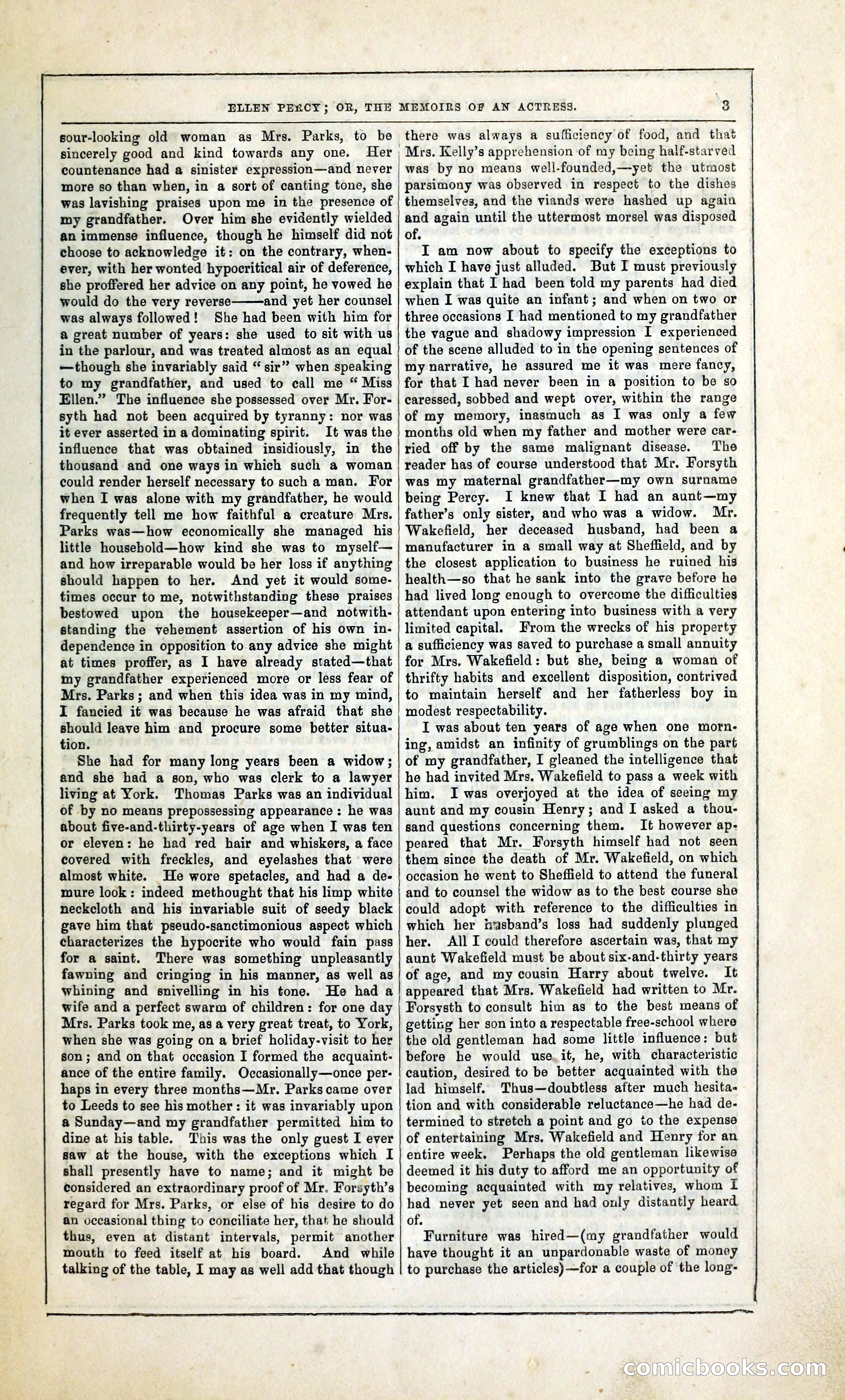
A restored page from Penny Dreadfuls, 1856. Page through the whole issue in the reader above.
📄 Transcribed text from this page (OCR, searchable)
Machine-transcribed from the original scan — historical spelling and the odd misread are preserved.
ELLEN PERCY; OR, THE MEMOIRS OF AN ACTRESS. 3 sour-looking old woman as Mrs. Parks, to be sincerely good and kind towards any one. Her countenance had a sinister expression—and never more so than when, in a sort of canting tone, she was lavishing praises upon me in the presence of my grandfather. Over him she evidently wielded an immense influence, though he himself did not choose to acknowledge it: on the contrary, when- ever, with her wonted hypocritical air of deference, she proffered her advice on any point, he vowed he would do the very reverse and yet her counsel was always followed! She had been with him for a great number of years: she used to sit with us in the parlour, and was treated almost as an equal —though she invariably said “ sir” when speaking to my grandfather, and used to call me “ Miss Ellen.” The influence she possessed over Mr. For- syth had not been acquired by tyranny: nor was it ever asserted in a dominating spirit. It was the influence that was obtained insidiously, in the thousand and one ways in which such a woman could render herself necessary to such a man. For when I was alone with my grandfather, he would frequently tell me how faithful a creature Mrs. Parks was—how economically she managed his little housebold—how kind she was to myself— and how irreparable would be her loss if anything should happen to her. And yet it would some- times occur to me, notwithstanding these praises bestowed upon the housekeeper—and notwith- standing the vehement assertion of his own in- dependence in opposition to any advice she might at times proffer, as I have already stated—that my grandfather experienced more or less fear of Mrs. Parks; and when this idea was in my mind, I fancied it was because he was afraid that she should leave him and procure some better situa- tion. She had for many long years been a widow; and she had a son, who was clerk to a lawyer living at York. Thomas Parks was an individual of by no means prepossessing appearance : he was about five-and-thirty-years of age when I was ten or eleven: he had red hair and whiskers, a face covered with freckles, and eyelashes that were almost white. He wore spetacles, and had a de- mure look: indeed methought that his limp white neckcloth and his invariable suit of seedy black gave him that pseudo-sanctimonious aspect which characterizes the hypocrite who would fain pass for a saint. There was something unpleasantly fawning and cringing in his manner, as well as whining and snivelling in his tone. He had a wife and a perfect swarm of children: for one day Mrs. Parks took me, as a very great treat, to York, when she was going on a brief holiday-visit to her son; and on that occasion I formed the acquaint- ance of the entire family. Occasionally—once per- haps in every three months—Mr. Parks came over to Leeds to see his mother: it was invariably upon a Sunday—and my grandfather permitted him to dine at his table. This was the only guest I ever saw at the house, with the exceptions which I shall presently have to name; and it might be considered an extraordinary proof of Mr. Forsyth’s regard for Mrs. Parks, or else of his desire to do an occasional thing to conciliate her, that he should thus, even at distant intervals, permit another mouth to feed itself at his board. And while talking of the table, I may as well add that though there was always a sufficiency of food, and that Mrs. Kelly’s apprehension of my being half-starved was by no means well-founded,—yet the utmost parsimony was observed in respect to the dishes themselves, and the viands were hashed up agaiu and again until the uttermost morsel was disposed of. I am now about to specify the exceptions to which I have just alluded. But I must previously explain that I had been told my parents had died when I was quite an infant; and when on two or three occasions I had mentioned to my grandfather the vague and shadowy impression I experienced of the scene alluded to in the opening sentences of my narrative, he assured me it was mere fancy, for that I had never been in a position to be so caressed, sobbed and wept over, within the range of my memory, inasmuch as I was only a few months old when my father and mother were car- ried off by the same malignant disease. The reader has of course understood that Mr. Forsyth was my maternal grandfather—my own surname being Percy. I knew that I had an aunt—my father’s only sister, and who was a widow. Mr. Wakefield, her deceased husband, had been a manufacturer in a small way at Sheffield, and by the closest application to business he ruined his health—so that he sank into the grave before he had lived long enough to overcome the difficulties attendant upon entering into business with a very limited capital. From the wrecks of his property a sufficiency was saved to purchase a small annuity for Mrs. Wakefield: but she, being a woman of thrifty habits and excellent disposition, contrived to maintain herself and her fatherless boy in modest respectability. I was about ten years of age when one morn- ing, amidst an infinity of grumblings on the part of my grandfather, I gleaned the intelligence that he had invited Mrs. Wakefield to pass a week with him. Iwas overjoyed at the idea of seeing my aunt and my cousin Henry; and I asked a thou- sand questions concerning them. It however ap- peared that Mr. Forsyth himself had not seen them since the death of Mr. Wakefield, on which occasion he went to Sheffield to attend the funeral and to counsel the widow as to the best course she could adopt with reference to the difficulties in which her Gasband’s loss had suddenly plunged her. All I could therefore ascertain was, that my aunt Wakefield must be about six-and-thirty years of age, and my cousin Harry about twelve. It appeared that Mrs. Wakefield had written to Mr. Forsysth to consult him as to the best means of getting her son into a respectable free-school where the old gentleman had some little influence: but before he would use.it, he, with characteristic caution, desired to be better acquainted with the lad himself. Thus—doubtless after much hesita- tion and with considerable reluctance—he had de- termined to stretch a point and go to the expense of entertaining Mrs. Wakefield and Henry for an entire week. Perhaps the old gentleman likewise deemed it his duty to afford me an opportunity of becoming acquainted with my relatives, whom I had never yet seen and had only distantly heard of. Furniture was hired—(my grandfather would have thought it an unpardonable waste of money to purchase the articles)-—for a couple of the long- eet cei lesnesemimasemmnnrmencetidedpeteeisehsottnas ug CSTE Opa GCoOmichoo <S Com