
Penny Dreadfuls, 1856 · page 155 of 399
Ellen Percy; or, The Memoirs of an Actress — page 155: what you’re looking at
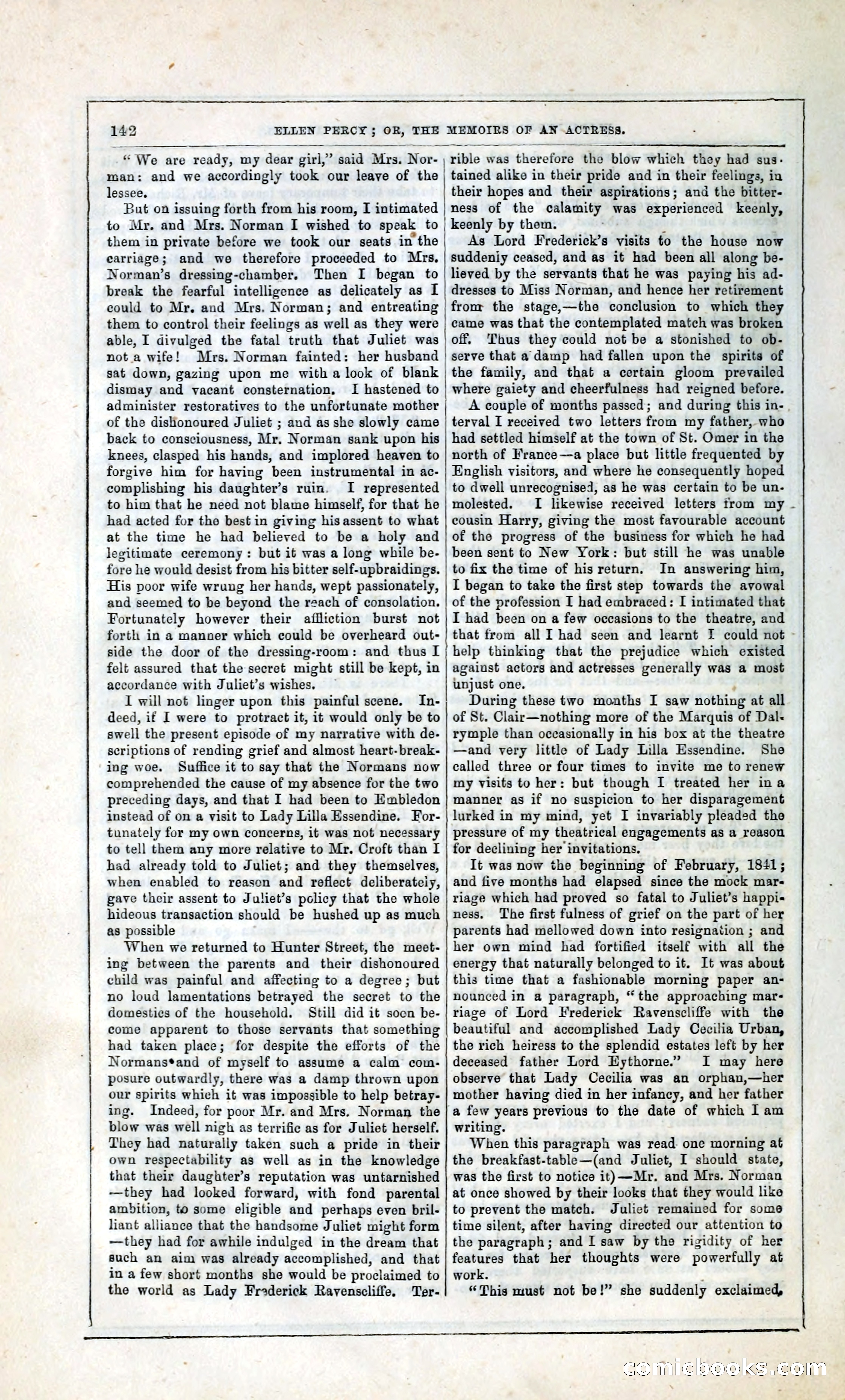
A restored page from Penny Dreadfuls, 1856. Page through the whole issue in the reader above.
📄 Transcribed text from this page (OCR, searchable)
Machine-transcribed from the original scan — historical spelling and the odd misread are preserved.
14:2 ELLEN PERCY ; OR, THE MEMOIRS OF AN ACTRESS. TT “ We are ready, my dear girl,” said. Miri Nor- | rible was therefore the blow which they had sus: man: and we accordingly took our leave of the | tained alike in their pride and in their feelings, iu lessee. their hopes and their aspirations; and the bitter- But on issuing forth from his room, I intimated | ness of the calamity, was experienced keenly, to Mr. and Mrs. Norman I wished to speak to | them in private before we took our seats in the carriage ; and we therefore proceeded to Mrs. Norman’s dressing-chamber. Then I began to break the fearful intelligence as delicately as I could to Mr, and Mrs. Norman; and entreating them to control their feelings as well as they were able, I divulged the fatal truth that Juliet was not a wife! Mrs. Norman fainted: her husband sat down, gazing upon me witha look of blank dismay and vacant consternation. I hastened to administer restoratives to the unfortunate mother of the dislionoured Juliet ; and as she slowly came back to consciousness, Mr, Norman sank upon his knees, clasped his hands, and implored heaven to forgive him for having been instrumental in ac- complishing his daughter’s ruin. I represented to him that he need not blame himself, for that he had acted for the best in giving his assent to what at the time he had believed to be a holy and legitimate ceremony: but it was a long while be- fore he would desist from his bitter self-upbraidings. His poor wife wrung her hands, wept passionately, and seemed to be beyond the reach of consolation. Fortunately however their affliction burst not forth in a manner which could be overheard out- side the door of the dressing-room: and thus I felt assured that the secret might still be kept, in accordance with Juliet’s wishes. — I will not linger upon this painful scene. ‘In- deed, if I were to protract it, it would only be to swell the present episode of my narrative with de- scriptions of rending grief and almost heart-break- ing woe. Suffice it to say that the Normans now comprehended the cause of my absence for the two preceding days, and that I had been to Embledon instead of on a visit to Lady Lilla Essendine. For- tunately for my own concerns, it was not necessary to tell them any more relative to Mr. Croft than I had already told to Juliet; and they themselves, when enabled to reason and reflect deliberateiy, gave their assent to Juliet’s policy that the whole hideous transaction should be hushed up as much as possible When we returned to Hunter Street, the meet- ing between the parents and their dishonoured child was painful and affecting to a degree; but no loud lamentations betrayed the secret to the domestics of the household. Stiil did it soon be- come apparent to those servants that something had taken place; for despite the efforts of the Normans*and of myself to assume a calm com- posure outwardly, there was a damp thrown upon our spirits which it was impossible to help betray- ing. Indeed, for poor Mr. and Mrs. Norman the blow was well nigh as terrific as for Juliet herself. They had naturally taken such a pride in their own respectability as well as in the knowledge that their daughter’s reputation was untarnished —they had looked forward, with fond parental ambition, to some eligible and perhaps even bril- liant alliance that the handsome Juliet might form —they had for awhile indulged in the dream that such an aim was already accomplished, and that in a few short months she would be proclaimed to the world as Lady Fraderick Ravenscliffe. Ter- keenly by them. As Lord Frederick’s visits to the house now suddeniy ceased, and as it had been all along be- lieved by the servants that he was paying his ad- dresses to Miss Norman, and hence her retirement fronr the stage,—the conclusion to which they came was that the contemplated match was broken off. Thus they could not be a stonished to ob- serve that a damp had fallen upon the spirits of the family, and that a certain gloom prevailed where gaiety and cheerfulness had reigned before. A couple of months passed; and during this in- | terval I received two letters from my father, who had settled himself at the town of St. Omer in the north of France—a place but little frequented by English visitors, and where he consequently hoped to dwell unrecognised, as he was certain to be un- molested. [I likewise received letters trom my cousin Harry, giving the most favourable account of the progress of the business for which he had been sent to New York: but still he was unable to fix the time of his return. In answering him, I began to take the first step towards the avowal of the profession I had embraced: I[ intimated that I had been on a few occasions to the theatre, and that from all I had seen and learnt I could not - help thinking that the prejudice which existed against actors and actresses generally was a most unjust one. During these two months I saw nothing at all of St. Clair—nothing more of the Marquis of Dal~ rymple than occasionally in his box at the theatre —and very little of Lady Lilla Essendine. She called three or four times to invite me to renew my visits to her: but though I treated her ina manner as if no suspicion to her disparagement lurked in my mind, yet I invariably pleaded the pressure of my theatrical engagements as a reason for declining her invitations. It was now the beginning of February, 1841; and five months had elapsed since the mock mar- riage which had proved so fatal to Juliet’s happi- ness. The first fulness of grief on the part of her parents had mellowed down into resignation ; and her own mind had fortified itself with all the energy that naturally belonged to it. It was about this time that a fashionable morning paper an- nounced in a paragraph, “the approaching mar- riage of Lord Frederick Ravenscliffe with the beautiful and accomplished Lady Cecilia Urban, the rich heiress to the splendid estates left by her deceased father Lord Eythorne.” I may here observe that Lady Cecilia was an orphan,—her mother having died in her infancy, and her father a few years previous to the date of which Lam writing. When this paragraph was read one morning at the breakfast-table—(and Juliet, I should state, was the first to notice it)—Mr. and Mrs. Norman at once showed by their looks that they would like to prevent the match. Juliet remained for some time silent, after having directed our attention to the paragraph; and I saw by the rigidity of her features that her thoughts were powerfully at work. “This must not be!” she suddenly exclaimed, ElNOOKS COM com