
Penny Dreadfuls, 1856 · page 148 of 399
Ellen Percy; or, The Memoirs of an Actress — page 148: what you’re looking at
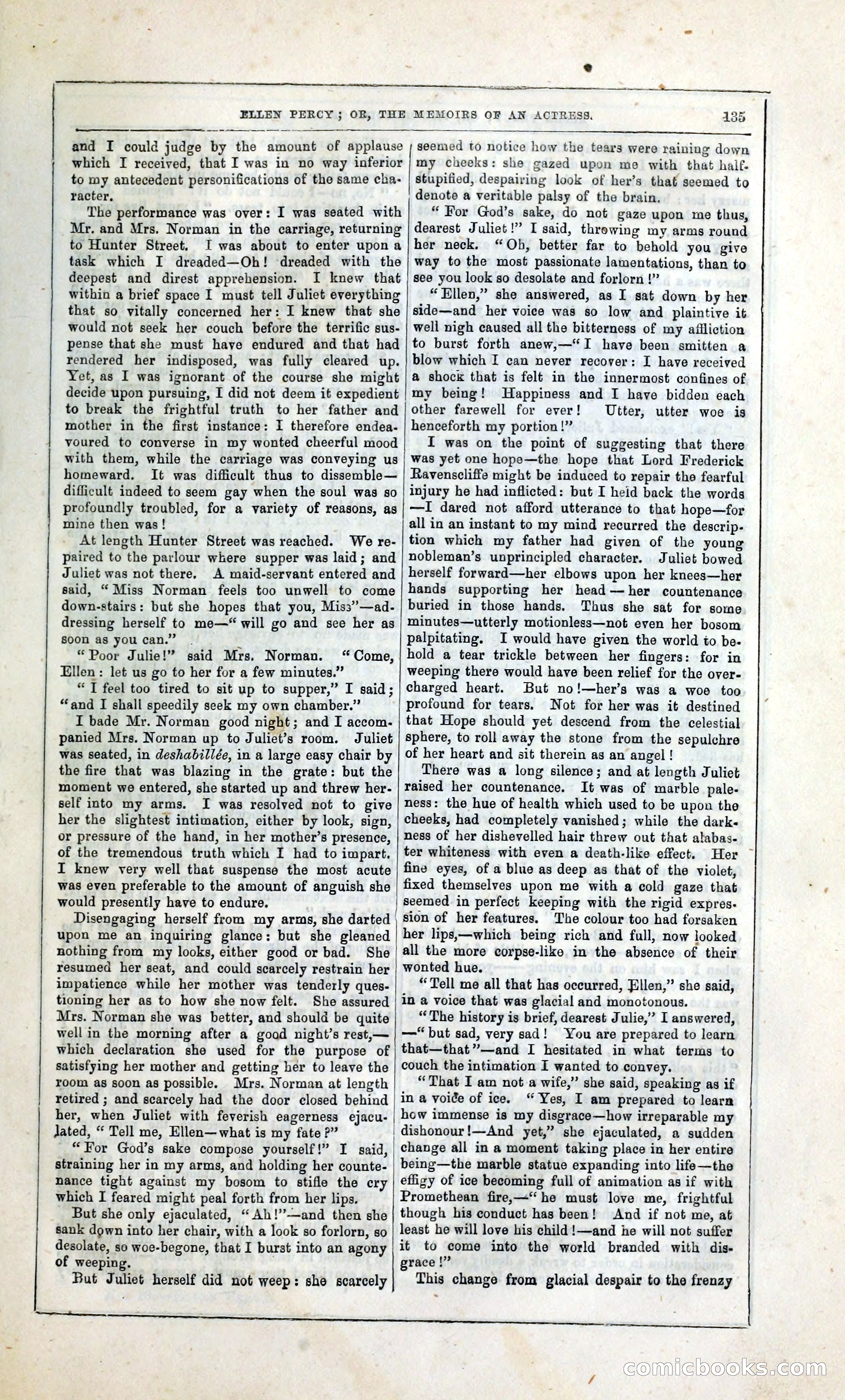
A restored page from Penny Dreadfuls, 1856. Page through the whole issue in the reader above.
📄 Transcribed text from this page (OCR, searchable)
Machine-transcribed from the original scan — historical spelling and the odd misread are preserved.
ELLEN PERCY ; OR, THE MEMOIRS OF AN ACTRESS. Ra EE RE oS OR 8 ee ad lee —— — ee + and I could judge by the amount of applause which I received, that I was in no way inferior to my antecedent personifications of the same cha- racter, The performance was over: I was seated with Mr, and Mrs. Norman in the carriage, returning to Hunter Street. I was about to enter upona task which I dreaded—Oh! dreaded with the deepest and direst apprehension. I knew that within a brief space I must tell Juliet everything that so vitally concerned her: I knew that she would not seek her couch before the terrific sus- pense that she must haye endured and that had rendered her indisposed, was fully cleared up. Yet, as I was ignorant of the course she might decide upon pursuing, I did not deem it expedient to break the frightful truth to her father and mother in the first instance: I therefore endea- voured to converse in my wonted cheerful mood with them, while the carriage was conveying us homeward. It was difficult thus to dissemble— difficult indeed to seem gay when the soul was so profoundly troubled, for a variety of reasons, as mine then was! At length Hunter Street was reached. We re- paired to the parlour where supper was laid; and Juliet was not there, A maid-servant entered and said, “ Miss Norman feels too unwell to come down-stairs: but she hopes that you, Mis3”—ad- dressing herself to me—* will go and see her as soon as youcan.” . i “Poor Julie!” said Mrs, Norman. “Come, Ellen: let us go to her for a few minutes.” “I feel too tired to sit up to supper,” I said; “and I shall speedily seek my own chamber.” I bade Mr. Norman good night; and I accom. panied Mrs. Norman up to Juliet’s room. Juliet was seated, in deshabillée, in a large easy chair by the fire that was blazing in the grate: but the moment we entered, she started up and threw her- self into my arms. I was resolved not to give her the slightest intimation, either by look, sign, or pressure of the hand, in her mother’s presence, of the tremendous truth which I had to impart. I knew very well that suspense the most acute was even preferable to the amount of anguish she would presently have to endure. Disengaging herself from my arms, she darted upon me an inquiring glance: but she gleaned nothing from my looks, either good or bad. She resumed her seat, and could scarcely restrain her impatience while her mother was tenderly ques- tioning her as to how she now felt. She assured Mrs. Norman she was better, and should be quite well in the morning after a goad night’s rest,— which declaration she used for the purpose of satisfying her mother and getting her to leave the room as soon as possible. Mrs. Norman at length retired ; and scarcely had the door closed behind her, when Juliet with feverish eagerness ejacu- dated, “ Tell me, Ellen—what is my fate ?” “For God’s sake compose yourself!” I said, straining her in my arms, and holding her counte- nance tight against my bosom to stifle the cry which I feared might peal forth from her lips. But she only ejaculated, “Ah!”—and then she sank down into her chair, with a look so forlorn, so desolate, so woe-begone, that I burst into an agony of weeping. But Juliet herself did not weep: she scarcely 135 seemed to notice how the tears were raining down my cheeks: she gazed upon me with that half. stupified, despairing look of her’s that seemed to denote a veritable palsy of the brain, “ For God’s sake, do not gaze upon me thus, dearest Juliet!” I said, threwing my arms round her neck. “Ob, better far to behold you give way to the most passionate lamentations, than to see you look so desolate and forlorn !” “llen,” she answered, as I sat down by her side—and her voice was so low and plaintive it well nigh caused all the bitterness of my affliction to burst forth anew,—*I have been smitten a blow which I can never recover: I have received & shock that is felt in the innermost confines of my being! Happiness and I have bidden each other farewell for ever! Utter, utter woe is henceforth my portion !” I was on the point of suggesting that there was yet one hope—the hope that Lord Frederick Ravenscliffe might be induced to repair the fearful injury he had inflicted: but I heid back the words —I dared not afford utterance to that hope—for all in an instant to my mind recurred the descrip. tion which my father had given of the young nobleman’s unprincipled character. Juliet bowed herself forward—her elbows upon her knees—her hands supporting her head —her countenance buried in those hands. Thus she sat for some minutes—utterly motionless—not even her bosom palpitating. I would have given the world io be- hold a tear trickle between her fingers: for in weeping there would have been relief for the over- charged heart. But no!—her’s was a woe too profound for tears. Not for her was it destined that Hope should yet descend from the celestial sphere, to roll away the stone from the sepulchre of her heart and sit therein as an angel ! There was a long silence; and at length Juliet raised her countenance. It was of marble pale- ness: the hue of health which used to be upon the cheeks, had completely vanished; while the dark-« ness of her dishevelled hair threw out that alabas- ter whiteness with even a death-like effect. fine eyes, of a blue as deep as that of the violet, fixed themselves upon me with a cold gaze that seemed in perfect keeping with the rigid expres. sion of her features. The colour too had forsaken her lips,—which being rich and full, now looked all the more corpse-like in the absence of their wonted hue. “Tell me all that has occurred, Ellen,” she said, in a voice that was glacial and monotonous. “The history is brief, dearest Julie,” I answered, —“but sad, very sad! You are prepared to learn that—that”’—and I hesitated in what terms to couch the intimation I wanted to convey. “That I am not a wife,” she said, speaking as if in a voice of ice. “Yes, I am prepared to learn how immense is my disgrace—how irreparable my dishonour!—And yet,” she ejaculated, a sudden change all in a moment taking place in her entire being—the marble statue expanding into life—the effigy of ice becoming full of animation as if with Promethean fire,—‘ he must love me, frightful though his conduct has been! And if not me, at least he will love his child!—and he will not suffer it to come into the world branded with dis- grace |” This change from glacial despair to the frenzy a Her — Com 0)(0) <S Com