
Penny Dreadfuls, 1856 · page 131 of 399
Ellen Percy; or, The Memoirs of an Actress — page 131: what you’re looking at
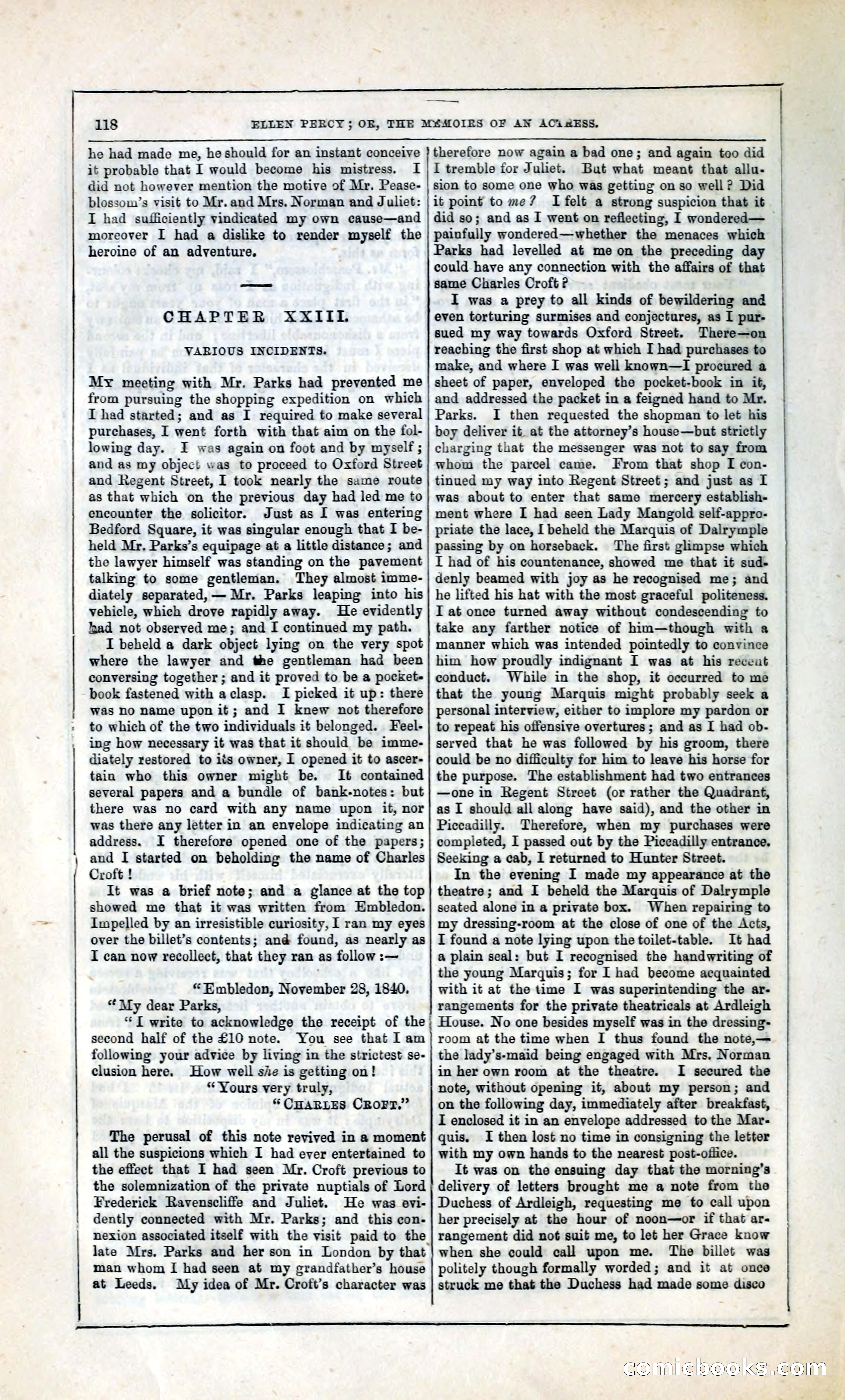
A restored page from Penny Dreadfuls, 1856. Page through the whole issue in the reader above.
📄 Transcribed text from this page (OCR, searchable)
Machine-transcribed from the original scan — historical spelling and the odd misread are preserved.
118 Si: ELLEN PERCY; OR, THE M¥MI0IRS OF AN ACiESS. he had made me, he should for an instant conceive it probable that I would become his mistress. I did not however mention the motive of Mr. Pease- blossom’s visit to Mr. and Mrs. Norman and Juliet: I had sufficiently vindicated my own cause—and moreover I had a dislike to render myself the heroine of an adventure. CHAPTER XXIIL VARIOUS INCIDENTS. My meeting with Mr. Parks had prevented me from pursuing the shopping expedition on which I had started; and as I required to make several purchases, I went forth with that aim on the fol- lowing day. I was again on foot and by myself ; and as my object was to proceed to Oxford Street and Regent Street, 1 took nearly the same route as that which on the previous day had led me to encounter the solicitor. Just as I was entering Bedford Square, it was singular enough that I be- held Mr. Parks’s equipage at a little distance; and the lawyer himself was standing on the pavement talking to some gentleman. They almost imme- diately separated, — Mr. Parks leaping into his vehicle, which drove rapidly away. He evidently kad not observed me; and I continued my path. I beheld a dark object lying on the very spot where the lawyer and the gentleman had been conversing together ; and it proved to be a pocket- book fastened with aclasp. I picked it up: there was no name upon it; and I knew not therefore to which of the two individuals it belonged. Feel- ing how necessary it was that it should be imme- diately restored to its owner, I opened it to ascer- tain who this owner might be. It contained several papers and a bundle of bank-notes: but there was no card with any name upon if, nor was there any letter in an envelope indicating an address. I therefore opened one of the papers; and I started on beholding the name of Charles Croft ! It was a brief note; and a glance at the top showed me that it was written from Embledon. Impelled by an irresistible curiosity, I ran my eyes over the billet’s contents; and found, as nearly as I can now recollect, that they ran as follow :— *Embledon, November 28, 1840, “ My dear Parks, therefore now again a bad one; and again too did I tremble for Juliet. But what meant that allu- sion to some one who was getting on so well? Did it point to me? I felt a strong suspicion that it did so; and as I went on reflecting, I wondered— painfully wondered—whether the menaces which Parks had levelled at meon the preceding day could have any connection with the affairs of that same Charles Croft? I was a prey to all kinds of bewildering and even torturing surmises and conjectures, as I pur- sued my way towards Oxford Street. There—on reaching the first shop at which I had purchases to make, and where I was well known—I procured a sheet of paper, enveloped the pocket-book in if, and addressed the packet in a feigned hand to Mr. Parks. I then requested the shopman to let his boy deliver it at the attorney’s house—but strictly charging that the messenger was not to say from whom the parcel came. From that shop I con- tinued my way into Regent Street; and just as I was about to enter that same mercery establish- ment where I had seen Lady Mangold self-appro- priate the lace, I beheld the Marquis of Dalrymple passing by on horseback. The first glimpse which I had of his countenance, showed me that it sud- denly beamed with joy as he recognised me; and he lifted his hat with the most graceful politeness. I at once turned away without condescending to take any farther notice of him—though with a manner which was intended pointedly to convince him how proudly indignant I was at his recent conduct. While in the shop, it occurred to me that the young Marquis might probably seek a personal interview, either to implore my pardon or to repeat his offensive overtures; and as I had ob- served that he was followed by his groom, there could be no difficulty for him to leave his horse for the purpose. The establishment had two entrances —one in Regent Street (or rather the Quadrant, as I should all along have said), and the other in Piccadilly. Therefore, when my purchases were completed, I passed out by the Piccadilly entrance. Seeking a cab, I returned to Hunter Street. In the evening I made my appearance at the theatre; and I beheld the Marquis of Dalrymple seated alone in a private box. When repairing to my dressing-room at the close of one of the Acts, I found a note lying upon the toilet-table. It had a plain seal: but I recognised the handwriting of the young Marquis; for I had become acquainted with it at the time I was superintending the ar- rangements for the private theatricals at Ardleigh “I write to acknowledge the receipt of the; House. No one besides myself was in the dressing- second half of the £10 note. You see that lam following your advice by living in the strictest se- clusion here. How well she is getting on! “Yours very truly, “CHARLES CROFT.” The perusal of this note revived in a moment all the suspicions which I had ever entertained to the effect that I had seen Mr. Croft previous to the solemnization of the private nuptials of Lord Frederick Ravenscliffe and Juliet. He was evi- dently connected with Mr. Parks; and this con- nexion associated itself with the visit paid to the late Mrs. Parks and her son in London by that man whom I had seen at my grandfather’s house at Leeds. My idea of Mr. Croft’s character was room at the time when I thus found the note,— the lady’s-maid being engaged with Mrs, Norman in her own room at the theatre. I secured the note, without opening it, about my person; and on the following day, immediately after breakfast, I enclosed it in an envelope addressed to the Mar- quis. I then lost no time in consigning the letter with my own hands to the nearest post-oflice. It was on the ensuing day that the morning’s delivery of letters brought me a note from the Duchess of Ardleigh, requesting me to call upon her precisely at the hour of noon—or if that ar- rangement did not suit me, to let her Grace know when she could call n me. The billet was politely though formally worded; and it at once struck me that the Duchess had made some disco CONMIEDIOOKS ———— LBL, com