
Penny Dreadfuls, 1856 · page 116 of 399
Ellen Percy; or, The Memoirs of an Actress — page 116: what you’re looking at
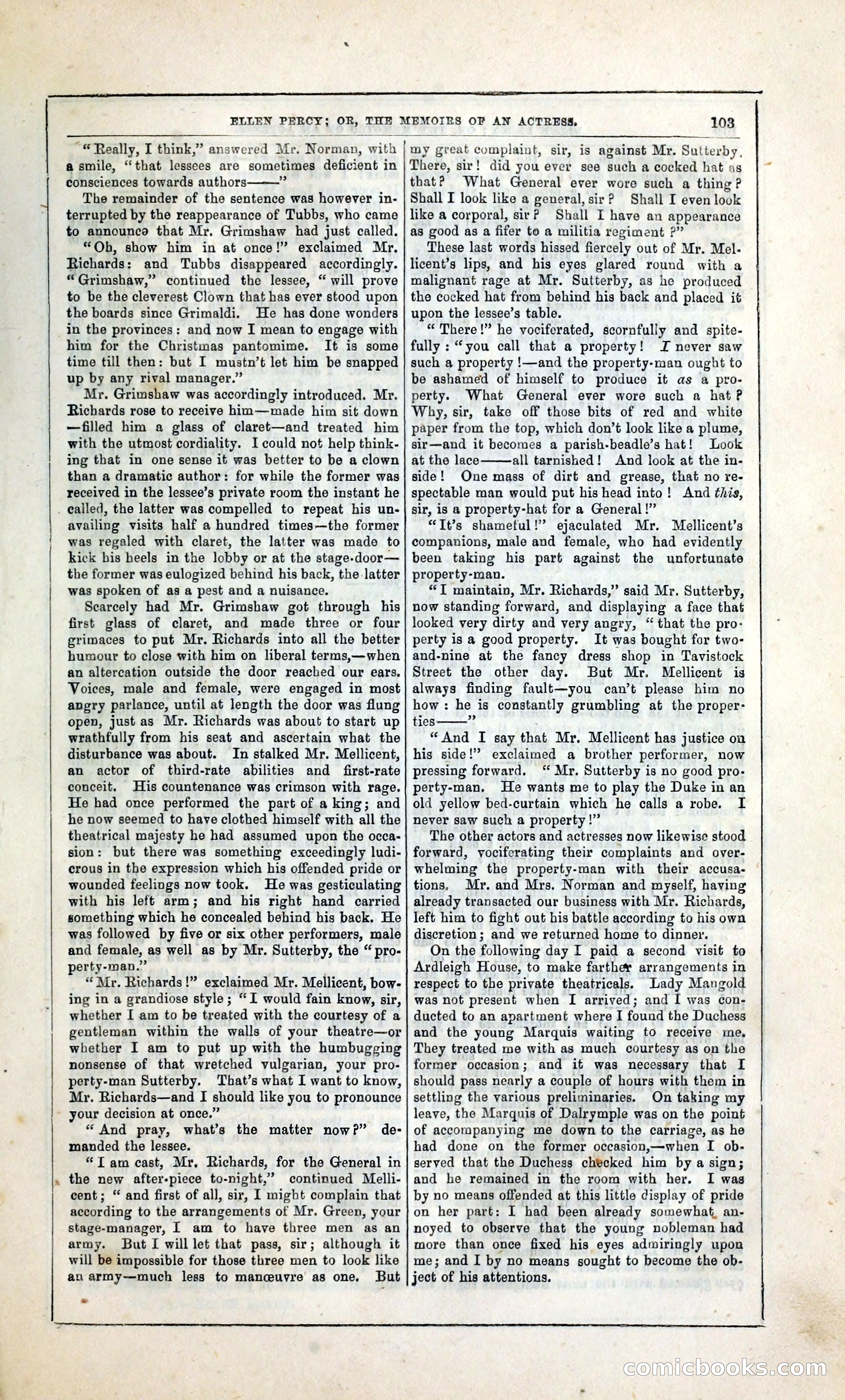
A restored page from Penny Dreadfuls, 1856. Page through the whole issue in the reader above.
📄 Transcribed text from this page (OCR, searchable)
Machine-transcribed from the original scan — historical spelling and the odd misread are preserved.
epee fetes A gC SS ELLEN PERCY; OR, THE MEMOIRS OF AN ACTRESS, “© Really, I think,” answered Mr. Norman, with a smile, “that lessees are sometimes deficient in consciences towards authors - The remainder of the sentence was however in- terrupted by the reappearance of Tubbs, who came to announce that Mr. Grimshaw had just called. * Ob, show him in at once!” exclaimed Mr. Richards: and Tubbs disappeared accordingly. “Grimshaw,” continued the lessee, “ will prove to be the cleverest Clown that has ever stood upon the boards since Grimaldi. He has done wonders in the provinces: and now I mean to engage with him for the Christmas pantomime. It is some time till then: but I mustn’t let him be snapped up by any rival manager.” Mr. Grimshaw was accordingly introduced. Mr. Richards rose to receive him—made him sit down —filled him a glass of claret—and treated him with the utmost cordiality. I could not help think- ing that in one sense it was better to be a clown than a dramatic author: for while the former was received in the lessee’s private room the instant he . ealled, the latter was compelled to repeat his un- availing visits half a hundred times—the former was regaled with claret, the latter was made to kick bis heels in the lobby or at the stage-door— the former was eulogized behind his back, the latter was spoken of as a pest and a nuisance. Searcely had Mr. Grimshaw got through his first glass of claret, and made three or four grimaces to put Mr. Richards into all the better humour to close with him on liberal terms,—when an altercation outside the door reached our ears. Voices, male and female, were engaged in most angry parlance, until at length the door was flung open, just as Mr. Richards was about to start up wrathfully from his seat and ascertain what the disturbance was about. In stalked Mr. Mellicent, an actor of third-rate abilities and first-rate conceit. His countenance was crimson with rage. He had once performed the part of a king; and he now seemed to have clothed himself with all the theatrical majesty he had assumed upon the occa- sion: but there was something exceedingly ludi- crous in the expression which his offended pride or wounded feelings now took. He was gesticulating with his left arm; and his right hand carried something which he concealed behind his back. He was followed by five or six other performers, male and female, as well as by Mr. Sutterby, the “ pro- perty-man.” é * Mr. Richards!” exclaimed Mr. Mellicent, bow- ing in a grandiose style; “I would fain know, sir, whether I am to be treated with the courtesy of a gentleman within the walls of your theatre—or whether I am to put up with the humbugging nonsense of that wretched vulgarian, your pro- perty-man Sutterby. That’s what I want to know, Mr. Richards—and I should like you to pronounce your decision at once.” “ And pray, what’s the matter now P” manded the lessee. “Tam cast, Mr, Richards, for the General in the new after-piece to-night,’ continued Melli- cent; “ and first of all, sir, 1 might complain that according to the arrangements of Mr. Green, your stage-manager, I am to have three men as an army. But I will let that pass, sir; although it will be impossible for those three men to look like an army—much less to manceuyre as one, But de- ) 5 . my great complaint, 103 sir, is against Mr. Sutterby, There, sir! did you ever see such a cocked hat as that? What General ever wore such a thing? Shall I look like a general, sir? Shall I even look like a corporal, sir? Shall I have an appearance as good as a fifer to a militia regiment ?” These last words hissed fiercely out of Mr. Mel. licent’s lips, and his eyes glared round with a malignant rage at Mr. Sutterby, as he produced the cocked hat from behind his back and placed it upon the lessee’s table. “ There!” he vociferated, scornfully and spite- fully : “you call that a property! TJ never saw such a property !—and the property-man ought to be ashamed of himself to produce it as a pro- perty. What General ever wore such a hat? Why, sir, take off those bits of red and white paper from the top, which don’t look like a plume, sir—and it becomes a parish-beadle’s hat! Look at the lace all tarnished! And look at the in- side! One mass of dirt and grease, that no re- spectable man would put his head into! And this, sir, is a property-hat for a General !” “Tt’s shameful!” ejaculated Mr. Mellicent’s companions, male and female, who had evidently been taking his part against the unfortunate property-man. “JT maintain, Mr. Richards,” said Mr. Sutterby, now standing forward, and displaying a face that looked very dirty and very angry, “ that the pro- perty is a good property. It was bought for two- and-nine at the fancy dress shop in Tavistock Street the other day. But Mr. Mellicent is always finding fault—you can’t please him no how: he is constantly grumbling at the proper- ties * “And I say that Mr, Mellicent has justice on his side!” exclaimed a brother performer, now pressing forward. ‘“ Mr. Sutterby is no good pro- perty-man. He wants me to play the Duke in an old yellow bed-curtain which he calls a robe. I never saw such a property !” The other actors and actresses now likewise stood forward, vociferating their complaints and over- whelming the property-man with their accusa- tions. Mr. and Mrs. Norman and myself, having already transacted our business with Mr. Richards, left him to fight out his battle according to his own discretion ; and we returned home to dinner. On the following day I paid a second visit to Ardleigh House, to make farther arrangements in respect to the private theatricals. Lady Mangold was not present when I arrived; and I was con- ducted to an apartment where I found the Duchess and the young Marquis waiting to receive me, They treated me with as much courtesy as on the former occasion; and it was necessary that I should pass nearly a couple of hours with them in settling the various preliminaries. On taking my leave, the Marquis of Dalrymple was on the point of accompanying me down to the carriage, as he had done on the former occasion,—when I ob- served that the Duchess checked him by a sign; and he remained in the room with her. I was by no means offended at this little display of pride on her part: I had been already somewhat, an- noyed to observe that the young nobleman had more than once fixed his eyes admiringly upon me; and I by no means sought to become the ob- ject of his attentions. Com .OOkK (ECON