
Penny Dreadfuls, 1865 · page 87 of 400
Agnes: A Tale of the Streets — page 87: what you’re looking at
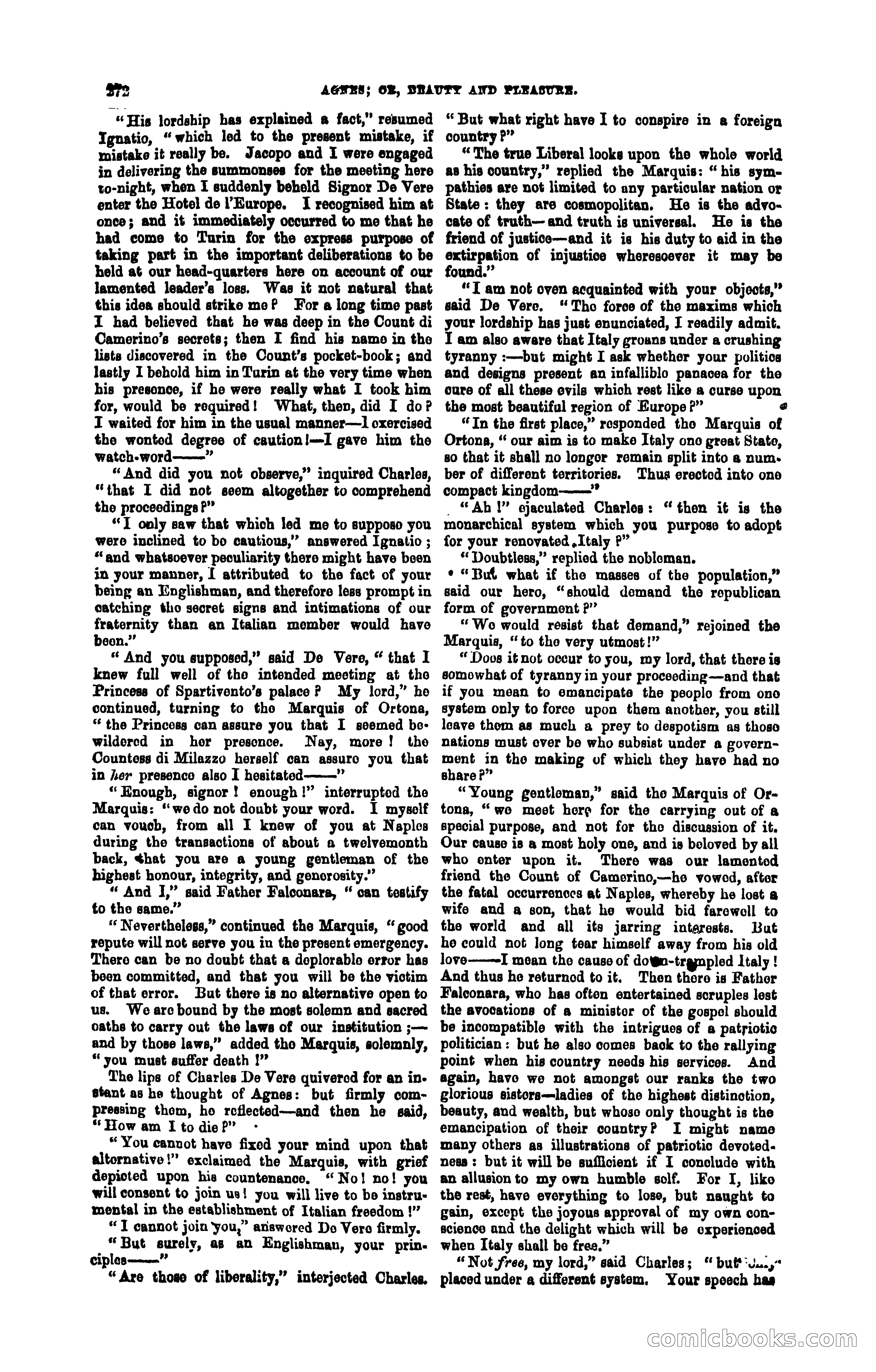
A restored page from Penny Dreadfuls, 1865. Page through the whole issue in the reader above.
📄 Transcribed text from this page (OCR, searchable)
Machine-transcribed from the original scan — historical spelling and the odd misread are preserved.
a2 “His lordship bas explained a fact,” resumed Ignatio, “which led to the present mistake, if ywistake it really be. Jacopo and I were engaged in delivering the summonses for the meeting here to-night, when I suddenly beheld Signor De Vere enter the Hotel de l'Europe. I recognised him at once; and it immediately occurred to me that he had come to Turin for the oxpress purpose of taking part in the important deliberations to be held a¢ our head-quarters here on account of our lamented leader’s loss. Was it not natural that this idea should strike mo? For a long time past I had believed that he was deep in the Count di Camerino’s secrets; then I find his namo in the lists diacovered in the Count’s pocket-book; and lastly I behold him in Turin at the very time when his presence, if he were really what I took him for, would be required! What, then, did I do? I waited for him in the usual manner—1 oxercised the wonted degree of caution!—I gave him tho watch-word-———” “And did you not observe,” inquired Charles, “that I did not seem altogether to comprehend the proceedings P” “JT only saw that which led me to supposo you wero inclined to bo cautious,” answered Ignatio ; “and whatsoever peculiarity there might have been in your manner, I attributed to the fact of your being an Englishman, and therefore less prompt in catching tho secret signe and intimations of our fraternity than an Italian member would have been.” “ And you supposed,” said De Vere, “ that I knew full well of the intended mecting at the Princess of Spartivento’s palace? My lord,” he continued, turning to tho Marquis of Ortona, “ the Princess can assure you that I seemed be- wildered in her presonce. Nay, more! tho Countess di Milazzo herself can assuro you that in her presence also I hesitated—”’ “Enough, signor! enough!” interrupted the Marquis: “wedo not doubt your word. I myself can vouch, from all I knew of you at Naples during the transactions of about a twelvemonth back, ¢hat you are a young gentleman of the highest honour, integrity, and genorosity.” “ And J,” said Father Falconars, “ can testify to the same.” “ Nevertheless,” continued the Marquis, “ good repute will not serve you in the present emergency. There can be no doubt that a deplorablo error has been committed, and that you will be the victim of that error. Gut there is no alternative open to us. Weare bound by the most solemn and sacred oaths to carry out the laws of our institution ;— and by those laws,” added tho Marquis, solemnly, * you must suffer death !’ The lips of Charles De Vere quivered for an in- stant as he thought of Agnes: but firmly com- pressing them, hoe reflected—and then he said, ** How am I to die ?” “You cannot have fixed your mind upon that alternative!” exclaimed the Marquis, with grief depicted upon his countenance. “No! no! you will consent to join us! you will live to be instru- mental in the establishment of Italian freedom !’ “TI cannot join you,” anewored Do Vere firmly. “But surely, as an Englishman, your prin- ciples————”” “Are those of liberality,” interjected Charles. AGFES; OF, DRAVTY ANY PLEASURE. “ But what right have I to conspire in a foreign country P” * The true Liberal looks upon the whole world as his country,” replied the Marquis: “his sym- pathies are not limited to any particular nation or State: they are cosmopolitan. He is the advo- cate of truth—and truth is universal. He is the friend of justico—and it is his duty to aid in the extirpation of injustice wheresoever it may be found.” “Tam not oven acquainted with your objects,” said De Vere. “Tho force of the maxims which your lordship has just enunciated, I readily admit. TI am also aware that Italy groans under a crushing tyranny :—but might I ask whether your politics and designs present an infalliblo panacea for tho cure of all these evils which rest like a curse upon the most beautiful region of Europe ?” @ “In the first place,” responded tho Marquis of Ortona, “ our aim is to make Italy ono great State, so that it shall no longor remain split into a num. ber of different territories. Thus erectod into ono compact kingdom——~” _ “Ab!” ejaculated Charles: “then it is the monarchical system which you purpose to adopt for your renovated ,Italy ?” * Doubtless,” replied the nobleman. ¢ “But what if the masses of the population,” said our hero, “should demand the republican form of government ?” “Wo would resist that demand,” rejoined the Marquis, “to the very utmost!” Dovs if not occur to you, my lord, that there is somowhat of tyranny in your proceeding—and that if you mean to emancipate the peoplo from ono system only to force upon them another, you still leave thom as much a prey to despotism as thoso nations must ever be who subsist under a govern- ment in tho making of which they have had no share ?” “Young gentloman,” said the Marquis of Or- tona, “we meet here for the carrying out of a especial purpose, and not for the discussion of it. Our cause is a most holy one, and is beloved by all who onter upon it. There was our lamentod friend the Count of Camerino,—ho yowed, after the fatal occurrences at Naples, whereby he lost a wife and a son, that he would bid farewell to the world and all its jarring intgrests. Lut he could not Jong tear himself away from his old love—~I mean the cause of dogn-trgmpled Italy ! And thus he returnod to it. Then there is Fathor Falconara, who has often entertained scruples lest the avocations of a minister of the gospel should be incompatible with the intrigues of a patriotic politician: but he also comes back to the rallying point when his country needs his servicos. And again, have we not amongst our ranks the two glorious sisters—ladies of the highest distinction, beauty, and wealth, but whoso only thought is the emancipation of their country? I might name many others as illustrations of patriotic devoted. ness: but it will be sufficient if I conclude with an allusion to my own humble solf. For I, liko the rest, have everything to lose, but naught to gain, except the joyous approval of my own con- science and the delight which will be experienced when Italy shall be free.” “Not free, my lord,” said Charles; “ but**vu.,* placed under a different system. Your speech has oO MIKGOO CO S CO