
Penny Dreadfuls, 1865 · page 49 of 400
Agnes: A Tale of the Streets — page 49: what you’re looking at
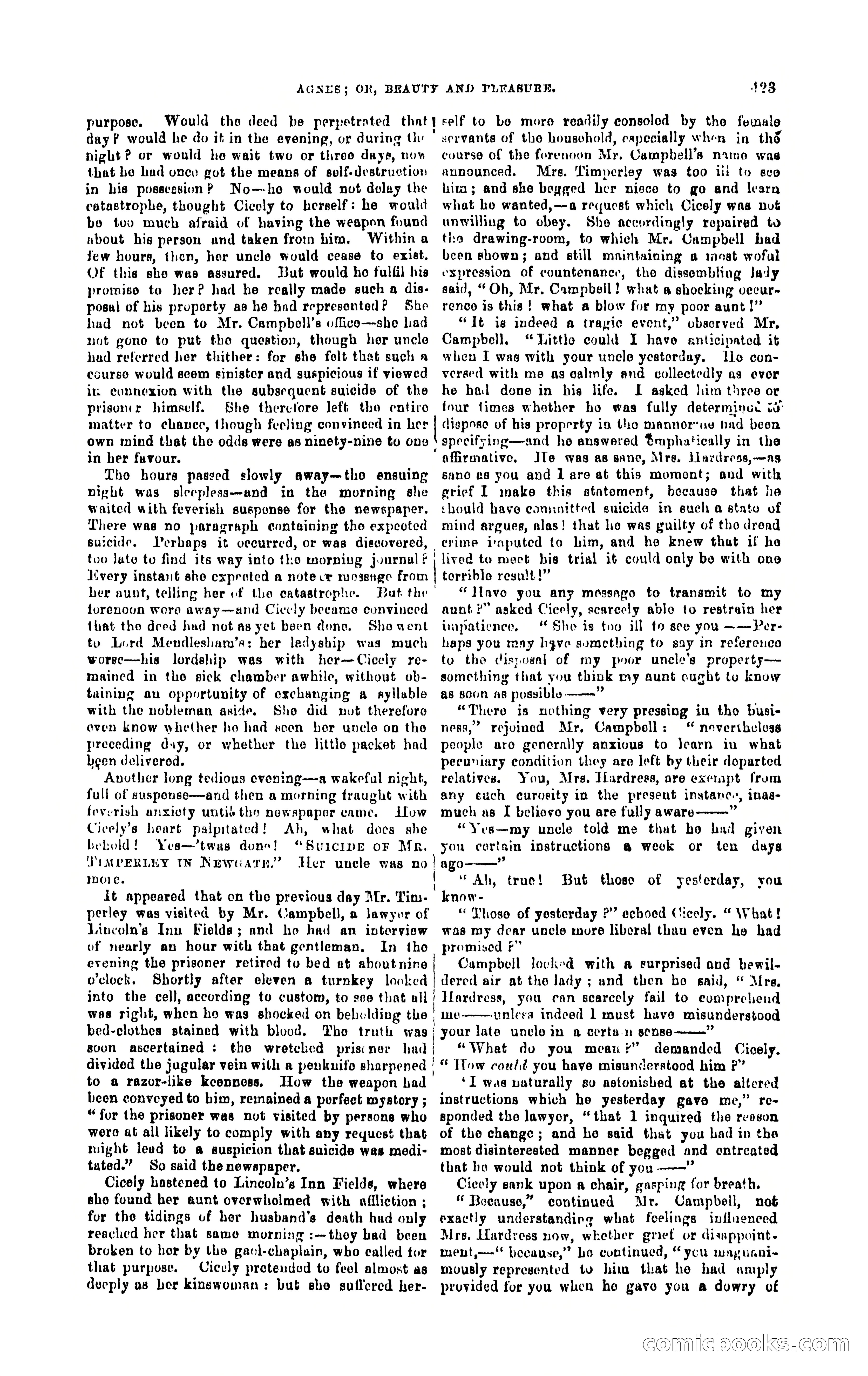
A restored page from Penny Dreadfuls, 1865. Page through the whole issue in the reader above.
📄 Transcribed text from this page (OCR, searchable)
Machine-transcribed from the original scan — historical spelling and the odd misread are preserved.
AGNIS; OR, BEAUTY AND PLEASURE. purpose. day P would he do it in the evening, or during ty night? or would he wait two or threo days, nov that bo had once got the means of self-destruction in his possession? No—ho would not dolay the catastrophe, thought Cicoly to herself: he would bo tov much afraid of having the weapon found rbout his person and taken from him. Within a few hours, then, her uncle would cease to exist. Of this she was assured. But would ho fulfil his promise to her? had he really made such ao dis- posal of his proporty as he had represented? She had not been to Mr. Campbell’s offico—she had not gono to put the question, though her uncle had referred her thither: for she folt thet such a ccurso would seem sinister and suspicious if viewed in connexion with the subsequent suicide of the prisoner himself. She therctore left the cntiro matter to chance, though fecling convinced in her own mind that tho odds were as ninety-nine to one ' in her favour. Tho hours passed slowly away~—tho ensuing night was sleepless—and in the morning she waited with feverish susponse for the newspaper. There was no paragraph containing the expeoted su:cide, Perhaps it occurred, or was discovered, too Jate to find its way into the morning journal f Jivery instant sho expected a note ce messnge from her aunt, telling her of the catastrophe. forenoun wore away—and Ciccly became convinecd that the deed had not as yet been done. Sho went ov Lurd Mendiesharo’s: her ladyship was much worse—his lordship was with her—Cicely re- mained in the sick chamber awhile, without ob- tuining an opportunity of exchanging a syllable with the nobleman aside. She did nut therefore even know wiether he had scen her uncle on the preceding duy, or whether the littl packet had been delivered. Anvther long tedious evening—a wakeful nicht, full of euspense—and then a morning fraught with feverish anxicty untis the newspaper came. Ilow Cicely’s heart palpitated! Ah, what docs she behold! Yes-—’twas done! “Suicipe oF Mr, an VEIMPERLEY IN Neweaatr.” it appeared that on tho previous day Mr. 'Tim- perley was visited by Mr. Campbell, a Jawyer of Lincoln's Inn Fields; and ho had an interview of nearly an hour with that gentleman. In tho evening the prisoner retired to bed at aboutnine o'clock. Shortly after eleven a turnkey looked into the cell, according to custom, to see that all was right, when ho was shocked on bebclding the | bed-clothes stained with blood. Tho truth was | soon ascertained : the wretched priscner had | | divided the jugular vein with a penknifo sharpened ' to a razor-like keenness. How the weapon had been conveyed to him, remained a porfect mystory ; “for the prisoner wag not visited by persons who wero at all likely to comply with any requcst that might lead to @ suspicion that suicide was medi- tated.” So said the newspaper. Cicely hastened to Lincoln’s Inn Fields, where sho found her aunt overwholmed with affliction ; for the tidings of her husband's death had only reached her that same morning :—thoy had been broken to hor by the gaol-chaplain, who called tur that purpose. Cicely pretended to feel almost as dveply as Ler kinswoman: but she suffered her- Jat the - Her uncle was no | ago-— moc. | i Hardress, 193 Would the deed be perpetrated that {self to be moro readily consoled by the female " servants of the household, especially when in thd course of the forenoon Mr. tamphell’s namo was announced. Mrs. Timycriey was too iil to sco hima; and she begged her nisco to go and learn what ho wanted,—a request which Cicely was nut unwilling to obey. She accordingly repaired to tia drawing-room, to which Mr. Campbell had been shown; and still maintaining a moat woful expression of countenanee, tho dissembling laly said, “Oh, Mr. Campbell! what a shocking vecur- renco is this! what a blow for my poor aunt !” “It ia indeed a traic event,” observed Mr. Campbell. “ Qittlo could I have anticipated it when I was with your uncle ycatorday. tio con- veraed with me as calmly and collectedly as evor he hal done in hia life. IL asked him three or four times whether he was fully determing: iv dispose of his property in tho mannor‘ne bad been speeifying—and he answered €mphatically in the affirmative. Te was as sane, Mre. Liardress,—as sano es you and L are at this moment; and with erief I inake this statoment, because that he thould have conninitted enicide in sucha stato of mind argues, alas! that ho was guilty of tho dread crime imputed to bim, and he knew that if he j lived to mect his trial it could only be with one torriblo result!” “}lave you any messaro to transmit to my aunt ?” asked Cicely, scarcely able to restrain her impatience, “ She is too ill to see you ~—Per- haps you rany hqve sumething to say in refercico to tho disposal of my poor uncle’s property— something that you think my aunt cught tu know as soon as possible ——” “There is nothing very pressing iu tho busi- ness,” rejuincd Mr, Campbell: “ nevertheless people aro generally anxious to Jearn in what pecuniary condition they are left by their doparted relatives, You, Mrs. Hardress, are exetapt frum any euch curoesity in the present instarc», inag- much as I beliove you are fully aware ” a Yes—my uncle told me that ho bad given you cortain instructions @ week or ten days Ah, know- “ hose of yesterday ?” echoed Cicely. “ What! was my dear uncle more liberal thau even he had promised F” Campbell Jocked with a surprised and bewil- dered air at the lady ; and then bo said, “ Mra. you can scarcely fail to comprehend ie-——unlers indeed 1 must have misunderstood your late uncle in a certa.n sense “What do you meaur” demanded Cicely. “© Tow could you have misunderstood him P” ‘I was vaturally sv astonished at the altered instructions which he yesterday gave me,” re- sponded the lawyer, “that 1 inquired the reogon of the change ; and he said that you bad in the most disinterested mannor begged and entrcated that bo would not think of you ——” Cicely sank upon a chair, gasping for breath. “ Bocause,” continued Mr. Campbell, not exactly understanding what feelings influenced Mrs. Lfardress now, whether griet or dianppoint. ment,—‘' because,” hoe continued, “you magyunni~ mously represented to him that he bad amply provided for you whcn ho gave you a dowry of truce! But those of yestorday, you Comiclooo SS CO