
Penny Dreadfuls, 1865 · page 36 of 400
Agnes: A Tale of the Streets — page 36: what you’re looking at
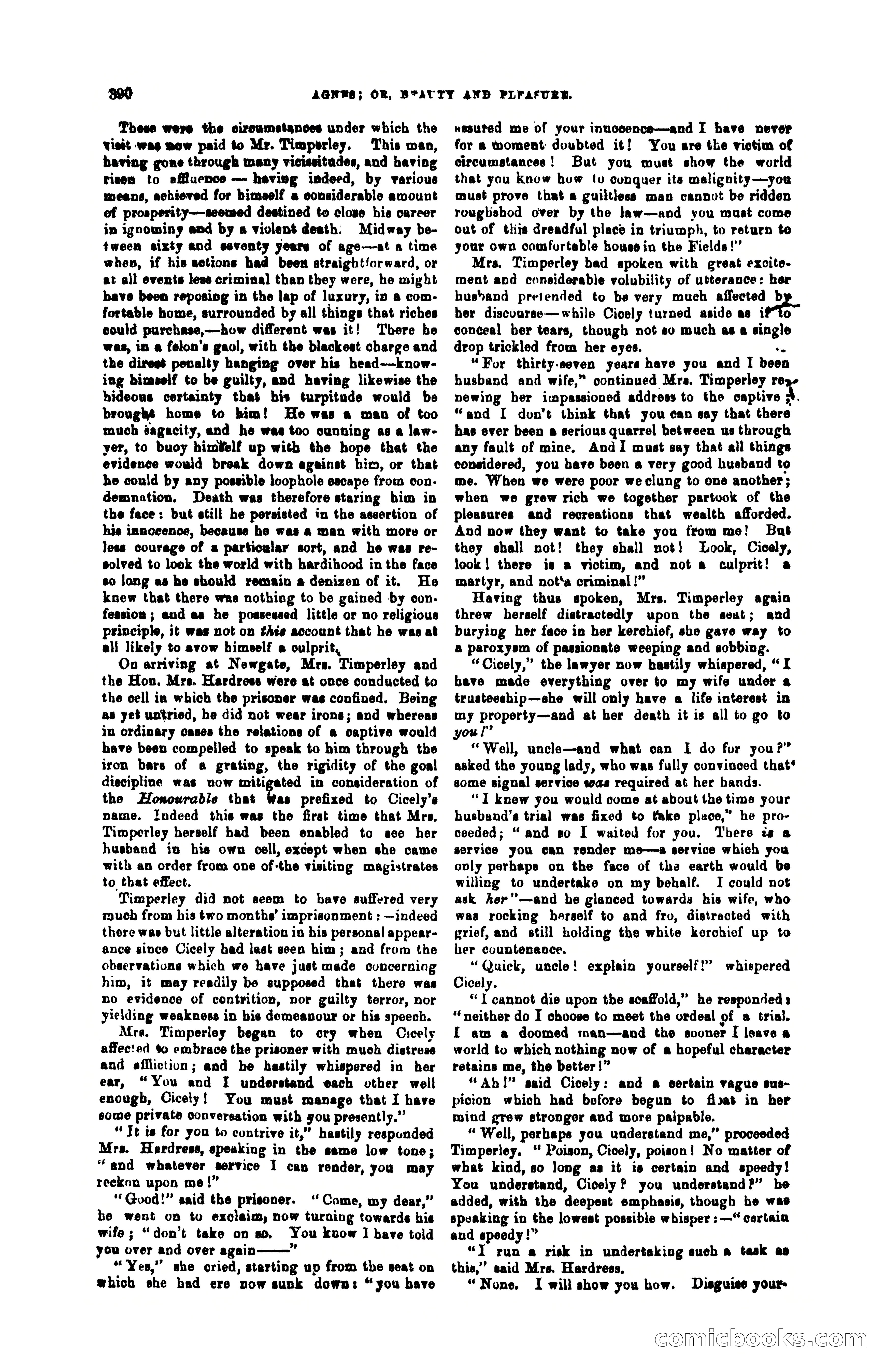
A restored page from Penny Dreadfuls, 1865. Page through the whole issue in the reader above.
📄 Transcribed text from this page (OCR, searchable)
Machine-transcribed from the original scan — historical spelling and the odd misread are preserved.
390 Theee were the circumstances under which the visit was sow paid to Mr. Timperley. This man, having gone through many vicissitudes, and beving rieen to affluence — having indeed, by various means, achieved for bimaelf a considerable amount of prosperity—seomed destined to close his career in ignominy and by a violent death: Midway be- tween sixty and ssventy years of age—at a time when, if his actions had been straightforward, or at all events less criminal than they were, he might have been reposing in the lap of luxury, ip a com- fortable home, surrounded by all things that riches could purchase,—how different was it! There he was, in a felon’s gaol, with the blackest charge and the direst penalty hanging over his head—know- ing himself to be guilty, and having likewise the hideous certainty that bis turpitude would be brought home to him! He was a man of too much éagacity, and he was too cunning as a law- yer, to buoy him¥elf up with the hope that the evidence would break down against him, or that he could by any possible loophole escape from con- demnation. Death was therefore staring him in the face: but still he persisted in the assertion of hie innocence, because he was a man with more or Jees courage of a particular sort, and he was re- solved to look the world with hardihood in the face so long as he should remain a denizen of it. He knew that there wae nothing to be gained by con- fession ; and as he possessed little or no religious principle, it was not on thee account that he was at all likely to avow himeelf a culprit, On arriving at Newgate, Mrs. Timperley and the Hon. Mrs. Hardrese were at once conducted to the cell in which the prisoner was confined. Being as yet untried, he did not wear irons; and whereas in ordinary cases the relations of a captive would have been compelled to speak to him through the iron bars of a grating, the rigidity of the goal discipline was vow mitigated in consideration of the Honourable that Was prefixed to Cicely’s name. Indeed this was the first time that Mrs. Timperley herself had been enabled to see her husband in bis own cell, except when she came with an order from one of-the visiting magistrates to that effect. Timperley did not seem to have suffered very much from his two months’ imprisonment : —indeed there wae but little alteration in his personal appear- ance since Cicely had last seen him; and from the observations which we have just made cuncerning him, it may readily be supposed that there was no evidence of contrition, nor guilty terror, nor yielding weakness in bis demeanour or his speech. Mra. Timperley began to cry when Cicely affected to embrace the prisoner with much distress and effliction; and he hastily whispered in her ear, “You and I understand each other well enough, Cicely! You must manage that I have some private conversation with you presently.” “Ie is for you to contrive it,” hastily respunded Mrs. Hardress, speaking in the same low tone; ‘and whatever service I can render, you may reckon upon me!” “Good!” said the prieoner. “Come, wy dear,” he went on to exclaim, now turning towards hie wife; “don’t take on so, You know ] have told you over and over again 7 “Yes,” she cried, starting up from the seat on which she bad ere now sunk down: “ you have AGNRB; OR, BTAUTY AND PLFAFURE. nesuted me of your innosence—and I have never for a moment doubted it! You are the victim of circumstances! But you must show the world that you Know huw to conquer its malignity—you must prove that a guiltless man cannot be ridden roughsbod over by the law—and you mast come out of this dreadful place in triumph, to return to your own comfortable house in the Fields!” Mrs. Timperley had apoken with great excite- ment and considerable volubility of utterance: her hushand pretended to be very much affected by her discuurse—while Cicely turned aside as if*to conceal ber tears, though not so much as a single drop trickled from her eyes. “For thirty-seven years have you and I been husband and wife,” continued Mrs. Timperley rey newing her impassioned address to the captive ; “and I don’t think that you can say that there has ever been a serious quarrel between us through any fault of mine. AndI must say that all things considered, you have been a very good husband to me. When we were poor we clung to one another; when we grew rich we together partuok of the pleasures and recreations that wealth afforded. And now they want to take you from me! Bat they shall not! they shall not! Look, Cicely, look! there is a victim, and not a culprit! a martyr, and not‘a criminal !” Having thuae spoken, Mrs. Timperley again threw herself dietractedly upon the seat; and burying her face in her kerchief, she gave way to & paroxysm of passionate weeping and sobbing. “Cicely,” the lawyer now hastily whispered, “I bave made everything over to my wife under a trusteeship—she will only have a life interest in my property—and at her death it is all to go to you!” “Well, uncle—and what can I do for you?” asked the young lady, who was fully convinced that* some signal service was required at her hands. “‘] knew you would come at about the time your husband’s trial was fixed to take place,” he pro- ceeded; “and so I waited for you. There is a service you can render me—a service whieh you only perhaps on the face of the earth would be willing to undertake on my behalf. I could not ask her"’—~and he glanced towards his wife, who was rocking herself to and fro, distracted with grief, and still holding the white kerchief up to her countenance. “Quick, uncle! explain yourself!” whispered Cicely. “1 cannot die upon the scaffold,” he responded s “neither do I choose to meet the ordeal of a trial. I am a doomed man—and the sooner I leave a world tu which nothing now of a hopeful character retains me, the better!” “Ab!” said Cicely: and a eertain vague sus~ picion which had before begun to fisat in her mind grew stronger and wore palpable. “ Well, perbaps you understand me,” proceeded Timperley. ‘ Poison, Cicely, poison! No matter of what kind, so long as it is certain and speedy! You understand, Cicely? you understand?” he added, with the deepest emphasis, though he was speaking in the lowest possible whisper :—“ certain and speedy!” “T run a risk in undertaking such a task as this,” said Mrs. Hardress. “None. I will show you how. Disguise your- S C© comicboo