
Penny Dreadfuls, 1865 · page 258 of 400
Agnes: A Tale of the Streets — page 258: what you’re looking at
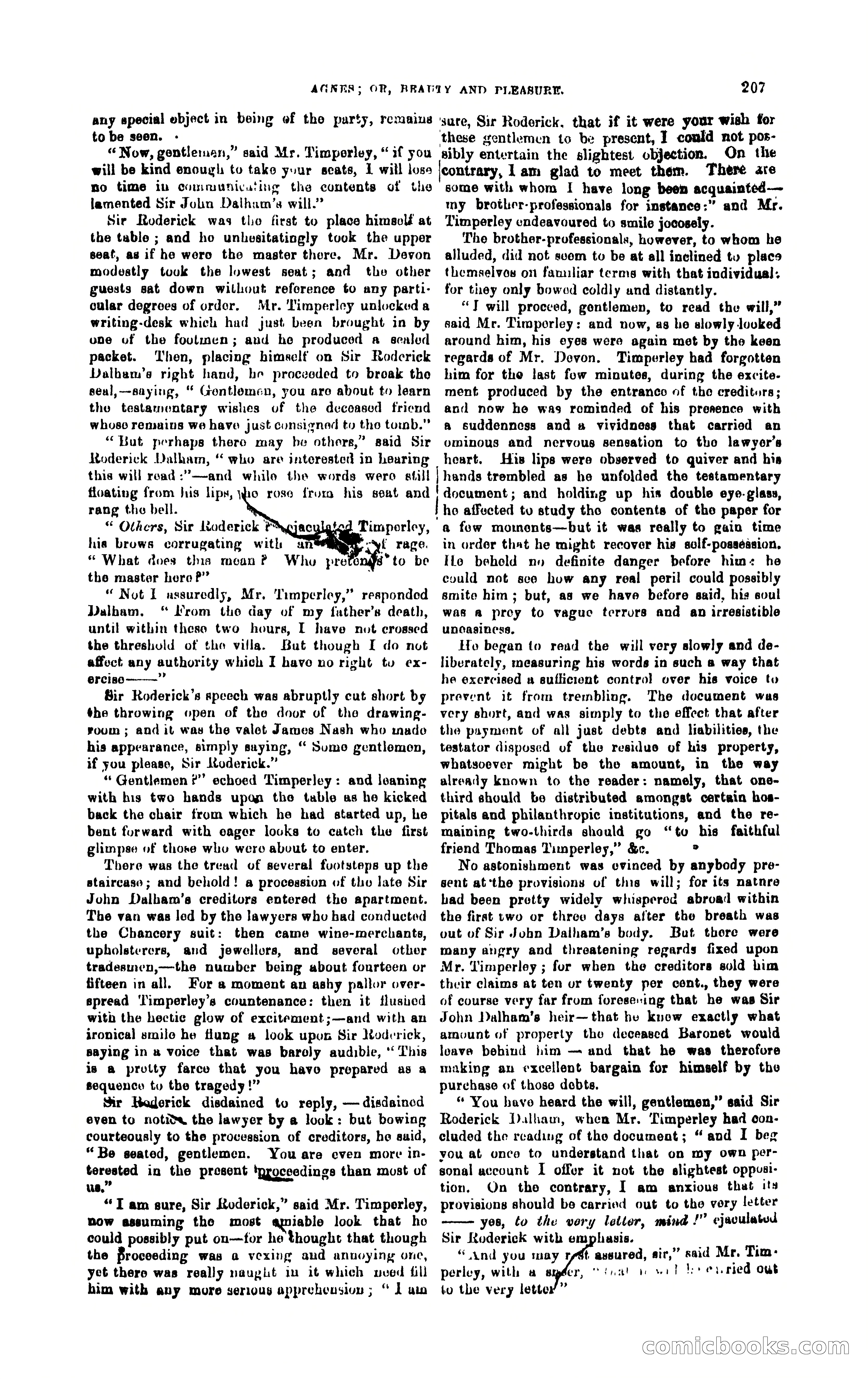
A restored page from Penny Dreadfuls, 1865. Page through the whole issue in the reader above.
📄 Transcribed text from this page (OCR, searchable)
Machine-transcribed from the original scan — historical spelling and the odd misread are preserved.
AGNES; OR, REATTY AND PLEASURE, any apecial object in being of the party, remains to be seen. “ Now, gentleman,” said Mr. Timperley, “if you will be kind enough to take your seats, 1 will lose no time in communicuting the contents of the lamented Sir Jolin Dalham’s will.” Sir Roderick was tho first to place himesolé at the table ; and ho unhesitatingly took the upper seat, as if he wero the master there. Mr. Devon modestly tovuk the lowest seat; and the other guests sat down without reference 6o any parti- cular degrees of order. Mr. Timperley unlocked a writing-desk which had just been brought in by one of the foulmen; and he produced a_ sealed packet. Then, placing himself on Sir Roderick Dalbam’s right hand, he proceeded to broak the seal,—aaying, “ Gentlemen, you are about to learn the testamontary wishes of the deceased friend whose remains we have just consigned tu tho tomb.” “But perhaps thero may be others,” said Sir Roderick Dalham, “ who are interested in hearing this will read :”’—and while the words wero still floating from hus lips, yao rose from his seat and rang the bell. “ Others, Sir Roderick & Timporley, hia brows corrugating with “yf rage. * What does tha mean ? afi to be the master here P” “ Not 1 assuredly, Mr. Timperley,” responded Dalbam. “ rom tho day of my father’s death, until within these two hours, I have not crossed the threshuld of the villa. But though I do not affect any authority which I have no right tu ex- erciso ” Sir Roderick’s speech was abruptly cut short by the throwing open of the door of the drawing- youm ; and it was the valet James Nash who mado his appearance, simply saying, “ Sume gentlemen, if you please, Sir itoderick.” “Gentlemen ?”’ echoed Timperley: and leaning with his two hands upon the table as he kicked back the chair from which he had started up, he bent furward with eager looks to catch the first glimpse of those who were abut to enter. There was the tread of several fuotsteps up the staircase ; and behold! a proceasion of tho late Sir John Dalbam’s creditors entered the apartment. The van was led by the Jawyers who bad conducted the Chancery suit: then came wine-merchants, upholsterers, and jewellors, and several other tradesmen,—the number being about fourteen or fifteen in all. For a moment an ashy pallor over- spread ‘limperley’s countenance: then it flusied with the hectic glow of excitement ;—and with an ironical] smile he flung # look upon Sir Roderick, Baying in w voice that was barely audibie, ‘ This is a protty farce that you have prepared as a sequence tu the tragedy!” Sir Baderick disdained to reply, — disdained even to notidte the lawyer by a look: but bowing courteously to the procession of creditors, he suid, “Be seated, gentlemen. You are even more in- terested in the present ‘proceedings than must of us,” “‘T am sure, Sir Roderick,” said Mr. Timperley, now assuming the most amiable look that ho could possibly put on—for he thought that though the Proceeding was a vexing and annoying one, yet there was really naught iu it which weed fill him with any more serious apprehension ; “ 1 ain Whu prete 207 ‘sure, Sir Roderick, that if it were your wish for these gentlemen to be present, ] could not pos- sibly entertain the slightest objection. On the contrary, 1am glad to meet them. There are some with whom I have long been acquainted— my brother-professionals for instance:” and Mr. Timperley endeavoured to smile jocosely. The brother-professionals, however, to whom he alluded, did not svem to be at all inclined tu place themselves on familiar terms with that individual: for they only bowed coldly and distantly. “J will proceed, gentlemen, to read the will,” said Mr. Timporley: and now, as he slowly looked around him, his eyes were again met by the keen regards of Mr. Devon. Timperley had forgotten him for the last fow minutes, during the excite- ment produced by the entranco of the creditors; and now he was rominded of his presence with a suddenness and # vividness that carried an ominous and nervous sensation to tho lawyer's heart. His lips were observed to quiver and his | hands trembled as he unfolded the testamentary 'document; and holding up his double eye-glass, | ho affected to study tho contents of the paper for a fow moments—but it was really to gain time in order that he might recover his self-posséssion, Ile beheld no definite danger before him: he could not sce how any real peril could possibly smite him; but, as we have before said, his svul was a proy to vague terrors and an irresistible uncaginess, Ho began to read the will very slowly and de- liberately, measuring bis words in such a way that he excrcised a sufficient control over his voice to prevent it from trembling. The document was very short, and was simply to the effect that after the payment of all just debts and liabilities, the testator disposed of the residue of his property, whatsoever might be the amount, in the way already known to the reader: namely, that one- third should be distributed amongst certain hos- pitals and philanthropic institutions, and the re- maining two-thirds should go “to his faithful friend Thomas Timperley,” &c. ° No astonishment was evinced by anybody pre- sent at‘the provisions of this will; for its natnre had been pretty widely whispered abroad within the first two or three days after the breath was out of Sir John Dalham’s body. But there were many angry and threatening regards fixed upon Mr. Timperley ; fur when the creditors sold bim their claims at ten ur twenty per cent., they were of course very far from foresering that he was Sir John Dalham's heir—that he know exactly what amount of property the deceased Baronet would leave bebind him — and that he was therofore making an excellent bargain for himself by the purchase of those debts. “ You have heard the will, gentlemen,” said Sir Roderick Dalham, when Mr. Timperley had con- cluded the reading of the document; “and I beg you at once to understand that on my own per- sonal account I offer it not the slightest oppusi- tion, On the contrary, I am anxious that its provisions should be carried out to the vory letter yes, to the very letter, mind /” ejaculated Sir Roderick with emphasis. “And you may re€t assured, air,” said Mr. Tim: perley, with a a. “teat oar wil le eurted owt to the very lette ElDOO SS