
Penny Dreadfuls, 1865 · page 254 of 400
Agnes: A Tale of the Streets — page 254: what you’re looking at
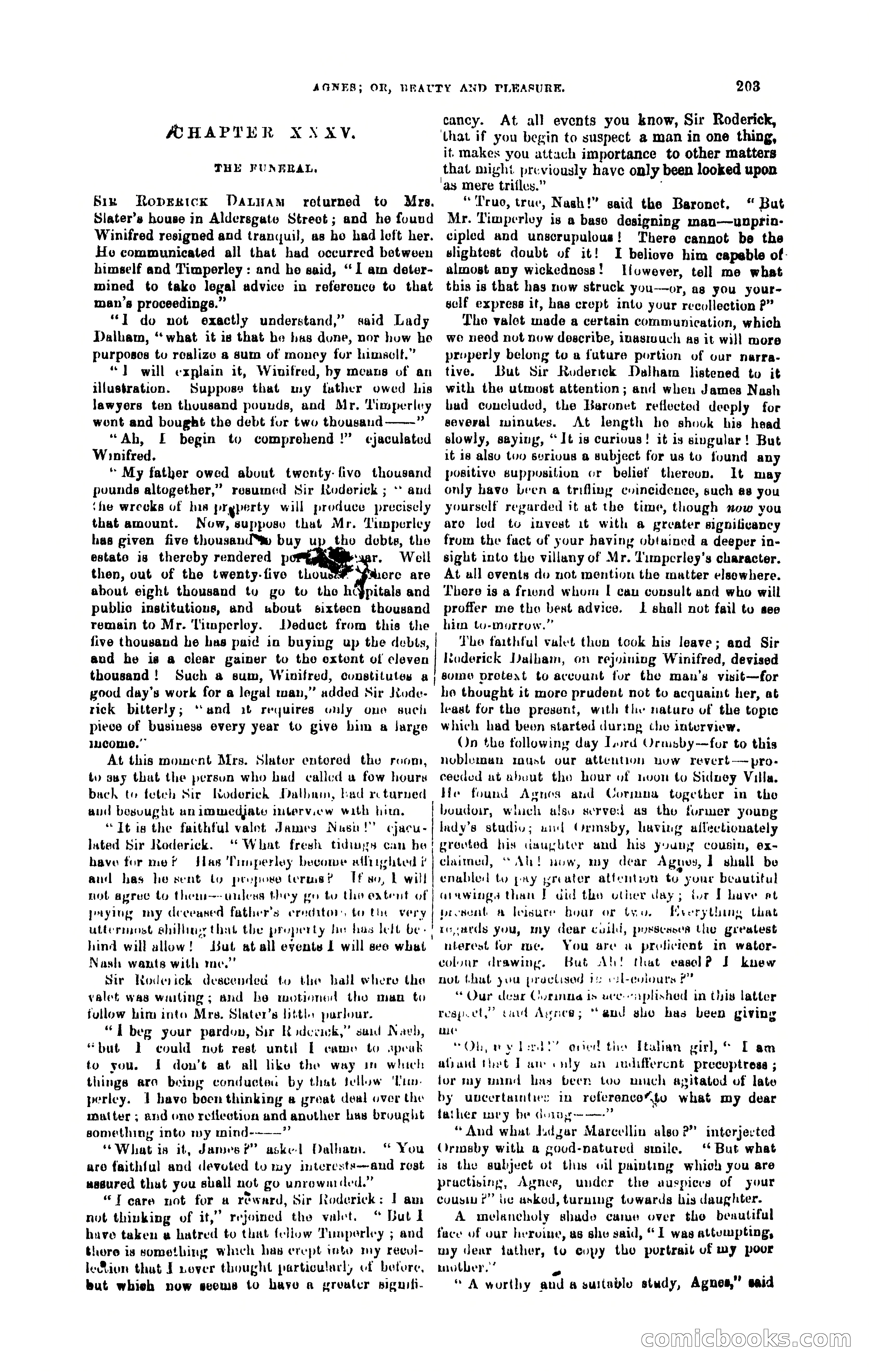
A restored page from Penny Dreadfuls, 1865. Page through the whole issue in the reader above.
📄 Transcribed text from this page (OCR, searchable)
Machine-transcribed from the original scan — historical spelling and the odd misread are preserved.
AGNES; OR, BRAUTY AND PLEASURE. A HAPTER XXXV. THE FUNTBAL, Bik Ropegick Danywam returned to Mrs. Slater’s house in Aldersgate Streot; and he fouud Winifred resigned and tranquil, as he had left her. He communicated all that had occurred between himself and Timperley: and he said, “1 am deter- mined to take legal advice in reference to that man’s proceedings.” “1 do not exactly understand,” said Lady Dalham, “what it is that be bas dune, nor how he purposos tu realize a sum of money for himaclt.” “J will explain it, Wiuifred, by means of an illustration. Suppose that my father owed his lawyers ten thousand pounds, and Mr. ‘Timperley wont and bought the debt fur two thousand ” “Ah, LF begin to comprehend !” ejaculated Winifred. * My father owed abuut twonty-fivo thousand puunds altogether,” resumed Sir Roderick ; ‘+ aud ‘he wreeks of his preperty will produce precisely that amount. Now, supposyv that Mr. Timperley has given five thousand™w buy up the debts, the estate is thereby rendered p ‘yar. Well then, out of the twenty-five thouss fin are about eight thousand tu go to tho hcfpitals and public institutions, and subout sixteen thousand remain to Mr. ‘limperloy. Deduct from this the five thousand he has paid in buying up the debts, | and he is a clear gainer to the extent of cleven thousand! Such a sum, Winifred, constitutes a good day’s work for a legal man,” added Sir Rode- tick bitterly; ‘‘and at requires only one such piece of business every year to give bim a Jarge 1ucome.” At this moment Mrs. Slater entored the room, to suy that the persun who bad called a fow hours bach to feteh Sire Koderich Dalbain, bad returned aud bosuught unimmedjate mberview wath hit, “It isthe faithful valet James Nusie!” cjacu- | lated Sir Roderick. “ What fresh tidiwes can be! have for me? flas Timperley becowe adfiighted ? and has he sent ty propose terme? Tf se, b will not aprec to ther—-auless they po tu tho extent of yetying my deceased father’s erediton, to the very uttermost shill that the property be has left be- hind will allow! J3ut at all events I will see what Nash wants with me.” Sir Roderick descended to the ball where the valet was wating ; and he motioned the man to fullow hira into Mrs. Slater’s ttl: parlour. “I beg your pardon, Sir Rodevick,” sant Navb, “but 2 could not rest until FE came to apeak to you. J don’t at all like the way in) which things aro being conducten by that fellaw ‘Pin. perley. 1 bave boen thinking a preat deal over the matter; and ono reflection and anuther hus brought something into wy mind--~——”’ “Whatis it, James?” askel Dalham. ‘“ You aro faithful and devoted to my interests—and rest uasured thut you shall not go unrowm ded.” “JT care not for a reward, Sir Roderick: I am not thinking of it,” rejoined the valet. “ But I have taken a hatred to that fellow Pumperley ; and there is something which bas crept mito my reeol- le&ion thut J vever thought particularl, of betere, but whish now seems to have a greater siguiti- | 203 cancy. At all events you know, Sir Roderick, ‘that if you begin to suspect a man in one thing, it. makes you attach importance to other matters that might previously have only been looked upon ‘as mere trifles.” “Truo, truc, Nash!” said the Baronct. “ But Mr. Timperley is a base designing man—uuprin- cipled and unscrupulous! There cannot be the slightest doubt of it! almost any wickedness! liuwever, tell me what this is that has now struck you-—or, as you your- self express it, has crept into your recollection P” The valet made a certain communication, which we need not now describe, inasruuch as it will more properly belong to a future portion of our narra- tive. But Sir Roderick Dualham listened to it with the utmost attention; and when James Nash bad concluded, the Baronet reflected deeply for several minutes. At length he shovk his head slowly, saying, “It is curious! it is singular! But it 18 alsu tuo serious o subject for us to found any positive suppusition or belief thereon, It may only havo been a trifling coincidence, such as you yourself regarded it at the time, though now you aro lud to invest it with a greater significancy frum the fact of your having obtained a deeper in- sight into the villany of Mr. Timpcrley's character. At all events do not mention the matter elsewhere. There is a friend whom | cau consult and who will proffer me the best advice. It shall not fail to see him to-morrow.” The faithful valet thon took his leave; and Sir Raderick Dalham, on rejoining Winifred, devised sume pretest to accuunt fur the man’s visit—for he thought it more prudent not to acquaint her, at leaut for the present, with the nature of the topte Which had been started durinp che interview. On the following day Lord Orusby-—for to this nubluman must our attention uuw revert— pro- ceeded at about the hour of muon to Sidney Villa. He found Agnes and Cormna together in the | boudoir, Wlhach afsu served as the former young lady’s studiv; und Grmaby, having affectionately grovted his cisugbter und his youny cousin, ex- claimed, “Ab! uuw, my dear Agues, 1 shall be enabled to pay greater attention tu your beautitul arawings than J did the other day; ivr Po have et present a teisare bour or tyo. Bverything that rewards you, my dear cuild, poxscsses the greatest nterest fur me. You are a proficient in wator- colonr drawing, But Ah! that easel? J knew not that you practised te cil-eolours P” “Our dear Curinna is uce en plished in this latter reapeel,” cad Agence ; “end sho has been giviny we “Ob wy bed? aned the Etalian girl, © Dam atpaid thet Tam only an andiffercnt precuptressa ; lor my mand has been too much agitated of late by uvcertainties im referenceto what my dear father mey be dura.” “ And what Judgar Marcellin algo 2” interjected Ormsby with a goud-natured sinile. ‘ But what is the subject ot this oil painting which you are practising, Agnee, under the auspices of your cuusiu ?” Ge asked, turning tuwards bis daughter. A melancholy shade came over the beautiful face of our hervine, as she said, “1 was attumpting, my dear father, to copy tho portrait uf my poor mother,’ ° “A worthy and a suitable study, Agnes,” said comicboo I beliove him capeble of- S CO