
Penny Dreadfuls, 1865 · page 247 of 400
Agnes: A Tale of the Streets — page 247: what you’re looking at
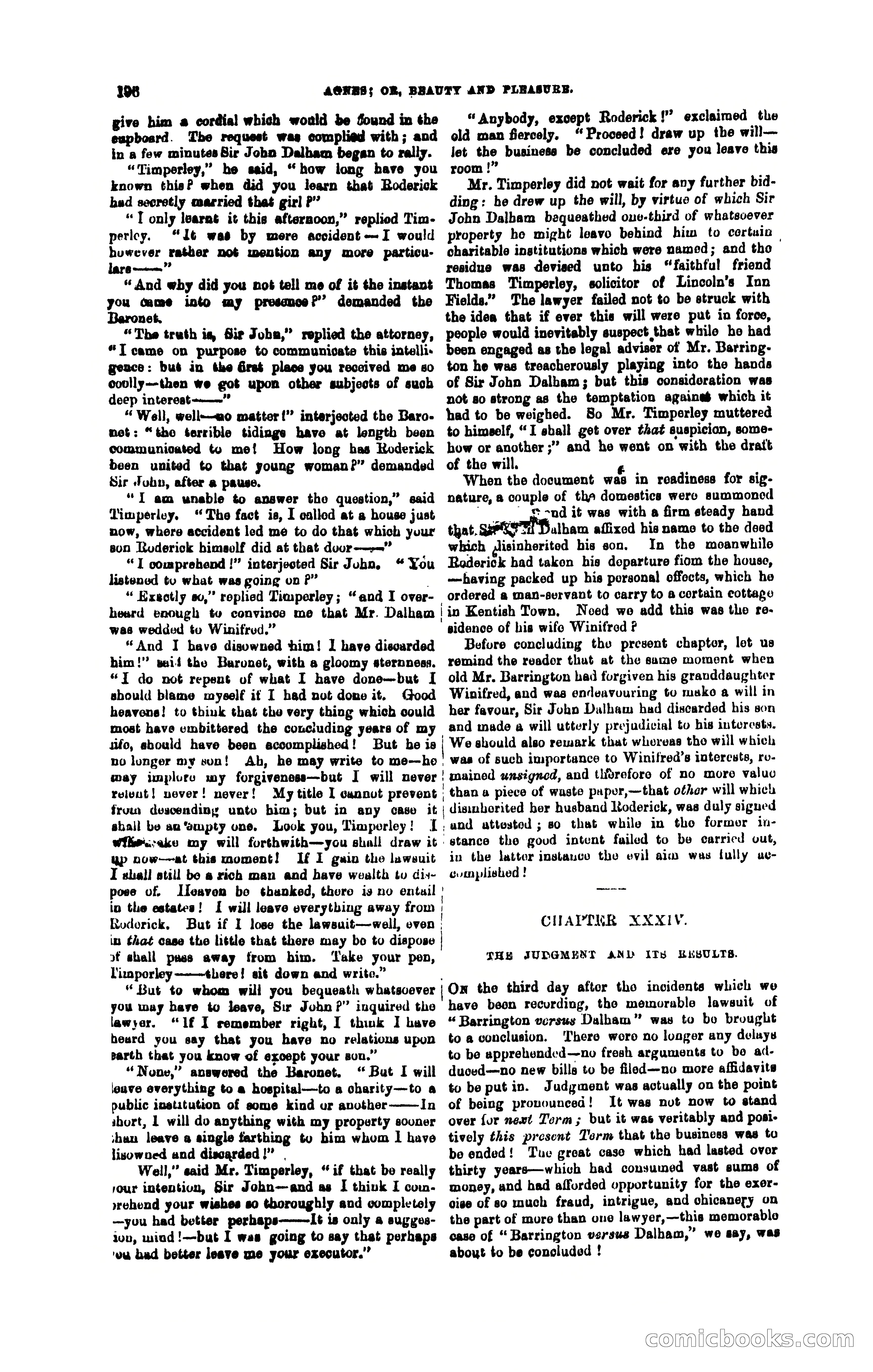
A restored page from Penny Dreadfuls, 1865. Page through the whole issue in the reader above.
📄 Transcribed text from this page (OCR, searchable)
Machine-transcribed from the original scan — historical spelling and the odd misread are preserved.
196 give him a cordial which would be Sound in the eupboard. The request was complied with; and in a few minutes Sir John Dalham began to rally. “Timperley,” he seid, “how long have you known thie? when did you learn that Roderick had secretly married that girl P”’ “T only learnt it this afternoon,” repliod Tim- perloy. “It was by mere accident ~—I would huwever rather not mention any more particu- lare-——~—~”’ “And why did you not tell me of it the instant you came into my presence?’ demanded the Baronet. “The truth ia, Sie Joba,” replied the attorney, “IT came on purpose to communicate this intelli- geuce: but in the Grat place you received me so coolly-—-then we got upon other subjects of such deep intereat-—~”” “Well, well—wo matter!” interjected the Baro- not: “the terrible tidinge have at length been communicated to met How long has Roderick been united to that young woman?” demanded Sir Job, after a pause. “I am unable to answer the question,” said Timperley, “The fact is, I called at a house just now, where accident led me to do that which your son Roderick himeolf did at that duur—-—” “I comprehend !” interjected Sir Juha, listened tv what was going on P” “ Exectly av,” replied Timperley; “and I ovar- heard enough tu convince me that Mr. Dalham | was wedded tu Winifred.” “And I have disowned him! I have discarded him!” said the Baronet, with a gloomy sternness. “I do not repent of what I have done—but I should blame myself it I had not done it. Good heavene! to think that the very thing which could most have umbittered the concluding years of my sifo, abould have been accomplished! But be is | no lunger my sun! Ah, he may write to me—he . may implore my forgiveness—but I will never: reluut! uever! never! My title I cannot prevent : fru descending unto bim; but in any case it | shall be an ‘ampty one. Look you, Timperley! I; wilecake my will forthwith—you shall draw it yp now—at this moment! If I gain the lawsuit I shall still be a rich man and have wealth tu dis- pose of. LIleaven bo thanked, there is no entuil ' in the estates! I[ will leave everything away trom | Rudorick, But if I lose the lawsuit—well, even ; in that case the little that there may bo to dispose | af shall pass away from him. ‘Take your pen, Liznporley-——there! sit down and write.” “But to whom will you bequeath whatsvever | you way have to leave, Sir John?” inquired the lawyer, “lf I remember right, I thiwk I have beard you say that you have no relations upon parth that you know of except your sun.” “None,” answered the Baronet. “ But I will leave everything to a hospital—to a oharity—to a public institution of some kind ur anuther In abort, L will do anything with my property sooner ‘han leave a single farthing tu him whom | have lisowned and discarded!” | Well,” said Mr. Timperley, “if that be really our intention, Sir John—and as I think I com- nrehend your wishes so thoroughly and completely —yuu had better perhaps——lé is only a sugyges- ion, wiud!—but I was going to say that perhaps ‘vu bad better leave me your executor.” “ You AGNRS; OR, BRAUTY AND PLEASURE. “ Anybody, except Roderick!” exclaimed the old man fiercely. “Proceed! draw up the will— Jet the businesa be concluded ere you leave this room !” Mr. Timperley did not wait for any further bid- ding: he drew up the will, by virtue of which Sir John Dalbam bequeathed one-third of whatsvever property he might leavo behind him to certain | charitable institutions which were named; and the residue was devised unto his “faithful friend Thomas Timperley, solicitor of Lincoln’s Inn Fields.” The lawyer failed not to be struck with the idea that if ever this will were put in force, people would inevitably suspect that while he had been engaged as the legal adviser of Mr. Barring- ton he was treacherously playing into the hands of Sir John Dalham; but this consideration was not so strong as the temptation againes which it had to be weighed. So Mr. Timperley muttered to himeelf, “I shall get over that suspicion, some- how or another ;” and he went on with the dratt of the will. ‘ When the document was in readiness for sig- nature, a couple of tha domestics were summoned _ st nd it was with a firm steady hand that. 9°! Balham affixed his name to the deed which Jisinherited his son. In the meanwhile Roderick had taken his departure fiom the house, —having packed up his personal effects, which he ordered @ man-servant to carry to a cortain cottage in Kentish Town, Need we add this was the re- sidence of his wife Winifred ? Before concluding the present chapter, let us remind the reador that at the same moment when old Mr. Barrington had forgiven his granddaughter Winifred, and was endeavouring tu mako a will in her favour, Sir Joho Dalham had discarded his son and made a will utterly prejudicial to his interests. We should also remark that whereas the will which was of such importance to Winifred’s intercsts, ro- mained unsigned, and therefore of no more valuc than a piece of waste paper,—that o¢her will which disinberited ber husband loderick, was duly signed and attested ; so that while in tho former in- stance the goud intent failed to be carried out, in the latter instance the evil aiw was fully ae- cumplished ! CHAPTKMER XXXIV. THH JUDGMENT AND ITS ELGULTS. On the third day after tho incidents which we have been recurding, the memorable lawsuit of “ Barrington versus Dalham” was to bo brought to a conclusion. There wero no longer any delays to be apprehendcd—no fresh arguments to bo ad- duced—no new bills to be filed—no more affidavits to be put in. Judgment was actually on the point of being provounced! It was nut now to stand over fur next Term; but it was veritably and posi- tively this present Term that the business was to be ended! Tuc great case which had lasted ovor thirty years—which had consumed vast sume of money, and had afforded opportunity for the exer- cise of so much fraud, intrigue, and chicanery on the part of more than one lawyer,—this memorable case of “ Barrington versus Dalham,” we say, was about to be concluded ! CoOMmicloo