
Penny Dreadfuls, 1865 · page 235 of 400
Agnes: A Tale of the Streets — page 235: what you’re looking at
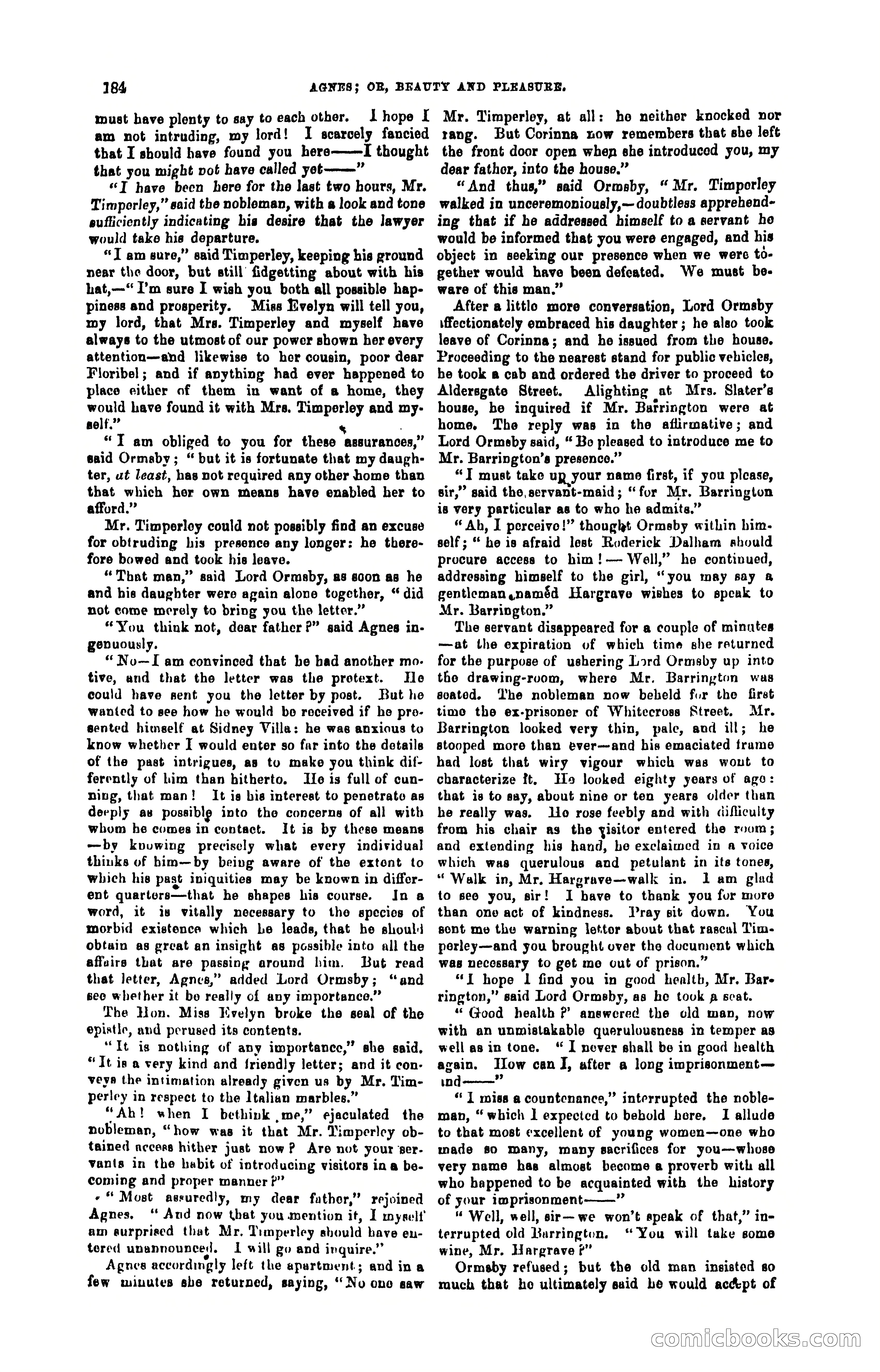
A restored page from Penny Dreadfuls, 1865. Page through the whole issue in the reader above.
📄 Transcribed text from this page (OCR, searchable)
Machine-transcribed from the original scan — historical spelling and the odd misread are preserved.
184 must have plenty to say to each other. hope I am not intruding, my lord! I scarcely fancied that I should have found you here——I thought that you might vot have called yeb-——” “T have been here for the last two hours, Mr. Timperley,” said the nobleman, with a look and tone sufficiently indicating bis desire that the lawyer would take his departure. “TJ am sure,” said Timperley, keeping his ground near the door, but still fidgetting about with his hat,—“ I’m sure I wish you both all possible hap- piness and prosperity. Miss Evelyn will tell you, my lord, that Mrs. Timperley and myself have always to the utmost of our power shown her every attention—and likewise to her cousin, poor dear Fioribel ; and if anything had ever happened to place either of them in want of a home, they would have found it with Mrs. Timperley and my- self.” . “JT am obliged to you for these “assurances,” said Ormaby; “ but it is fortunate that my daugh- ter, ut least, has not required any other home than that which her own means have enabled her to afford.” Mr. Timperley could not possibly find an excuse for obtruding his presence any longer: he there- fore bowed and took his leave. “That man,” said Lord Ormsby, as soon as he and his daughter wero again alone together, “ did not come merely to bring you the letter.” “You think not, dear father ?” said Agnes in- gepuously. “ No—I am convinced that he had another mo. tive, and that the letter was the pretext. He could have sent you the letter by post. But he wanted to see how he would be received if he pro- sented himself at Sidney Villa: he wae anxious to know whether I would enter so far into the detaile of the past intrigues, as tu make you think dif- ferently of him than hitherto. Ife is full of cun- hing, that man! It is bis interest to penetrate as deeply as possible into the concerns of all with whom he comes in contact. It is by these means —by kvuwing precisely what every individual thinks of him—by being aware of the extent to Which his past iniquities may be known in differ- ent quarters—that he shapes his course. In a word, it is vitally necessary to the species of morbid existence which be leads, that he should obtain as great an insight as possible into all the affuirs that are passing around him. But read that letter, Agnes,” added Lord Ormsby; “and seo whether it bo really of any importance.” The Hon. Miss Kvelyn broke the seal of the epistle, and perused its contents. “It is nothing of any importance,” she said. “Tt is a very kind and friendly letter; and it con- veya the intimation already given us by Mr. Tim- perley in respect to the Italian marbles.” “Ab! when I bethink me,” ejaculated the nobleman, “how was it that Mr. Timperley ob- tained access hither just now? Are not your ser- Vants in the habit of introducing visitors in a be- coming and proper manner P” «* Most assuredly, my dear fathor,” rejoined Agnes, am surprised that Mr. Timperley should have en- tered unannounced. 1 will go and inquire.” Agnes accordingly left the apartment; and in a few minutes she returned, saying, “No one saw “And now that you mention it, I myself AGNES; OR, BEAUTY AND PLEASURE. Mr. Timperley, at all: ho neither knocked nor rang. But Corinna now remembers that she left the front door open when she introduced you, my dear fathor, into the house.” “And thus,” said Ormsby, “Mr. Timporley walked in unceremoniously,— doubtless apprehend- ing that if he addressed himself to a servant he would be informed that you were engaged, and his object in seeking our presence when we were to- gether would have been defeated. We must be- ware of this man.” After a littlo more conversation, Lord Ormsby iffectionately embraced his daughter; he also took leave of Corinna; and he issued from the house. Proceeding to the nearest stand for public vehicles, he took a cab and ordered the driver to proceed to Aldersgate Street. Alighting at Mrs. Slater’s house, be inquired if Mr. Barrington were at home. The reply was in the aflirmative; and Lord Ormeby said, “ Bo pleased to introduce me to Mr. Barrington’s presence.” “T must take up your namo first, if you please, sir,” said the, servant-maid; “for Mr. Barrington i8 very particular as to who he admits.” “ Ah, I perceive!” thought Ormsby within him- self; “ he is afraid lest Roderick Dalham should procure access to him!—- Well,” he continued, addressing himself to the girl, “you may say 4 gentioeman,gnaméd Hargrave wishes to speak to Mr. Barrington.” The servant disappeared for a couple of minutes —at the expiration of which time she returned for the purpose of ushering Lord Ormsby up into the drawing-room, where Mr. Barrington was seated. The nobleman now beheld fur the first time the ex-prisoner of Whitecross Street. Mr. Barrington looked very thin, pale, and ill; he stooped more than ever—and his emaciated frame had lost that wiry vigour which was wont to characterize it. Hs looked eighty years of age: that is to say, about nine or ten years older than he really was. io rose feebly and with difficulty from his chair as the yisitor entered the room; and extending his hand, be exclaimed in a voice which was querulous and petulant in its tones, “Walk in, Mr. Hargrave—walk in. 1 am glad to see you, sir! I bave to thank you fur more than one act of kindness. YPray sit down. You sont me the warning lettor about that rascal Tim- perley—and you brought over the ducument which was necessary to get me cut of prison.” “I hope 1 find you in good health, Mr. Bare rington,” said Lord Ormsby, as he touk a scat. “Good health ?? answered the cold man, now with an unmistakable querulousness in temper as wellas intone. ‘“ I never shall be in good health acain. Ilow can I, after a long imprisonment— ind 7 “1 miss a countenance,” interrupted the noble- map, “which ] expected to bebold bere, I allude to that most ¢xcellent of young women—one who made 80 many, many sacrifices for you-—whose very name has almost become a proverb with all who happened to be acquainted with the history of your imprisonment ” “ Well, well, sir—we won’t apeak of that,” in- terrupted old Barrington. “You will take some wine, Mr. Hargrave ?” Ormsby refused; but the old man insisted so rouch that ho ultimately suid be would acckpt of Comiclbhoo S