
Penny Dreadfuls, 1865 · page 233 of 400
Agnes: A Tale of the Streets — page 233: what you’re looking at
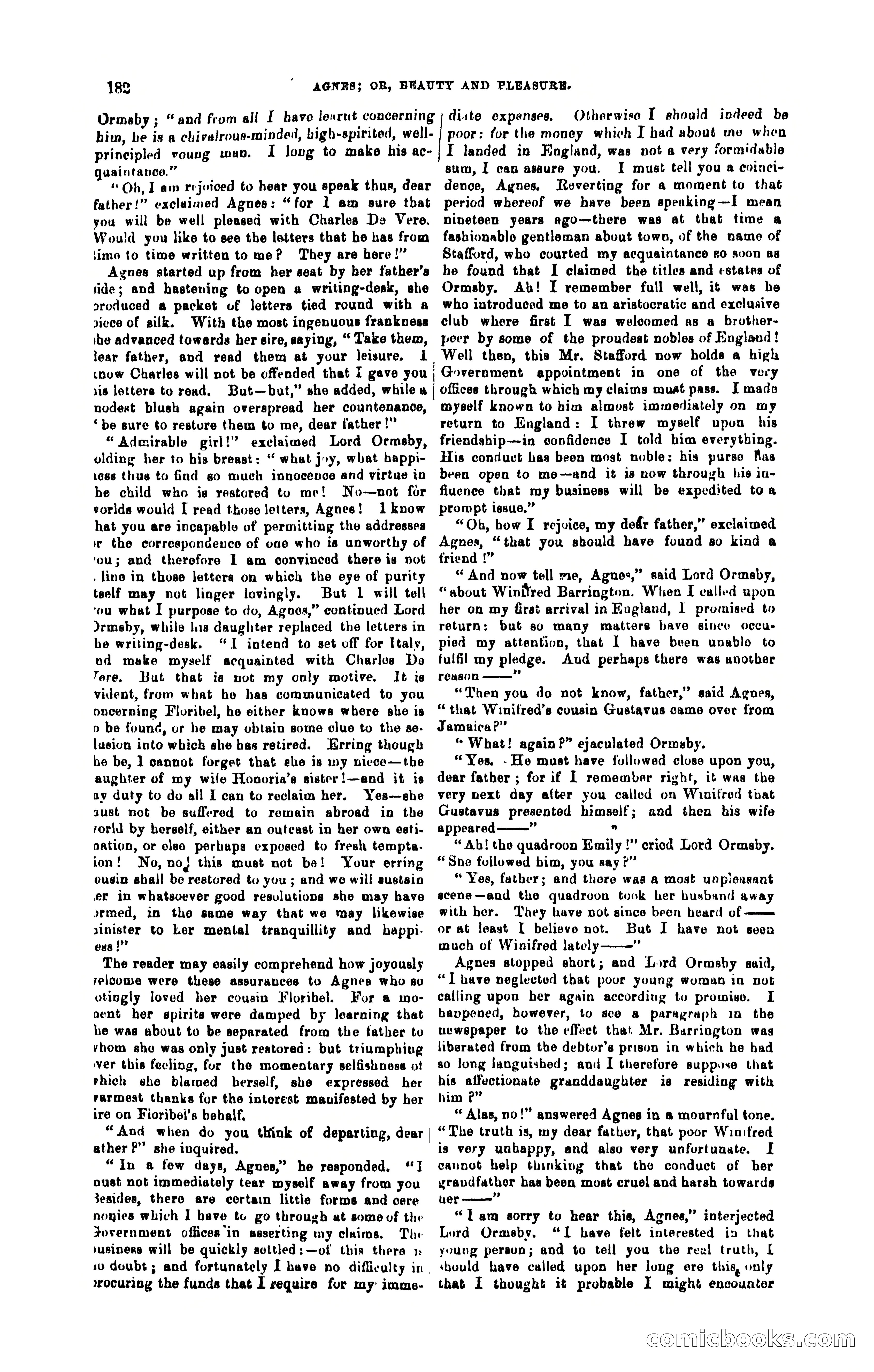
A restored page from Penny Dreadfuls, 1865. Page through the whole issue in the reader above.
📄 Transcribed text from this page (OCR, searchable)
Machine-transcribed from the original scan — historical spelling and the odd misread are preserved.
182 Ormesby ; “and from all I have lenrut concerning | diite expenses. AGNES; OR, BEAUTY AND PLEASURE. Otherwise I should indeed be him, he is a chivalrous-minded, high-spirited, well- | poor: for the money which I had about me when principled voung man. I long to make his ac- | I landed in England, was not a very formidable quaintance.” “Oh, 1 am rejoiced to hear you speak thus, dear father!” exclaimed Agnea: “for 1 am sure that you will be well pleased with Charles Do Vere. Would you like to see the letters that he has from Lime to time written tome? They are bere!” Agnes started up from her seat by her father’s lide; and hastening to open a writing-desk, she sroduced a packet of letters tied round with a niece of silk. With the most ingenuous frankness ihe advanced towards her sire, saying, “ Take them, lear father, and read them at your leisure. 1 cnow Charles will not be offended that i gave you | sum, I can assure you. I must tell you a coinci- dence, Agnes. Iteverting for a moment to that period whereof we have been speaking—I mean nineteen years ago—there was at that time a fashionablo gentleman abvut town, of the name of Stafford, who courted my acquaintance 60 svon as he found that I claimed the titles and estates of Ormaby. Ab! I remember full well, it was he who introduced me to an aristocratic and exclusive club where first I was welcomed as a_brother- peer by some of the proudest nobles of England! Well then, this Mr. Stafford now holde a high Government appvintment in one of the very is letters to read. But—but,” she added, while a {| offices through which my claims muat pass. J mado nodest blush again overspread her countenance, ‘be sure to resture them to me, dear father !” “Admirable girl!” exclaimed Lord Ormsby, olding her to his breast: “ what joy, what happi- 1ess thus to find go much innocence and virtue in he child who is restored to me! No—not for vorids would I read those letters, Agnes! 1 know hat you are incapable of permitting the addresses © the corresponcence of oae who is unworthy of ‘ou; and therefore I am convinced there is not . line in those lettera on which the eye of purity teelf may not linger lovingly. But 1 will tell ‘ou what I purpose to dv, Agnes,” continued Lord Irmeby, whilo lis daughter replaced the letters in he writing-desk. “I intend to set off for Italv, ud make myself acquainted with Charles De Tere. But that is not my only motive. It is vident, from what be bas communicated to you oncerning Floribel, he either knows where she is o be fuunc, or he may obtain some clue to the se- lusiun into which she bas retired. Erring though he be, 1 cannot forget that ehe is wy niece—the aughter of my wife Honoria’s sister!—and it is ay duty to do all I can to reclaim her. Yes—she aust not be suffered to remain abroad io the rorld by horself, either an outcast in her own esti- nation, or else perbaps exposed to fresh tempta- ion! No, nof this must not be! Your erring ousin shall be restored to you ; and wo will sustain er in whatsvever good resolutions she may have ormed, in the same way that we may likewise sinister to Ler mental tranquillity and happi- ess |” The reader may easily comprehend how joyously reloome were these assurances to Agnes who ao otingly loved her cousin Floribel. For a mo- nent her spirits were damped by learning that he was about to be separated from the father to vhom she was only just reatored: but triumpbing iver this fecling, fur the momentary selfishness ot vhich she blawed herself, she expressed her varmest thanks for the intereat mauifested by her ire on Fioribei’s behalf. “And when do you think of departing, dear | ather P”” she inquired. “In a few daya, Agnes,” he responded, ‘1 bust not immediately tear myself away from you 3esides, there sre certain little forms and cere nonies which I have tu go through at some of the Jovernment offices in asserting my claims. The yusiness will be quickly settled:—of this thera 1: 10 doubt ; and fortunately I have no difficulty in , wrocuring the funds that I require fur my imme- myself known to him almost immediately on my return to England: I threw myself upon his friendship—-in confidence I told him everything. His conduct has been most noble: his purse fas been open to me—and it is now through his in- fluence that my business will be expedited toa prompt issue.” “Ob, how I rejuice, my dedr father,” exclaimed Agnes, “that you should have found so kind a friend !” “ And now tell me, Agnes,” said Lord Ormsby, “about Winilred Barrington. When I called upon her on my first arrival in England, I promised to return: but so many matters have sinee occu- pied my attention, that I have been unablo to fulfil my pledge. Aud perhaps there was another reason 7 “Then you do not know, father,” said Acnes, “that Winifred’s cousin Gustavus came over from Jamuica?P” “What! again?” ejaculated Ormsby. “Yos. -He must have followed closo upon you, dear father ; for if I remember rivht, it was the very next day after you called on Winifred that Gustavus presented himself; and then his wife appeared m ° “Ab! the quadroon Emily !” eriod Lord Ormsby. “She followed bim, you say ?” “Yes, father; and there was a most unpleasant acene—and the quadroon took ber husband away with her. They have not since been heard of —— or at least I believe not. But I have not seen much of Winifred lately ” Agnes stopped short; and Lord Ormsby said, “IT bave neglected that poor young woman in not calling upon her again according to promise. [ happened, however, to see a paragraph in the newspaper to the effect that Mr. Barrington was liberated from the debtor’s prison in which he had so long languished; and I therefore suppose that his affectionate granddaughter is residing with him P” * Alas, no!” answered Agnes in & mournful tone. “The truth is, my dear father, that poor Wiuifred is very unhappy, and also very unfortunate. I cannot help thinking that the conduct of her yraudfathor bas been moat cruel and harsh towards uer 99 “Tam sorry to hear this, Agnea,’’ interjected Lord Ormsby. “1 have felt interested in that young person; and to tell you the rezl truth, [ should have called upon her long ere this, only that I thought it probable I might encounter comicboo S