
Penny Dreadfuls, 1865 · page 221 of 400
Agnes: A Tale of the Streets — page 221: what you’re looking at
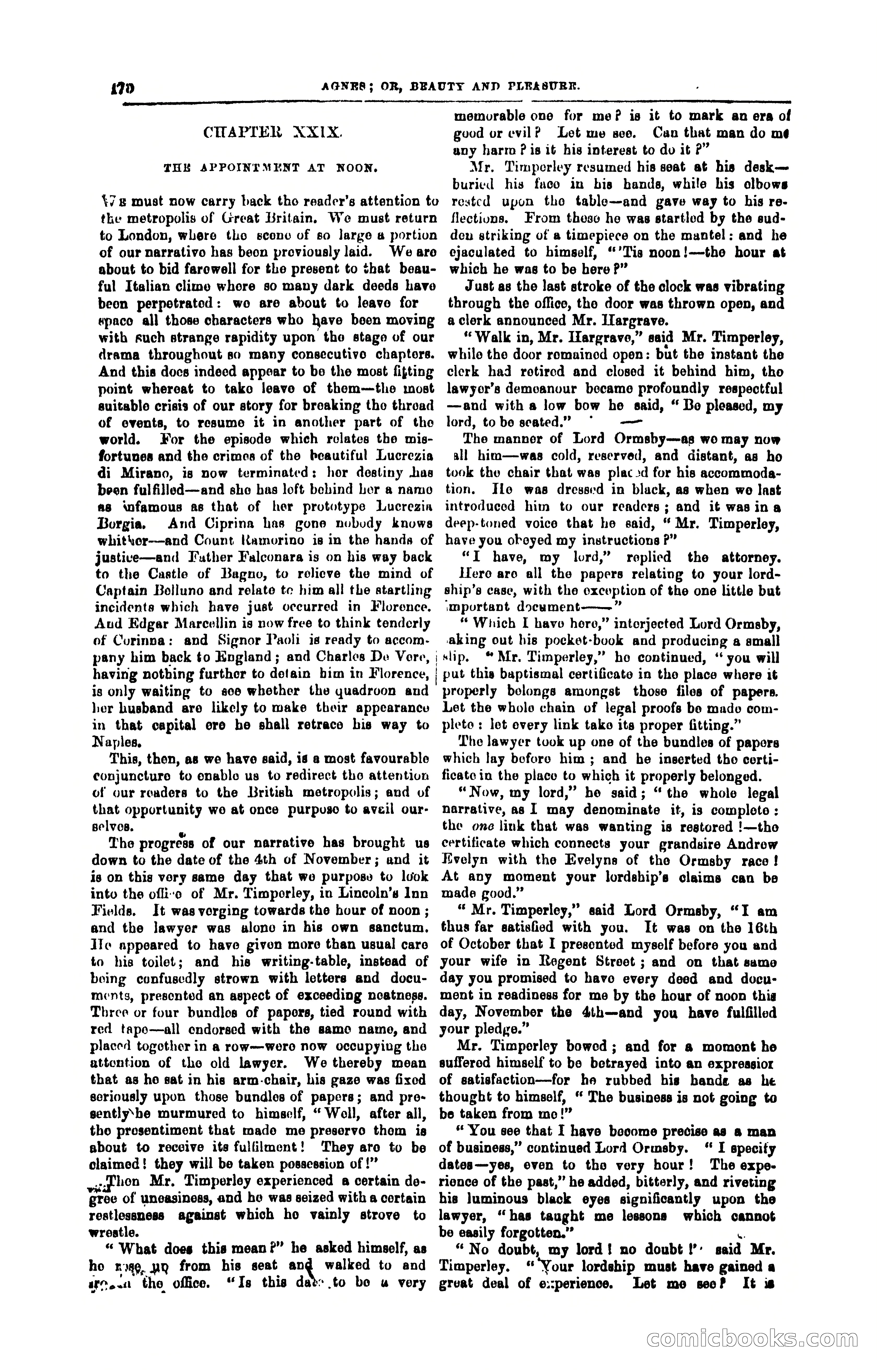
A restored page from Penny Dreadfuls, 1865. Page through the whole issue in the reader above.
📄 Transcribed text from this page (OCR, searchable)
Machine-transcribed from the original scan — historical spelling and the odd misread are preserved.
{70 CTAPTER XXIX. TUE APPOINTMENT AT NOON. }¥ = must now carry back tho reader's attention to the metropolis of Great Lritain, We must return to London, where tho scene of so large # portion of our narrativo has beon previously laid. We are about to bid farowell for the present to that beau- ful Italian clime whore so many dark deeds have been perpetrated: wo are about to leave for pace all those characters who have been moving with such strange rapidity upon the stage of our drama throughout so many consecutivo chaptors. And this docs indeed appear to be the most fifting point whereat to tako leave of them—the most suitable crisis of our story for breaking the throad of events, to resume it in another part of the world. For the episode which relates the mis- fortunes and the crimes of the beautiful Lucrezia di Mirano, is now terminated: hor destiny chas been fulfilled—and she has loft bebind her a namo as ‘famous as that of her prototype Lucrezia Borgia. And Ciprina has gone nubudy knows whithor-—and Count Kamorino is in the hands of justive—and Father Falconara is on his way back to the Castle of Bagno, to relicve the mind of Captain Bolluno and relate te him all the atartling incidents which have just occurred in Florence. Aud Edgar Marcellin is now free to think tenderly of Curinna: and Signor Paoli is ready to accom- pany him back to England; and Charles De Vore, | having nothing further to detain him in Florence, | is only waiting to sce whether the quadroon and her husband are likely to make their appearance in that capital ero he shall retrace his way to Naples, This, then, as we havo said, is a most favourable conjuncture to enable us to redirect the attention of our readers to the British metropolis; and of that opportunity we at once purpuso to aveil our- selves. « The progress of our narrative has brought us down to the date of the 4th of November; and it is on this very same day that we purpose to lok into the offi‘o of Mr. Timporley, in Lincoln’s Inn Fields. It was vorging towards the hour of noon ; and the lawyer was alono in his own sanctum. Jie appeared to have given more than usual care to his toilet; and his writing-table, instead of being confusedly strown with letters and docu- mcnts, presented an aspect of exceeding ncatness. Three or four bundlos of papors, tied round with red tapo—all endorsed with the same name, and placed together in a row—wero now occupying the attontion of the old lawyer. We thereby mean that as ho sat in his arm-chair, his gaze was fixed seriously upon those bundles of papers; and pre- sently\be murmured to himself, “ Well, after all, tho presentiment that made me preservo them is about to receive its fulfilment! They aro to be claimed! they will be taken possessiun of !” :phon Mr, Timperley experienced a certain de- gree of uneasiness, and he was seized with a certain restlessness against which ho vainly strove to wrestle. “What does this mean?” he asked himself, as ho rogo, wy from his seat an walked to and are..a the office. “Is this dat: to be uw very AGNES; OR, BEAUTY AND PLEASURR. memorable one for me? is it to mark an era of good or evil? Let me see. Can that man do me any harro ? is it his interest to do it P” Mr. Timperley resumed his seat at his desk— buried his faco in bis bands, while his olbows rested upon tho table-and gave way to his re- flections, From these he was startled by the sud- den striking of a timepiece on the mantel: and he ejaculated to himself, “’Tis noon!—the hour at which he was to be here P” Just as the last stroke of the clock was vibrating through the office, the door was thrown open, and a clerk announced Mr. Hargrave. “Walk in, Mr. Ifargrave,” said Mr. Timperley, while the door romainod open: but the instant the clerk had rotircd and closed it behind him, tho lawyor’s demoanour became profoundly respectful —and with a low bow he said, “ Be pleased, my lord, to be seated.” The manner of Lord Ormsby—as wo may now all him—was cold, reserved, and distant, as ho took the chair that was plac.d for his accommoda- tion. Tle was dressed in black, as when wo last introduced him to our readers; and i¢ was ina deep-toned voice that he said, “ Mr. Timperley, have you obeyed my instructions P” “I have, my lord,” replied the attorney. Hero aro all the papers relating to your lord- ship’s case, with the oxception of the one little but important document——” “ Which I havo hero,” interjected Lord Ormsby, ‘aking out his pocket-book and producing a amall slip. © Mr. Timperley,” ho continued, “ you will put this baptismal certificate in the place where it properly bolongs amongst those files of papers. Let the whole chain of legal proofs be mado com- pleto: let overy link take its proper fitting.” The lawyer took up one of the bundles of papers which lay before him; and he inserted tho corti- ficate in the place to which it properly belonged. “Now, my lord,” he said; “the whole legal narrative, as I may denominate it, is complete : the one link that was wanting is restored !—tho certificate which connects your grandsire Andrew Evelyn with the Evelyns of the Ormsby race! At any moment your lordship’s claims can be made good.” “ Mr. Timperley,” aaid Lord Ormsby, “I am thus far satisfied with you. It was on the 16th of October that I presonted myself before you and your wife in Regent Street ; and on that sume day you promised to havo every deed and docu- ment in readiness for me by the hour of noon thia day, November the 4th—and you have fulfilled your pledge.” Mr. Timperley bowed ; and for a momont ho suffered himself to be betrayed into an expressior of satisfaction—for he rubbed his bande as he thought to himself, “ The business is not going to be taken from me!” “You see that I have bocome precise as a man of business,” continued Lord Ormsby. “ I specify dates—yes, even to tho very hour! The expe- rience of the past,” he added, bitterly, and riveting his luminous black eyes significantly upon the lawyer, “has taught me lessons which cannot be easily forgotten.” w. “No doubt, my lord! no doubt !’: said Mr. Timperley. “ ‘Your lordship must have gained a great deal of e::perience. Let me seof It is eal (e) Connie DOOK Coin