
Penny Dreadfuls, 1865 · page 163 of 400
Agnes: A Tale of the Streets — page 163: what you’re looking at
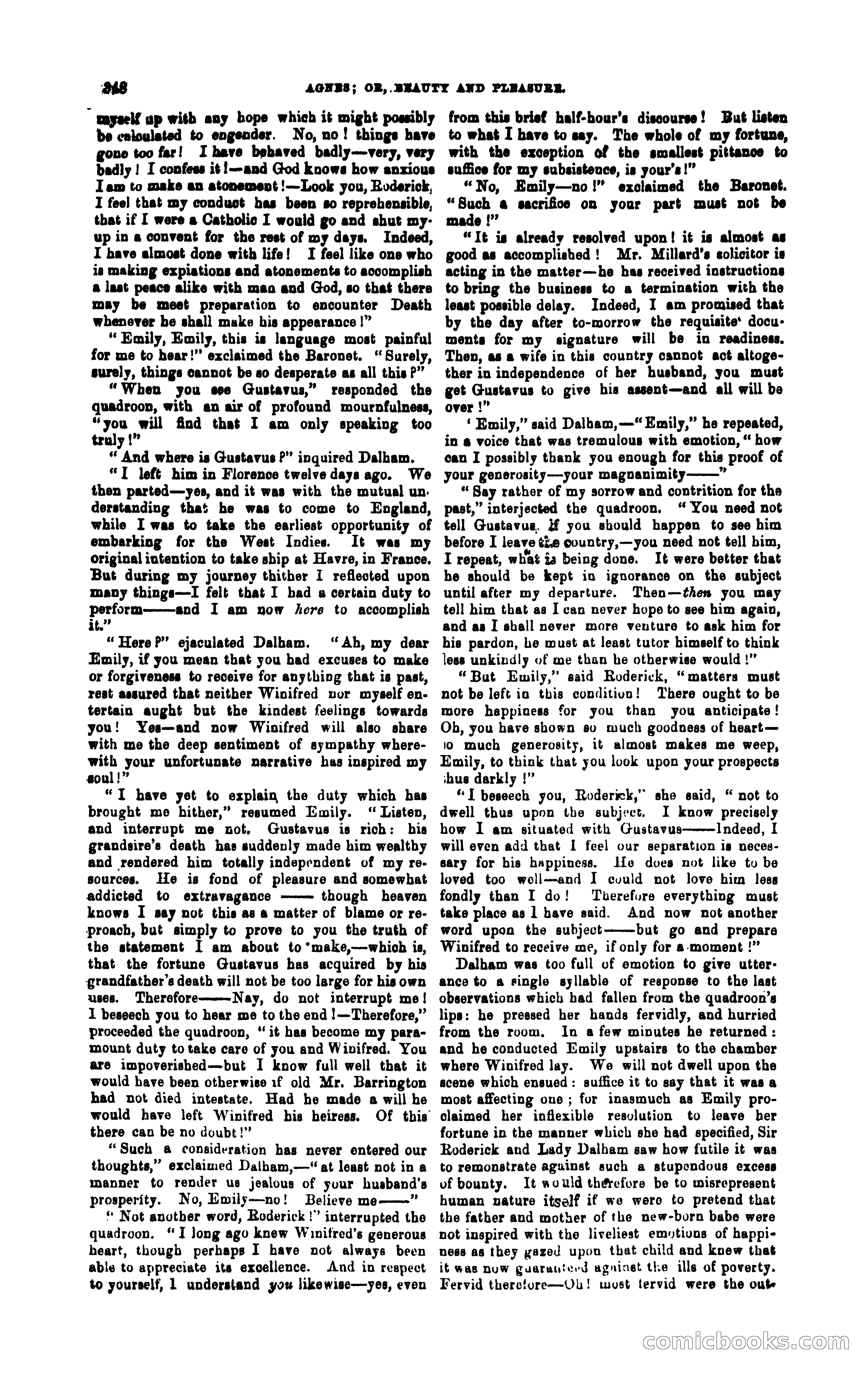
A restored page from Penny Dreadfuls, 1865. Page through the whole issue in the reader above.
📄 Transcribed text from this page (OCR, searchable)
Machine-transcribed from the original scan — historical spelling and the odd misread are preserved.
os myself up with any bope which it might possibly be cnloulated to engender. No, no! things have gono too far! Ihave behaved badly—very, very badly ! I confess it!—and God knows how anxious Iam to make an atonement !—Look you, Ruderick, I feel that my conduct has been so reprehensible, that if I were a Catholic I would go and shut my: up in a convent for the rest of my days. Indeed, I have almost done with life! I feel like one who is making expiations and atonements to accomplish a last peace alike with mao and God, so that there may be meet preparation to encounter Death whenever he shall muke bis appearance !” “Emily, Emily, this is language most painful for me to hear!” exclaimed the Baronet. “Surely, surely, things cannot be so desperate as all this ?” “When you see Gustavus,” responded the quadroon, with an air of profound mournfulness, “you will find that I am only speaking too truly !” “ And where is Gustavus ?” inquired Dalham. “I lefé him in Florence twelve days ago. We then parted—yes, and it was with the mutual un. derstanding that he was to come to England, while I was to take the earliest opportunity of embarking for the West Indies. It was my original intention to take ship at Havre, in France, But during my journey thither I reflected upon many thinge—I felt that I bad a certain duty to perform and I am now here to accomplish it.’ “Here P” ejaculated Dalham. ‘Ah, my dear Emily, if you mean that you had excuses to make or forgiveness to receive for anything that is past, reat assured that neither Winifred nor myself en- tertain aught but the kindest feelings towards you! Yes—and now Winifred will also share with me the deep sentiment of sympathy where- with your unfortunate narrative has inspired my soul!” “TI have yet to explain the duty which has brought me hither,” resumed Emily. “ Listen, and interrupt me not. Gustavus is rich: his grandsire’s death hae suddenly made him wealthy and rendered him totally independent of my re- sources. He is fond of pleasure and somewhat addicted to extravagance ——~ though heaven knows I say not this as a matter of blame or re- proach, but simply to prove to you the truth of the statement I am about to ‘make,—which is, that the fortune Gustavus has acquired by his grandfather's death will not be too large for his own uses. Therefore——Nay, do not interrupt me! 1 beseech you to hear me to the end !—Therefore,” proceeded the quadroon, ‘it has become my para- mount duty to take care of you and Winifred. You are impoverished—but I know full well that it would have been otherwise if old Mr. Barrington had not died intestate. Had he made a will he would have left Winifred his heiress. there can be no doubt!” “Such a consideration has never entered our thoughts,” exclaimed Dalham,—“ at least not in a manner to render us jealous of your husband's prosperity. No, Emily—no! Believe me——” “ Not anutber word, Roderick!” interrupted the quadroon. “I Jong ago knew Whinitred’s generous heart, though perhaps I have not always been able to appreciate ita excellence. And in respect to yourself, 1 understand you likewise—yes, even Of this AGNES; OR, BEAUTY AND PLEASURE. from this brief half-hour’s discourse! But listen to what I have to say. The whole of my fortune, with the exception of the smallest pittance to suffice for my subsisteuce, is your’s!” “No, Emily—no!” exclaimed the Baronet. “Such @ sacrifice on your part must not be made !” “Tt is already resolved upon! it is almost as good as accomplished! Mr. Millard’s solicitor is acting in the matter—he has received instructions to bring the business to a termination with the least possible delay. Indeed, I am promised that by the day after to-morrow the requisite’ docu- ments for my signature will be in readiness. Then, as a wife in this country cannot act altoge- ther in independence of her hueband, you must get Gustavus to give his assent—and all will be over !” ‘Ewily,” aaid Dalham,—“ Emily,” he repeated, in a voice that was tremulous with emotion, “ how can I possibly thank you enough for this proof of your generosity—your magnanimity id “ Say rather of my sorrow and contrition for the past,” interjected the quadroon. “ You need not tell Gustavue, if you should happen to see him before I leave ¢i.e country,—you need not tell bim, I repeat, what ia being done. It were better that be should be kept in ignorance on the subject until after my departure. Then—then you may tell him that as I can never hope to see him again, and as I shall never more venture to ask him for his pardon, he must at least tutor himeelf to think less unkindly of me than he otherwise would |” “But Ewily,” said Roderick, “matters must not be left in this conditiun! There ought to be more heppiness for you than you anticipate ! Ob, you have shown ev much goodness of heart— io much generosity, it almost makes me weep, Emily, to think that you look upon your prospects ihus darkly !” *T beseech you, Roderick,” she said, “ not to dwell thus upon the subject. I know precisely how I am situated with Gustavus Indeed, I will even add that I feel our separation is ueces- sary for his happiness. Le does not like tv be loved too woll—-and I cuuld not love him less fondly than I do! Therefure everything must take place as 1 have said. And now not another word upon the subject but go and prepara Winifred to receive me, if only for a-moment !” Dalham was too full of emotion to give utter- ance to a single syllable of response to the last observations which had fallen from the quadroon’s lips: he pressed her hands fervidly, and hurried from the room, In a few minutes he returned : and he conducted Emily upstairs to the chamber where Winifred lay. We will not dwell upon the scene which ensued : suffice it to say that it wasa moat affecting one ; for inasmuch as Emily pro- claimed her inflexible resvlution to leave her fortune in the manner which she had specified, Sir Roderick and Lady Dalham saw how futile it was to remonstrate aguinst such a atupendous excess of bounty. It would thérefore be to misrepresent human nature itself if we wero to pretend that the father and mother of the new-born babe were not inspired with the liveliest emutions of happi- ness as they gazed upou that child and knew that it was nuw guaranierd agninet the ills of poverty. Fervid thercfure—-Ol! wost tervid were the out nn CO GIOoOks CO