
Penny Dreadfuls, 1865 · page 161 of 400
Agnes: A Tale of the Streets — page 161: what you’re looking at
A restored page from Penny Dreadfuls, 1865. Page through the whole issue in the reader above.
📄 Transcribed text from this page (OCR, searchable)
Machine-transcribed from the original scan — historical spelling and the odd misread are preserved.
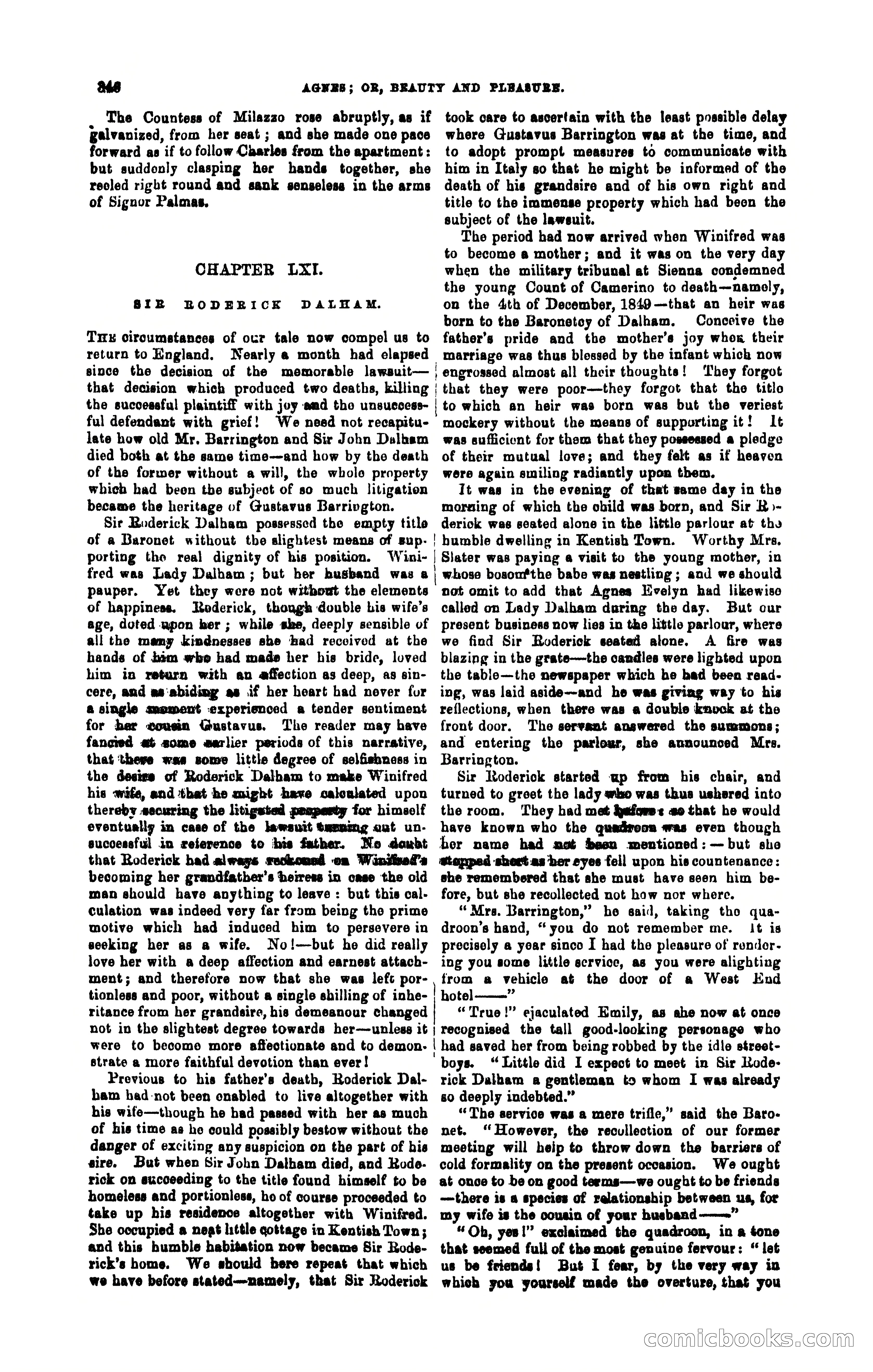
The Countess of Milazzo rose abruptly, as if galvanized, from her seat ; and she made one pace forward as if to follow Charles from the apartment : but suddonly clasping her hands together, she recoiled right round and sank senseless in the arms of Signor Palmas. CHAPTER LXI. SIR RODERICK DALHAM. Tx circumstances of our tale now compel us to return to England. Nearly a month had elapsed since the decision of the memorable lawsuit— that decision which produced two deaths, killing the successful plaintiff with joy and the unsuccess- ful defendant with grief! We nesd not recapitu- late how old Mr. Barrington and Sir John Dolham died both at the same time—and how by the death of the former without a will, the whole property which had beon the subject of so much litigation became the heritage of Gustavus Barrington. Sie Roderick Dalham possessed the empty title AGNES; OR, BEAUTY AND PLEASURE. took care to ascertain with the least possible delay where Gustavus Barrington was at the time, and to adopt prompt measures to communicate with him in Italy so that he might be informed of the death of his grandsire and of his own right and title to the immense property which had been the subject of the lawsuit. The period had now arrived when Winifred was to become a mother; and it was on the very day when the military tribunal at Sienna condemned the young Count of Camerino to death—namely, on the 4th of December, 1849-—that an heir was born to the Baronetcy of Dalham. Conccive the father’s pride and the mother’s joy whon their marriage was thus blessed by the infant which now , engrossed almost all their thoughts! They forgot | that they were poor—they forgot that the titlo |to which an heir was born was but the veriest mockery without the means of supporting it! It was suffcicnt for them that they possessed a pledge of their mutual love; and they felt as if heaven were again smiling radiantly upon them. It was in the evening of that same day in the moraing of which the obild was born, and Sir R>- derick was seated alone in the little parlour at the of a Baronet without the slightest means of sup- | humble dwelling in Kentish Town. Worthy Mrs. porting the real dignity of his position. Wni- fred was Lady Daiham; but ber busband was a pauper. Yet they were not without the elements of happiness. Roderick, though double bis wife’s age, doted wpon her ; while she, deeply sensible of all the mamy kindnesses she ‘had received at the hands of bim who had made her his bride, loved him in return with an affection as deep, as sin- cere, and as‘abiding ae if her heart had nover fur a single snement experienced a tender sentiment for her wousin Gustavus. The reader may have fancied at some earlier periods of this narrative, that theve waa some little degree of selfishness in the desies of Roderick Dalham to make Winifred his wife, and that he might have calculated upon thereby securing the litigated peaperty for himself eventually in case of the lawsuit tesmmg aut un- successful in reference to bie father. No doubt that Roderick had always seckoned on Winitsed’s becoming her grandfather's heiress in case the old man should have anything to leave : but this cal- Culation was indeed very far from being the prime motive which had induced him to persevere in seeking her as a wife. No!—but he did really love her with a deep affection and earnest attach- ment; and therefore now that she was lefc por- tionless and poor, without a single shilling of inhe- ritance from her grandsire, his demeanour changed not in the slightest degree towards her—unless it were to become more affectionate and to demon- strate a more faithful devotion than ever! Previous to his father’s death, Roderick Dal- ham had-not been enabled to live altogether with his wife—though he had passed with her as much of his time as he could possibly bestow without the danger of exciting any suspicion on the part of his sire. But when Sir John Datham died, and Rode- rick on succeeding to the title found himself to be homeless and portionless, ho of course proceeded to take up his residence altogether with Winifred. She occupied a neat little qottage in Kentish Town; and this humble habitation now became Sir Rode- rick’s home. We should here repeat that which we have before stated--namely, that Sir Roderiok | Slater was paying a visit to the young mother, in | whose bosomfthe babe was nestling; and we should not omit to add that Agnes Evelyn had likewise called on Lady Dalham daring the day. But our present business now lies in the little parloar, where we find Sir Roderick seateii alone. A fire was blazing in the grate—the candles were lighted upon the table—the newspaper which be had been read- ing, was laid aside-~—and he was giving way to his reflections, when there was a double knock at the front door. The servant answered the summons; and entering the parlour, she announced Mrs. Barrington. Sir Roderick started up from his chair, and turned to greet the lady who was thus ushered into the room. They had met hefores so that he would have known who the quadroon was even though her name had sot Seen mentioned: —but she stopped shert-as ‘ber eyes feil upon his countenance: she remembered that she must have seen him be- fore, but she recollected not how nor where. “Mrs. Barrington,” he said, taking tho qua- droon’s hand, “you do not remember me. it is precisely a year sinco I had the pleasure of render- log you some little service, as you were alighting from a vehicle at the door of a West End hotel ad “True!” ejaculated Emily, as ahe now at once | recognised the tall good-looking personage who | had saved her from being robbed by the idle street- boys. “Little did I expect to meet in Sir Rode- rick Dalbam a gentleman to whom I was already so deeply indebted.” “The service was a mere trifle,” said the Baro- net. ‘However, the recullection of our former meeting will heip to throw down the barriers of cold formality on the presont occasion. We ought at once to be on good terms—we ought to be friends —thore is a species of relationship between us, for my wife is the cousin of your husband ——~” “Oh, yes!” exclaimed the quadroon, in a tone that seemed full of the most genuine fervour: “ let us be friends! But I fear, by the very way in which you yourself made the overture, that you oO comicboo S C©