
Penny Dreadfuls, 1865 · page 159 of 400
Agnes: A Tale of the Streets — page 159: what you’re looking at
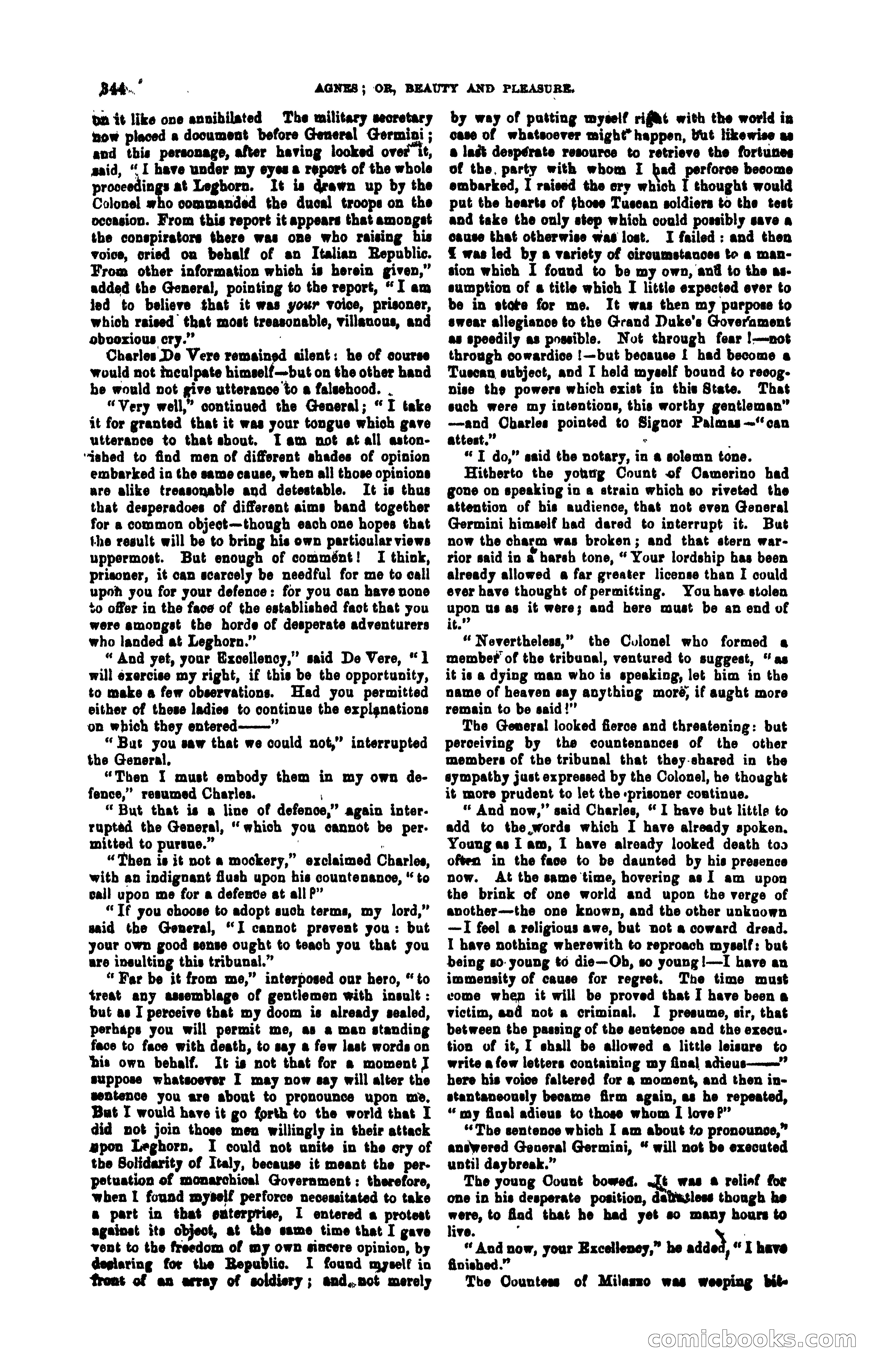
A restored page from Penny Dreadfuls, 1865. Page through the whole issue in the reader above.
📄 Transcribed text from this page (OCR, searchable)
Machine-transcribed from the original scan — historical spelling and the odd misread are preserved.
4 bn it like one annihilated The military secretary now placed a document before General Germini ; and this personage, after having looked over it, said, “I have under my eyes a report of the whole proneedings at Leghorn. It is drawn up by the Colonel who commanded the ducal troops on the occasion. From this report it appears that amongst the conspirators there was one who raising his voice, cried on behalf of an Italian Republic. From other information which is herein given,” added the General, pointing to the report, “I am fed to believe that it was your voice, prisoner, whioh raised that most treasonable, villanous, and obvoxious cry.” Charles De Vere remained ailent: he of course would not inculpate himself—~but on the other hand be would not give utterance to a falsehood. . “Very weil,” continued the General; “I take it for granted that it was your tongue which gave utterance to that shout. Iam not at all aston- ‘jahed to find men of different shades of opinion embarked in the same cause, when all those opinions ure alike treasonable and detestable. It is thus that desperadoes of difforent aime band together for a common object—though each one hopes that the result will be to bring his own particular views uppermost. But enough of commént! I think, prisoner, it can scarcely be needful for me to call upoh you for your defence: for you can have none +o offer in the face of the established fact that you were amongst the horde of desperate adventurers who landed at Leghorn.” “ And yet, your Excellency,” said De Vere, "1 will exercise my right, if this be the opportunity, to make a few observations. Had you permitted either of these ladies to continue the explanations on which they entered——” “ But you saw that we could not,” interrupted the General. “Then I must embody them in my own de- fence,” resumed Charies. ' “But that is a line of defence,” again inter- rupted the General, “which you cannot be per- mitted to pursue.” ; “Then is it not a mockery,” exclaimed Charles, with an indignant flush upon his countenance, “ to call upon me for a defente at all P” “Tf you choose to adopt such terms, my lord,” said the Goneral, “I cannot prevent you: but your own good sense ought to teach you that you are insulting this tribunal.” “Far be it from me,” interposed our hero, “ to treat any assemblage of gentlemen with insult : but as I perceive that my doom is already sealed, perhaps you will permit me, as a man standing face to face with death, to say a few last words on ‘his own bebalf. It is not that for a moment J suppose whatsoever I may now say will alter the wentence you are about to pronounce upon me, But I would have it go forth to the world that I did not join those men willingly in their attack mpon Leghorn. I could not unite in the ory of the Solidarity of Italy, because it meant the per- petuation of monarchical Government : therefore, when I found myself perforce necessitated to take a part in that enterpriee, I ontered a protest against its object, at the same time that I gave vent to the freedom of my own sincere opinion, by Gegiering for the Republic. I found myeelf in front of an array of soldiery; and..not merely AGNES; OR, BEAUTY AND PLEASURE. by way of putting myself rif&t with the world in case of whatsoever might* happen, but likewise as a ladt despérate resource to retrieve the fortunes of the. party with whom I bad perforce become embarked, I raised the ery which f thought would put the hearts of ¢hose Tuscan soldiers to the test and take the only step which could possibly save a cause that otherwise was lost. I failed: and then £ was led by a variety of ciroumstances to a man- sion which I found to be my own, and to the as- sumption of a title which I littie expected ever to be in etote for me. It was then my purpose to swear allegiance to the Grand Duke's Goverament as speedily as possible. Not through fear !—not through cowardice !|—but becauee { had become a Tuecan subject, and I held myself bound to reeog- nise the powers which exist in this State. That such were my intentions, this worthy gentleman” -—and Charles pointed to Signor Palmas ~‘‘can attest.” ° ; “I do,” said the notary, in a eoclemn tone. Hitherto the yotrg Count of Camerino had gone on speaking in a strain which ao riveted the attention of bis audience, that not even General Germini himself had dared to interrupt it. But now the charm was broken; and that stern war- rior said in a harsh tone, “ Your lordship has been already allowed a far greater license than I could ever have thought of permitting. You have stolen upon us as it were; and bere must be an end of it.” “* Novertheless,” the Culonel who formed a member? of the tribunal, ventured to suggest, “as it is a dying man who is speaking, let him in the name of heaven say anything moré, if aught more remain to be said!” The General looked fierce and threatening: but perceiving by the countenances of the other members of the tribunal that they-shared in the sympathy just expressed by the Colonel, he thought it more prudent to let the -prisoner coatinue. And now,” said Charles, “I have but little to add to the,words which I have already spoken. Young as Iam, I have already looked death too often in the face to be daunted by his presence now. At the same time, hovering as I am upon the brink of one world and upon tho verge of another—the one known, and the other unkuown —I feel a religious awe, but not a coward dread. I have nothing wherewith to reproach myself: but being so- young to die—Ohb, so young !—I have an immensity of cause for regret. The time must come when it will be proved that I have been a victim, aod not a criminal. I presume, sir, that between the passing of the sentence and tho execu. tion of it, I shall be allowed a little leisure to write a few letters containing wy final adieus——” here his voice faltered for a moment, and then in- stantaneously became firm again, as he repeated, “‘my finel adieus to those whom I love?” ‘The sentence which I am about to pronounce,” answered General Germini, “ will not be executed until daybreak.” The young Count bowed. ft was a relief for one in his desperate position, detusiess though he were, to find that he had yet so many hours to live. , * And now, your Excellency,” he adael, “I have finished.” The Countess of Milaszo was weeping bit- Oo Conniclooolks CO