
Penny Dreadfuls, 1865 · page 149 of 400
Agnes: A Tale of the Streets — page 149: what you’re looking at
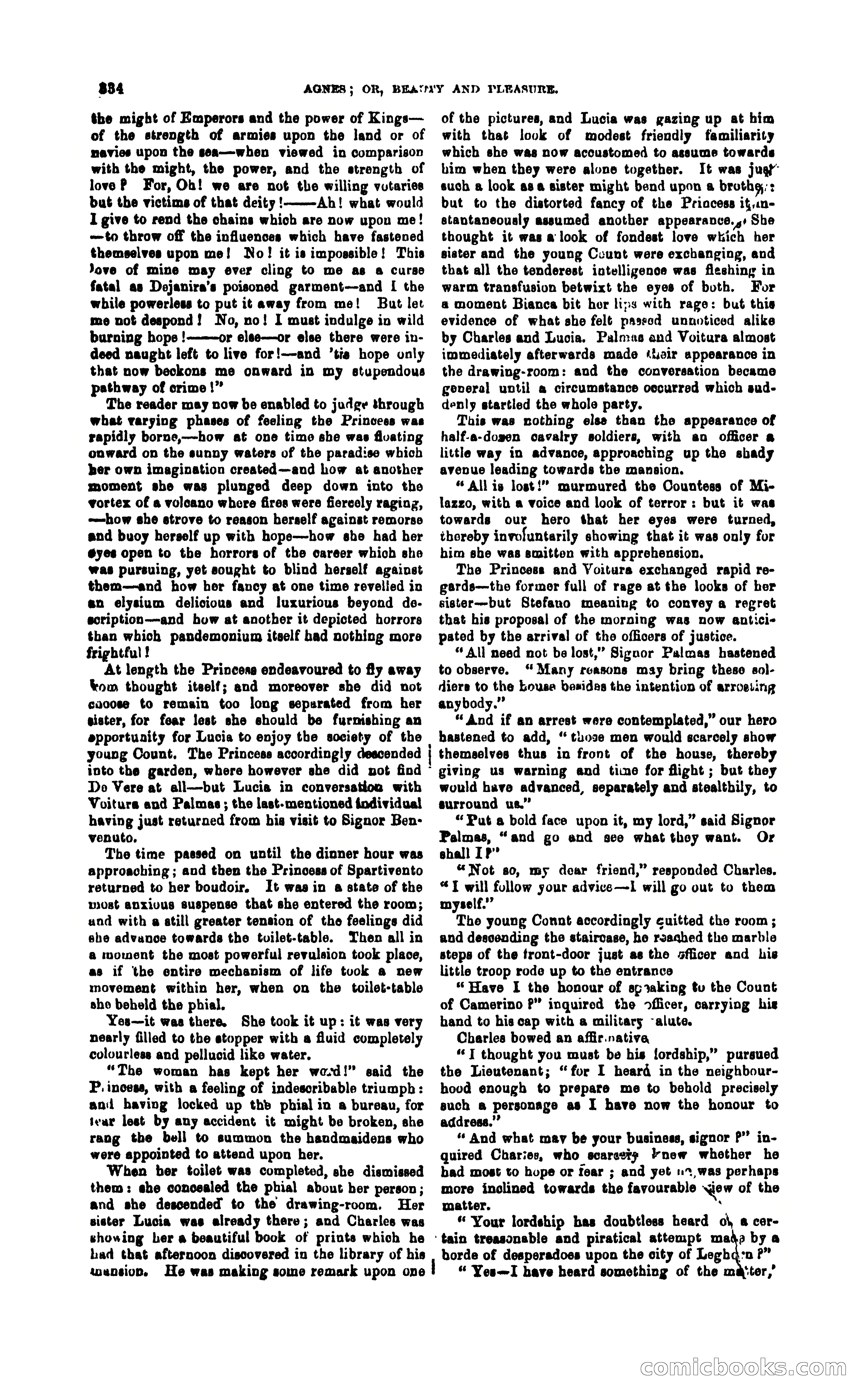
A restored page from Penny Dreadfuls, 1865. Page through the whole issue in the reader above.
📄 Transcribed text from this page (OCR, searchable)
Machine-transcribed from the original scan — historical spelling and the odd misread are preserved.
834 the might of Emperors and the power of Kings— of the strength of armies upon the land or of nevies upon the sea—when viewed in comparison with the might, the power, and the etrongth of love P For, Oh! we are not the willing vutaries but the victime of that deity !——-Ah! what would I give to rend the chains which are now upon me! —to throw off the influences which have fastened themselves upon me! No! it is impossible! This Jove of mine may ever cling to me as a curse fatal as Dojanira’s poisoned garment—and [ the while powerless to put it away from me! But let me not despond! No, no! I must indulge in wild burning hope !~———or elee—or else there were in- deed naught left to live for!—~and ’tis hope only that now beckons me onward in my stupendous pathway of crime !” The reader may now be enabled to judge through what varying phases of feeling the Princess wae rapidly borne,—how at one time she was fluating oaward on the sunny waters of the paradise which her own imagination created—and how at another moment she was plunged deep down into the wortex of a volcano where fires were fiercely raging, how she etrove to reason herself against remorse and buoy herself up with hope—bhow she had her @yes open to the horrors of the career which she was pursuing, yet sought to blind herself against them—and how her fancy at one time revelled in en elysium delicious and luxurious beyond de- scription—and how at another it depicted horrors than which pandemonium itself had nothing more frightful ! At length the Princosa endeavoured to fly away kom thought itself; and moreover she did not caoose to remain too long sepurated from her sister, for foar lest she should be furnishing an epportunity for Lucia to enjoy the society of the | young Count, The Princess accordingly descended into the garden, where however she did uot find © Do Vere at all—but Lucia in conversation with Voiture and Palmas ; the last-mentioned individual having just returned from bis visit to Signor Ben- venuto. The time passed on until the dinner hour was approaching ; and then the Princess of Spartivento returned to her boudoir. It was in a state of the wiost anxivus suspense that she entered the room; und with a atill greater tension of the feelings did she advance towards the tuilet-table. Then all in a moment the most powerful revulsion took place, as if the entire mechanism of life tuok a new movement within her, when on the toilot-table sho beheld the phial. Yes—it was there. She took it up: it was very nearly filled to the etopper with a fluid completely colourless and pellucid like water. “The woman has kept her wed!” said the P. incess, with a feeling of indescribable triumph: ani baving locked up the phial in a bureau, for tear lest by any accident it might be broken, she rang the bell to summon the handmaidens who were appointed to attend upon her. When ber toilet was completed, she dismissed them: she concealed the phial about ber person ; and she descended to the drawing-room. Her sister Lucia wae already there ; and Charles was showing ber a beautiful book of prints which he had that afternoon discovered in the library of his awensiop. He was making some remark upon one ‘tain treasonable and piratical attempt zn by a AGNES 5 OR, BEA'MY AND PLEASURE. of the pictures, and Lucia was gazing up at him with that look of modest friendly familiarity which she was now accustomed to assume towards bim when they were alone together. It was jugt such a look asa sister might bend upon a brothg,;: but to the distorted fancy of the Priacess it,m- atantaneously assumed another appearance.,» She thought it was a look of fondest love which her sister and the young Ccunt were exchanging, and that all the tenderest iatelligence was fleshing in warm transfusion betwixt the eyes of both. For @ moment Bianca bit hor lis with rage: but thie evidence of what she felt paseod unnoticed alike by Charles and Lucia. Palmas and Voitura almost immediately afterwards made (air appearance in the drawing-room: aud the conversation became goveral until a circumstance occurred which sud- denly startled the whole party. This was nothing else than the appearance of half-a-dozgen cavalry soldiers, with an officer a little way in advance, approaching up the sbady avenue leading towards the mansion. “Allis lost!” murmured the Countess of Mi- lazzo, with a woice and look of terror: but it was towards our hero that her eyes were turned, thereby invofunterily showing that it was only for him she was smitten with apprehension. Tho Princess and Voitura exchanged rapid re- gards—the former full of rage at the looks of her sister—but Stefano meaning to convey a regret that his proposal of the morning was now antici- pated by the arrival of the officers of justice. “ All need not be lost,” Signor Palmas hastened to observe. “ Many reasons may bring these sol- diere to the Louse besidas the intention of arroeiing anybody.” “And if an arrest were contemplated,” our hero hastened to add, “ tuose men would scarcely show themeelves thus in front of the house, thereby giving us warning and time for flight; but they would have advanced, separately and stealtbily, to surround us.” “Put a bold face upon it, my lord,” said Signor Palmas, “and go and see what they want. Or ehall Ip” “Not so, my dear friend,” responded Charles. “J will follow your advice—l will go out to them myself.” The young Connt accordingly cuitted the room ; and descending the staircase, ho rsaghed the marble steps of the tront-door just as the officer and his little troop rode up to the entrance “Have I the honour of sp raking tu the Count of Camerino ?” inquired the officer, carrying his hand to his cap with a military -alute. Charles bowed an affir.nativa “‘T thought you must be his fordship,” pursued the Lieutenant; “for I heard in the neighbour- hood enough to prepare me to behold precisely such a personage as I have now the honour to address.” “ And what may be your business, signor P” in- quired Charies, who ecarsetz new whether he bad most to hope or fear ; and yet 1%, was perhaps more inclined towards the favourable Yew of the matter. ‘ “ Your lordship bas doubtless heard ol, a cor- borde of desperadoes upon the city of Leghq:n P” “ Yes—I have heard something of the majter,’ COMUGIOO S CO