
Penny Dreadfuls, 1865 · page 13 of 400
Agnes: A Tale of the Streets — page 13: what you’re looking at
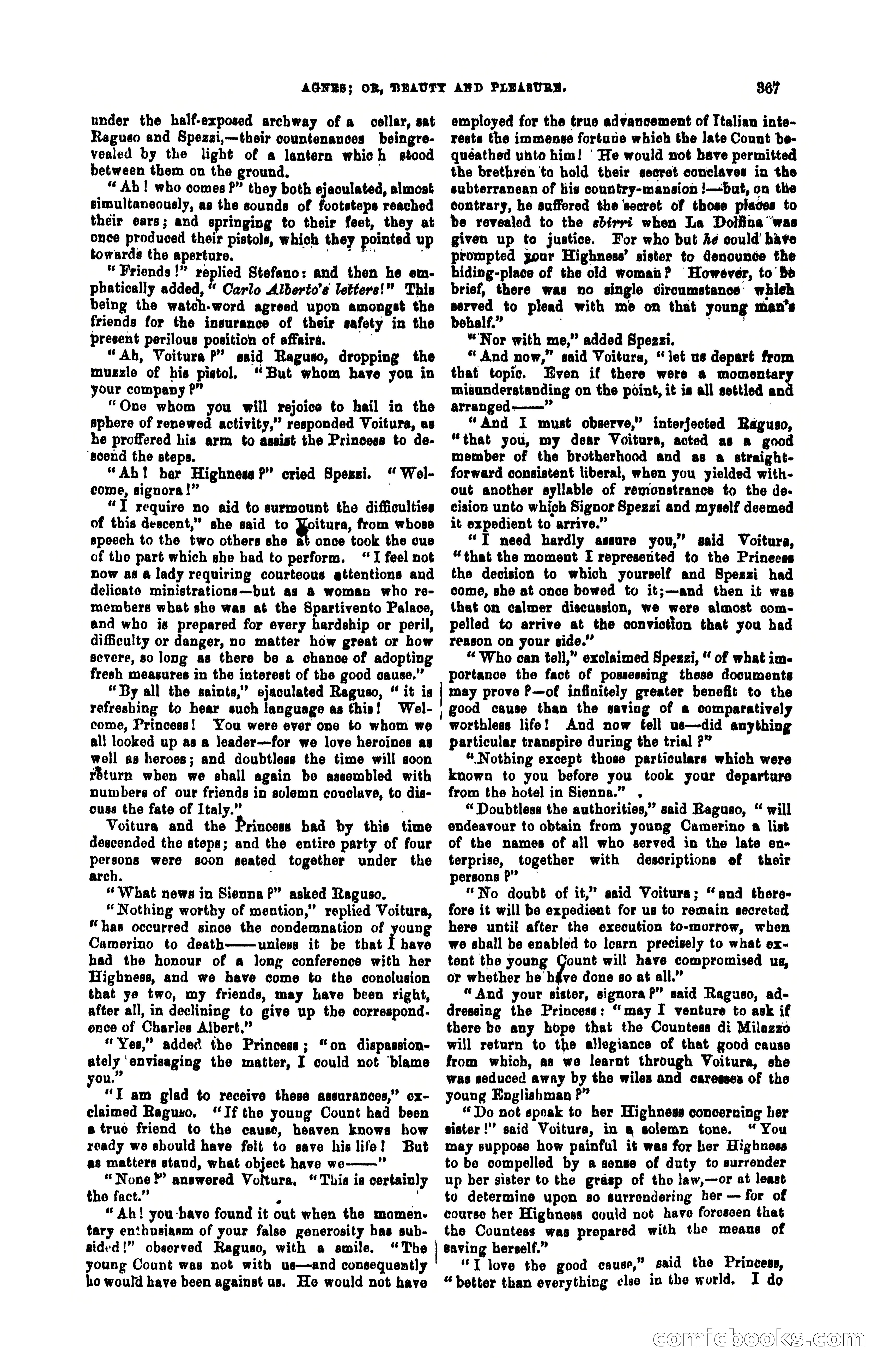
A restored page from Penny Dreadfuls, 1865. Page through the whole issue in the reader above.
📄 Transcribed text from this page (OCR, searchable)
Machine-transcribed from the original scan — historical spelling and the odd misread are preserved.
AGNES; OR, DEAUTY AND PLEASURE. under the half-exposed archway of a cellar, sat Raguso and Spezzi,—their countenances beingre- vealed by the light of a lantern which stood between them on the ground. “Ah! who comes P” they both ejaculated, almost simultaneously, as the sounds of footsteps reached their ears; and springing to their feet, they at once produced their pistols, which they pointed up towards the aperture. on “Friends!” replied Stefano: and then he em- phatically added, “ Carlo Alberto's letters!" This being the watch-word agreed upon amongst the friends for the insurance of their safety in the present perilous position of affaira. “Ah, Voitura P” said Raguso, dropping the muzzle of his pistol. “But whom have you in your company P” “One whom you will rejoice to hail in the sphere of renewed activity,” responded Voitura, as he proffered his arm to assist the Princess to de- ‘scend the ateps. “Ah! har Highness?” cried Spezzi. “ Wel- come, signora!” “T require no aid to surmount the difficulties of this descent,” she said to Goiture, from whose speech to the two others she at once took the cue of the part which she bad to perform. “TI feel not now as a lady requiring courteous ettentions and delicato ministrations—but as a woman who re- members what sho was at the Spartivento Palace, and who is prepared for every hardship or peril, difficulty or danger, no matter how great or how severe, 80 long as there be a chance of adopting fresh measures in the interest of the good cause.” “By all the saints,” ejaculated Raguao, “ it is refreshing to hear such language as this! come, Princess! You were ever one to whom we all looked up as a Jeader—for we love heroines as well as heroes; and doubtless the time will soon r8turn whon we shall again be assembled with numbers of our friends in solemn conclave, to dis- cusa the fate of Italy.” Voitura and the Princess had by this time descended the steps; and the entire party of four persons were soon seated together under the arch. “What news in Sienna P” asked Raguao. “Nothing worthy of mention,” replied Voitura, “has occurred since the condemnation of young Camerino to death———unless it be that I have had the honour of a long conference with her Highness, and we have come to the conclusion that ye two, my friends, may have been right, after all, in declining to give up the correspond- ence of Charles Albert.” “Yes,” added the Princess; “on dispassion- ately ‘envisaging the matter, I could not ‘blame ou. “T am glad to receive these assurances,” ex- claimed Raguso. “Ifthe young Count had been atruo friend to the cause, heaven knows how ready we should have felt to save his life! But as matters stand, what object have we——” “None answered Voitura. “This ie certain! the fact.” ° “Ah! you -havo found it out when the momen- tary enthusiasm of your false generosity has sub- sided!” observed Raguso, with a amile. “The young Count was not with us—and consequently ho would have been against us. Hoe would not have Wel- | 867 employed for the true advancement of Italian inte- reste the immense fortune which the late Count be- quéathed unto him! ‘He would not have permitted the brethren td hold their secret conclaves in the subterranean of his country-mansion !—~but, on the contrary, he suffered the secret of those places to be revealed to the sbirri when La Dolfina “was given up to justice. For who but hé could bave prompted your Highness’ sister to @enounce the hiding-place of the old woman? However, to be brief, there was no single circumstance’ which served to plead with me on that young man’s behalf.” “Nor with me,” added Spezzi. * And now,” said Voitura, “let us depart from that topic. Even if there were a momentar misunderstanding on the point, it is all settled a arranged-——”” ' “And I must observe,” interjected Raguso, “that you, my dear Voitura, acted as a good member of the brotherhood and as a straight- forward consistent liberal, when you yielded with- out another syllable of remonstrance to the de- cision unto which Signor Spezzi and myself deemed it expedient to arrive.” “‘T need hardly assure you,” said Voitura, “that the moment I represented to the Prineces the decision to which yourself and Spezzi had come, she at once bowed to it;—and then it was that on calmer discussion, we were almost com- pelled to arrive at the conviction that you had reason on your side.” “Who can tell,” exclaimed Spezzi, “ of what im- portance the fact of possessing these documents may prove P—of infinitely greater benefit to the good cause than the saving of a comparatively worthless life! And now fell us—did anything particular transpire during the trial ?” “Nothing except those particulara which were known to you before you took your departure from the hotel in Sienna.” . “Doubtless the authorities,” said Raguso, “ will endeavour to obtain from young Camerino a list of the names of all who served in the late en- terprise, together with descriptions of their persons ?” ‘No doubt of it,” said Voitura; “and there. fore it will be expedient for us to remain secreted here until after the execution to-morrow, when we shall be enabled to learn precisely to what ex- tent the young Count will have compromised us, or whether he have done so at all.” “ And your sister, signoraP” said Raguso, ad- dressing the Princess: “may I venture to ask if there bo any hope that the Countess di Milazzo will return to the allegiance of that good causo from which, as wo learnt through Voitura, she was seduced away by the wiles and caresses of tho young Englishman P” “Do not speak to her Highness concerning her sister!” said Voitura, in a solemn tone. “ You may suppose how painful it was for her Highness to be compelled by a sense of duty to surrender up her sister to the grasp of tho law,—or at least to determine upon so surrendering ber — for of course her Highness could not have foreseen that the Countess was prepared with the means of saving hereelf.” ; “T love the good cause,” said the Princess, “better than everything else in the world. I do Oo CoMmiclboo S CO