
Penny Dreadfuls, 1865 · page 125 of 400
Agnes: A Tale of the Streets — page 125: what you’re looking at
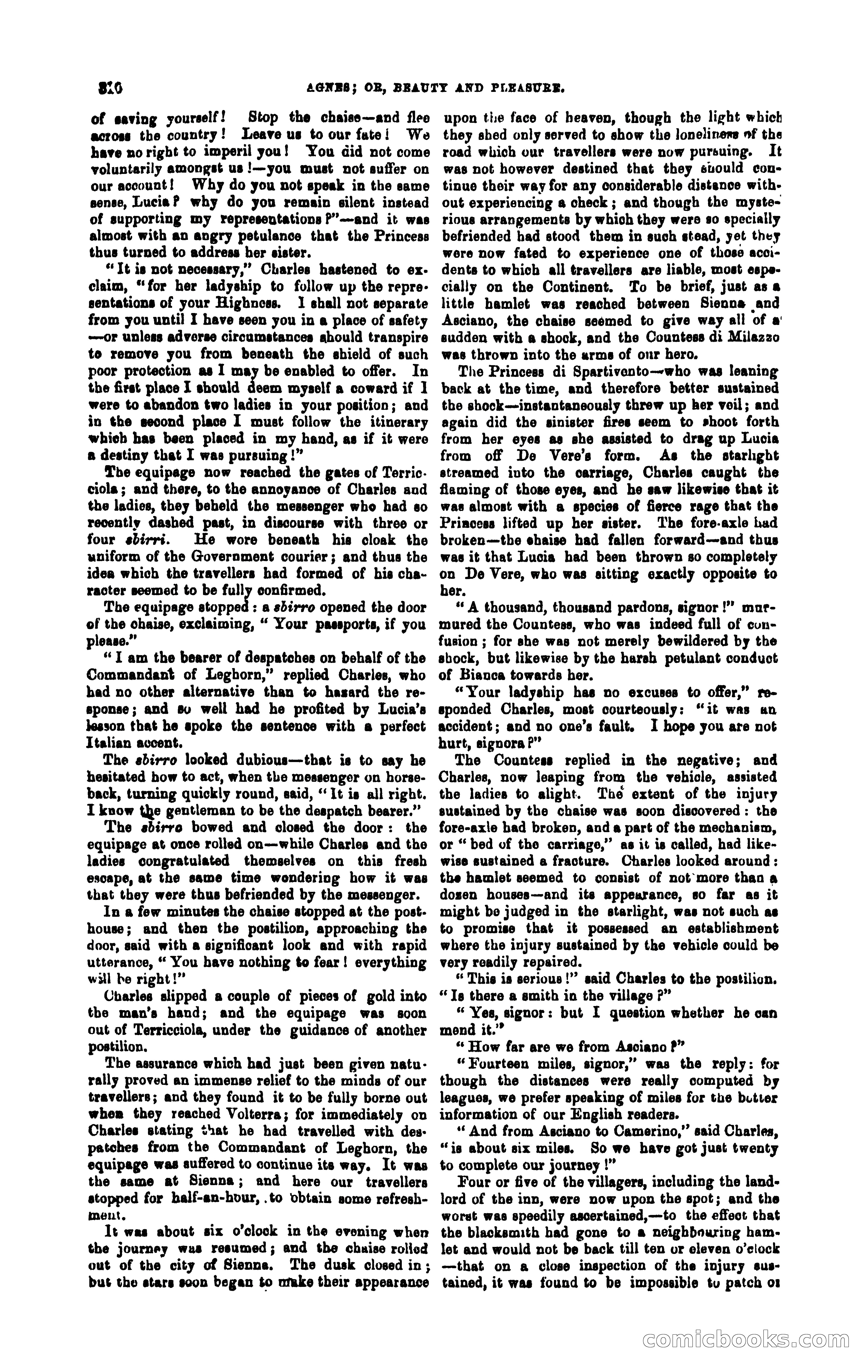
A restored page from Penny Dreadfuls, 1865. Page through the whole issue in the reader above.
📄 Transcribed text from this page (OCR, searchable)
Machine-transcribed from the original scan — historical spelling and the odd misread are preserved.
16 of saving yourself! Stop the chaise—and flee across the country! Leave us to our fatei We have no right to imperil you! You did not come voluntarily amongst us !—you must not suffer on our account! Why do you not speak in the same sense, LuciaP why do you remain silent instead of supporting my representations P’—~and it was almost with an angry petulance that the Princess thus turned to address her sister. ‘It is not necessary,” Charles hastened to ex- claim, “for her ladyship to follow up the repre- sentations of your Highness. I shall not separate from you until I have seen you in a place of safety —or unless adverse circumstances ahould transpire to remove you from beneath the sbield of such poor protection as I may be enabled to offer. In the first place I should deem myself a coward if ] were to abandon two ladies in your position; and in the second place I must follow the itinerary which bas been placed in my hand, as if it were a destiny that I was pursuing !” The equipage now reached the gates of Terric- ciola; and there, to the annoyance of Charles and the ladies, they bebeld the messenger who had so recently dashed past, in discourse with three or four sbirri. He wore beneath hia cloak the uniform of the Government courier; and thus the idea which the travellers had formed of bis cha- racter seemed to be fully confirmed. The equipage stopped : a sbirro opened the door of the chaise, exclaiming, “ Your paesports, if you please.” ‘“‘T am the bearer of despatches on behalf of the Commandant of Leghorn,” replied Charles, who had no other alternative than to hasard the re- sponse; and ev well had he profited by Lucia’s lesson that he spoke the sentence with a perfect Italian accent. The sbirro looked dubious—that is to say he hesitated how to act, when the messenger on horse- back, turning quickly round, said, “It is all right. I know the gentleman to be the despatch bearer.” The sbirro bowed and closed the door: the equipage at once rolled on—while Charles and tho ladies congratulated themselves on this fresh escape, at the same time wondering how it was that they were thus befriended by the messenger. In a few minutes the chaise stopped at the post- house; and then the postilion, approaching the door, said with a significant look and with rapid utterance, “ You have nothing to fear! everything will be right!” Charles slipped a couple of pieces of gold into tbe man’s hand; and the equipage was soon out of Terricciola, under the guidance of another postilion. The assurance which had just been given natu- rally proved an immense relief to the minds of our travellers; and they found it to be fully borne out when they reached Volterra; for immediately on Charles stating that he had travelled with des- patches from the Commandant of Leghorn, the equipage was suffered to continue its way. It was the same at Sienna; and here our travellers stopped for half-an-hour, .to obtain some refresh- ment. It was about six o’clock in the evening when the journey ws resumed; and the chuise rolled out of the city of Sienne. The dusk closed in; but the stars soon began to omke their appearance AGNES; OR, BEAUTY AND PLEASURE. upon the face of heaven, though the light which they shed only served to show the loneliness of the road which our travellers were now pursuing. It was not however destined that they sould con- tinue their way for any considerable distence with- out experiencing a check ; and though the myste- rious arrangements by which they were so specially befriended had stood them in such stead, yet they were now fated to experience one of those acci- dents to which all travellers are liable, most espe- cially on the Continent. To be brief, just as a little bamlet was reached between Sienna and Asciano, the chaise seemed to give way all of a sudden with a shock, and the Countess di Milazzo was thrown into the arms of onr hero, The Princess di Spartivento—-who was leaning back at the time, and therefore better sustained the shock—instantaneously threw up her voil; and again did the sinister fires seem to shoot forth from her eyes as she assisted to drag up Lucia from off De Vere’a form. As the starlight streamed iuto the carriage, Charles caught the flaming of those eyes, and he saw likewise that it was almost with a species of fierce rage that the Princess lifted up her sister. The fore-axle had broken—the ehaise had fallen forward—~and thus wae it that Lucia had been thrown so completely on De Vere, who was sitting exactly opposite to her. ‘A thousand, thousand pardons, signor !” mur- mured the Countess, who was indeed full of cun- fusion ; for she was not merely bewildered by the sbock, but likewise by the harsh petulant conduct of Bianca towards her. “Your ladyship has no excuses to offer,” re- sponded Charles, most courteously: “it was an accident; and no one’s fault. I hope you are not hurt, signora P” The Countess replied in the negative; and Charles, now leaping from the vehicle, assisted the ladies to alight. The extent of the injury sustained by the chaise was soon discovered : the fore-ax\e had broken, and a part of the mechanism, or “ bed of the carriage,” as it is called, had like- wise sustained a fracture. Charles looked around : the hamlet seemed to consist of not more than a dosen houses—and its appearance, so far as it might be judged in the starlight, wae not such as to promise that it possessed an establishment where the injury sustained by the vehicle could be very readily repaired. “ This is serious!” said Charles to the postilion. “Is there a smith in the village P” “ Yes, signor: but I question whether he can mond it.” “‘ How far are we from Asciano ?” “Fourteen miles, signor,” was the reply: for though the distances were really computed by leagues, we prefer speaking of miles for the butter information of our English readers. *‘ And from Asciano to Camerino,” said Charles, “is about six miles. So we have got just twenty to complete our journey !” Four or five of the villagers, including the land- lord of the inn, were now upon the spot; and the worst was speedily ascertained,—to the effect that the blacksmith had gone to a neighbouring ham- let and would not be back till ten or eleven o’clock —that on a close inspection of the injury sus- tained, it was found to be impossible tu patch o1 Oo Conn GIOoOks CO