
Penny Dreadfuls, 1865 · page 106 of 400
Agnes: A Tale of the Streets — page 106: what you’re looking at
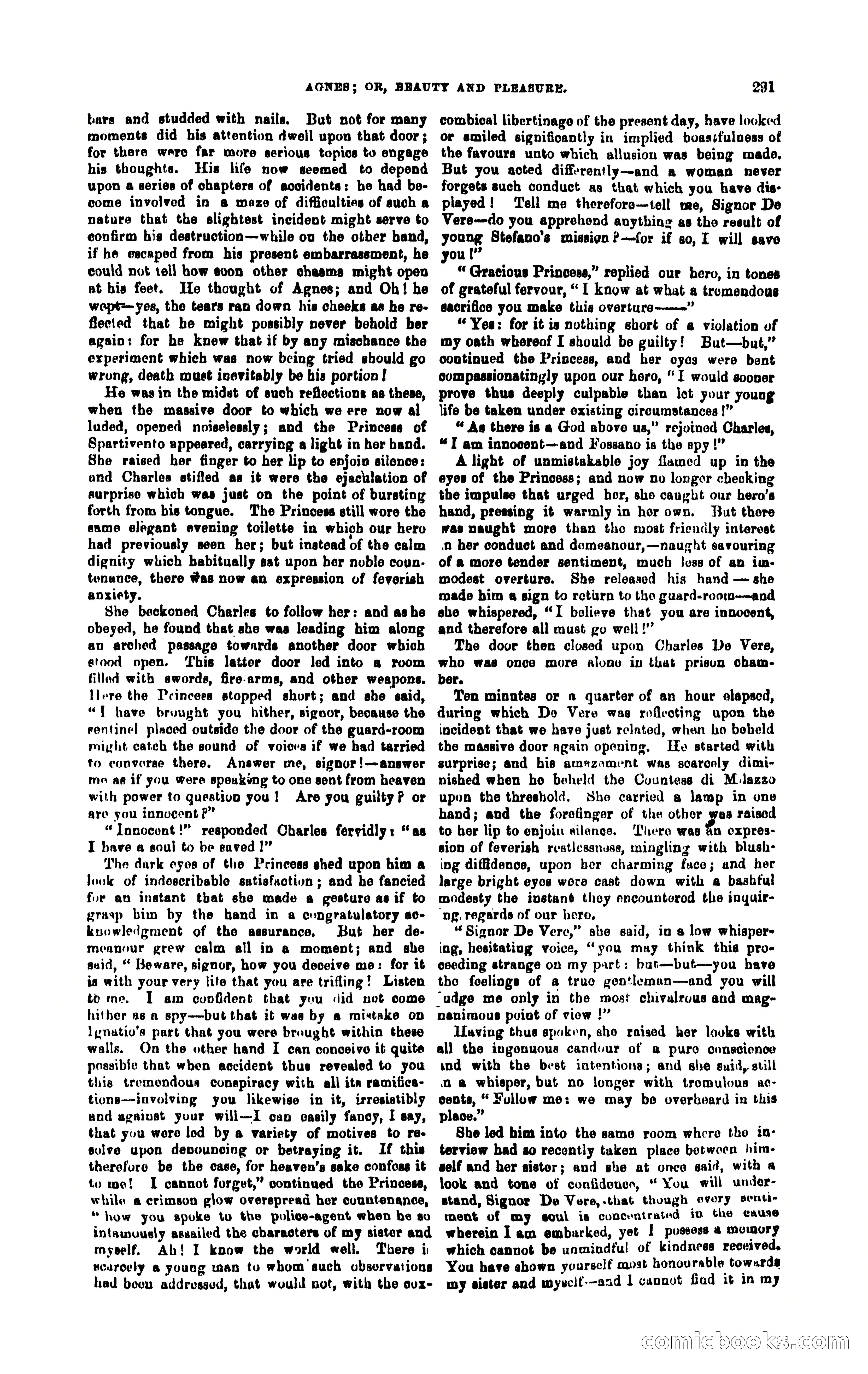
A restored page from Penny Dreadfuls, 1865. Page through the whole issue in the reader above.
📄 Transcribed text from this page (OCR, searchable)
Machine-transcribed from the original scan — historical spelling and the odd misread are preserved.
AGNES; OR, BEAUTY AND PLEASURE, bars and studded with naile. But not for many moments did his attention dwell upon that door ; for there wero far more serious topics to engage his thoughts. His life now seemed to depend upon a series of chapters of accidents: he had be- come involved in a maze of difficulties of such a nature that the slightest incident might serve to confirm his destruction—while ou the other hand, if he escaped from his present embarrassment, he could not tell how soon other chasms might open at bis feet. He thought of Agnes; and Oh! he wept—yes, the tears ran down his cheeks as he re- flected that he might possibly never behold ber again: for he knew that if by any mischance the experiment which was now being tried should go wrong, death must inevitably be his portion ! He was in the midat of such reflections as these, when the massive door to which we ere now al luded, opened noiselessly; and the Princesa of Spartivento appeared, carrying a light in her band. She raised her finger to her lip to enjoiv silence: and Charles stifled as it were the ejaculation of surprise which was just on the point of bursting forth from bis tongue. The Princess still wore the same elegant evening toilette in which our hero had previously seen her; but instead of the calm dignity which babitually sat upon her noble coun- tenance, there Was now an expression of feverish anxiety. She beckoned Charles to follow her: and ashe obeyed, he found that she was leading him along an arched passage towards another door which atood open. This latter door led into a room filled with swords, firearms, and other weapons. lfere the Princees stopped short; and she said, “f have brought you hither, sigoor, because the rentinel placed outside the door of the guard-room might catch the sound of voices if we had tarried to convorse there. Answer me, signor!—answer me aa if you were speakeng to one sent from heaven with power to queatiun you! Are you guilty? or are you innucent P” Innocent!” responded Charles fervidly: ‘as I have a soul to be saved !” The dark eyos of the Princess shed upon him a Jook of indescribable satisfaction; and he fancied fur an instant tbat she made a gesturo as if to grasp bim by the hand in a cungratulatory ac- knowledigment of the assurance. But her de- meanour grew calm all in a moment; and she suid, “ Beware, signor, how you deceive me: for it is with your very life that you are trifling! Listen to me. IT am confident that you did not come hither as a spy—but that it was by a mistake on lynatio’s part that you were brought within theese walls. On the other hand I can conceive it quite possibic that when accident thus revealed to you this tremendous conspiracy with all its ramifica- tions—involving you likewise in it, irresistibly and against your will—I can easily fancy, I say, that you were lod by a variety of motives to re- suive upon denouncing or betraying it. If this therofure be the case, for heaven's sake confess it to me! I cannot forget,” continued the Princess, while a crimson glow overspread her countenance, “how you spoke to the pulice-agent when be so infamously assailed the characters of my sister and myeelf. Ah! I know the world well. There ii scarcely a young man to whom such ubservations had boeu addressed, that would not, with the oux- 291 combical libertinage of the present day, have looked or smiled significantly in implied bvoas¢fulness of the favours unto which allusion was being made. But you acted differently—and a woman never forgets such conduct as that which you have die- played! Tell me therefore—tell me, Signor De Vere—do you apprehend anything as the result of young Stefano's missiyn ?—~for if so, I will save you |” “ Gracious Princess,” replied our hero, in tones of grateful fervour, “I know at what a tromendous sacrifice you make this overture-———” “You: for it is nothing short of a violation of my oath whereof I should be guilty! But—but,” continued the Princess, and her eyos were bent compassionatingly upon our hero, “I would sooner prove thus deeply culpable than let your young life be taken under oxisting circumstances |” “ As there is a God above us,” rejoined Charles, “TI am innocent—and Fossano is the apy !” A light of unmistakable joy flamed up in the eyes of the Princess; and now no longor checking the impulse that urged hor, sho cauyzht our hero’s hand, pressing it warmly in hor own. But there was naught more than the most fricndly interest .o her conduct and demeanour, —naucht savouring of a more tender sentiment, much lvss of an im- modest overture. Sho released his hand — she made him a sign to return to the guard-room—and she whispered, “I believe that you are innocent, and therefore all must go well!” The dovr then closed upon Charles De Vere, who was once more alonv in that prisun cham- ber. Ten minntes or a quarter of an hour elapsed, during which De Vere was roficcting upon the incident that we have juat related, whan ho beheld the massive door again opening, Ie started with surprise; and his amszament was scarcely dimi- nished when ho beheld the Countess di Milazzo upon the threshold. She carried a lamp in one hand; and the forefinger of the other was raised to her lip to enjoin silence. There was a oxpres- sion of feverish resticssnusa, mingling with blush- ing diffidence, upon ber charming fuce; and her large bright eyos wore cast down with a bashful modesty the instant they encounterod the inquir- “ng. regards of our hero. “Signor De Vere,” she said, in a low whisper ing, hesitating voice, “you may think thia pro- ceeding strange on my part: but—but—you have tho foelinge of a truc gentleman—and you will “udge me only in the most chivalrous and mag- nenimous puiat of view !” Having thus spaken, she raised her looks with all the ingenuous candour of a pure conscience ind with the best intentions; and she suid, still 0 @ whisper, but no longer with tremulous ac- cants, “ Yollow me: we may be overbeard in this place.” She led him into the same room where the in- terview bad so recontly taken place botwoen him- self and ber sister; aud she at once said, with a look and tone of cuonfidonen, “ You will under- stand, Signor De Vere,-that thuugh every senti- ment of my soul is concentrated in the cause wherein I am embarked, yet 1 possess a mewory which cannot be unmindful of kindness received. You have abown yourself most honourable towards my sister and wyscif--aad 1 cannot fiad it in my comicboo G S CO