
Penny Dreadfuls, 1890 · page 17 of 263
Detective Bob Bridger — page 17: what you’re looking at
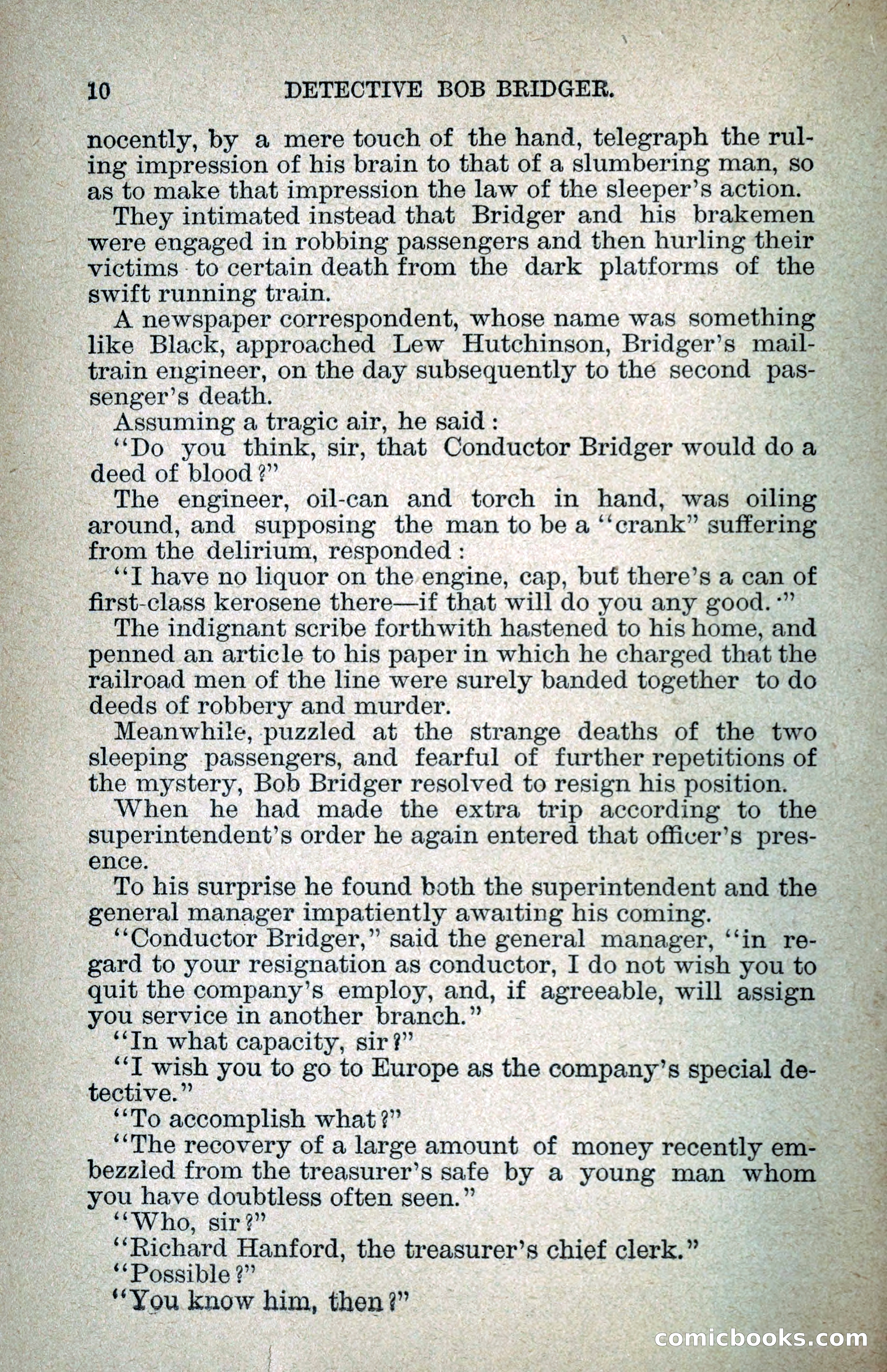
A restored page from Penny Dreadfuls, 1890. Page through the whole issue in the reader above.
📄 Transcribed text from this page (OCR, searchable)
Machine-transcribed from the original scan — historical spelling and the odd misread are preserved.
10 DETECTIVE BOB BRIDGER. nocently, by a mere touch of the hand, telegraph the rul- ing impression of his brain to that of a slumbering man, so ~ as to make that impression the law of the sleeper’s action. They intimated instead that Bridger and his brakemen were engaged in robbing passengers and then hurling their victims - to certain death from the dark platforms of the swift running train. A newspaper correspondent, whose name was something like Black, approached Lew Hutchinson, Bridger’s mail- — train engineer, on the day subsequently to the second pas- senger’s death. Assuming a tragic air, he said: ‘Do you think, sir, that Conductor Bridger would do a deed of blood ?” . The engineer, oil-can and torch in hand, was oiling around, and supposing the man to be a ‘‘crank” suffering from the delirium, responded : ‘‘T have no liquor on the engine, cap, buf there’s a can of first-class kerosene there—if that will do you any good.~*” The indignant scribe forthwith hastened to his home, and penned an article to his paper in which he charged that the railroad men of the line were surely banded together to do deeds of robbery and murder. Meanwhile, puzzled at the strange deaths of the two — sleeping passengers, and fearful of further repetitions of the mystery, Bob Bridger resolved to resign his position. When he had made the extra trip according to the superintendent’s order he again entered that offiver’s pres- ence. To his surprise he found both the superintendent and the general manager impatiently awaiting his coming. ‘‘Conductor Bridger,” said the general manager, ‘‘in re- gard to your resignation as conductor, I do not wish you to quit the company’s employ, and, if agreeable, will assign you service in another branch.” ‘‘In what capacity, sir?” “I wish you to go to Europe as the company’s special de- tective.” ‘To accomplish what ?” ‘ ‘The recovery of a large amount of money recently em- bezzled from the treasurer’s safe by a young man whom you have doubtless often seen.” “Who, sir?” ‘‘Richard Hanford, the treasurer’s chief clerk.” ‘*Possible ?” ‘You. know him, then ?” ; J I “ar -. * a¥ 2 Ne or - sy ae £- d * a FEOMIUICE Ss.co * -~ rs ¥ . : ee Aa, > *, i ", . —_— * .