
Penny Dreadfuls, 1895 · page 172 of 215
A Daughter of Maryland — page 172: what you’re looking at
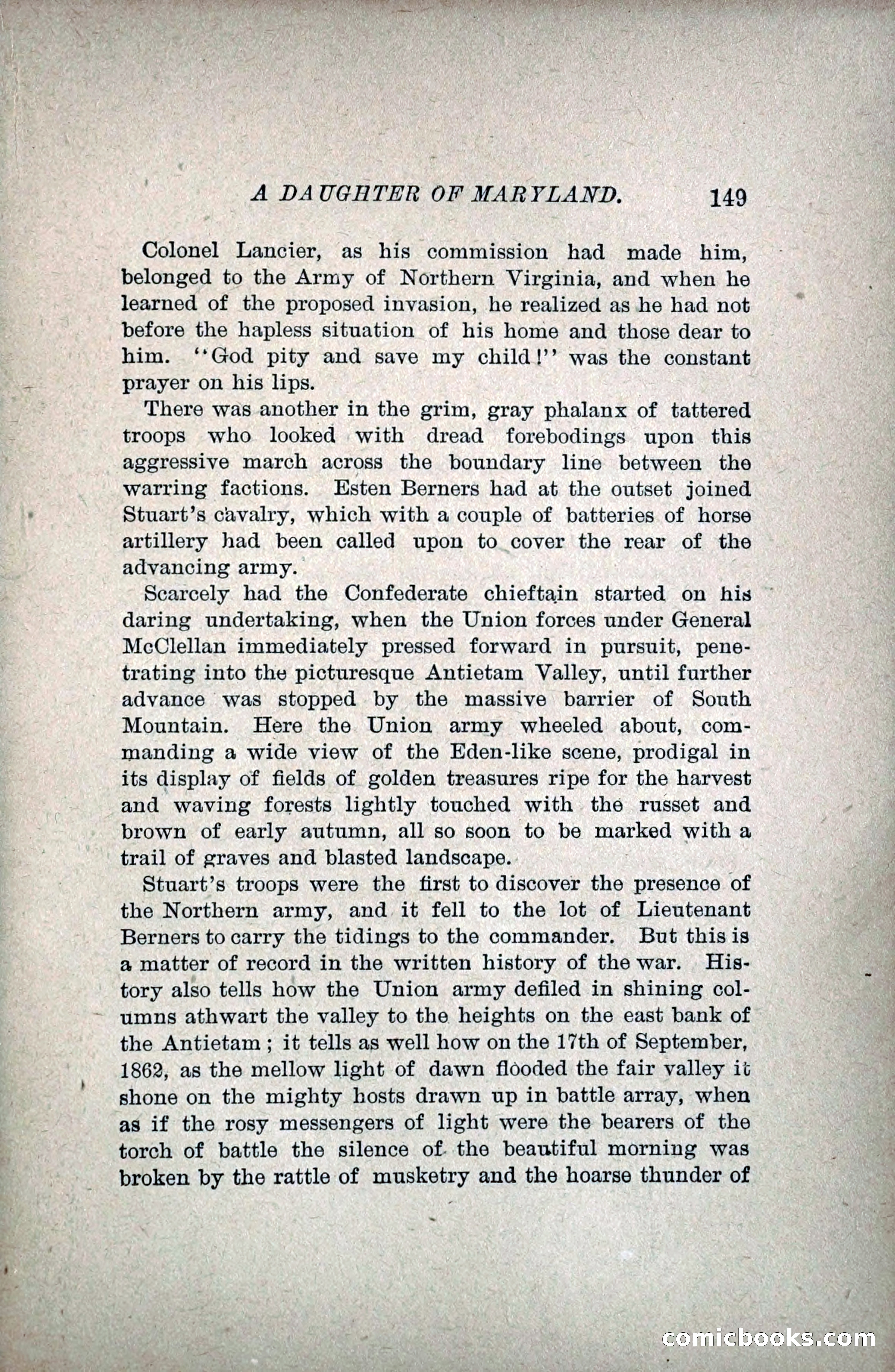
A restored page from Penny Dreadfuls, 1895. Page through the whole issue in the reader above.
📄 Transcribed text from this page (OCR, searchable)
Machine-transcribed from the original scan — historical spelling and the odd misread are preserved.
w «had J swt ty, PRY wr. at Xe Ae a ae | TY se we ae eS A 4 oie Wu a fe: he = Y Oy Vee ‘La. A eee kA ale be ‘ are 9 i ine 1h eae ig ales ei ly : OT ede Sai se Wea OAR mal ye PLM tase) Sock nl Te ye 4 ape uae : 7 A DAUGHTER OF MARYLAND. 149 Colonel Lancier, as his commission had made him, belonged to the Army of Northern Virginia, and when he learned of the proposed invasion, he realized as he had not before the hapless situation of his home and those dear to him. ‘*God pity and save my child!’’ was the constant prayer on his lips. There was another in the grim, gray phalanx of tattered troops who looked with dread forebodings upon this aggressive march across the boundary line between the warring factions. Hsten Berners had at the outset joined Stuart’s cavalry, which with a couple of batteries of horse artillery had been called upon to cover the rear of the advancing army. Scarcely had the Confederate chieftain started on his ~ daring undertaking, when the Union forces under General McClellan immediately pressed forward in pursuit, pene- trating into the picturesque Antietam Valley, until further advance was stopped by the massive barrier of South Mountain. Here the Union army wheeled about, com- manding a wide view of the Eden-like scene, prodigal in its display of fields of golden treasures ripe for the harvest and waving forests lightly touched with the russet and brown of early autumn, all so soon to be marked with a trail of graves and blasted landscape. Stuart’s troops were the first to discover the presence of the Northern army, and it fell to the lot of Lieutenant Berners to carry the tidings to the commander. But thisis a matter of record in the written history of the war. His- tory also tells how the Union army defiled in shining col- umns athwart the valley to the heights on the east bank of the Antietam ; it tells as well how on the 17th of September, 1862, as the mellow light of dawn flooded the fair valley it shone on the mighty hosts drawn up in battle array, when as if the rosy messengers of light were the bearers of the torch of battle the silence of. the beautiful morning was broken by the rattle of musketry and the hoarse thunder of 7 cS co Eomicboo