
Penny Dreadfuls, 1901 · page 46 of 324
D'Artagnan, the King Maker — page 46: what you’re looking at
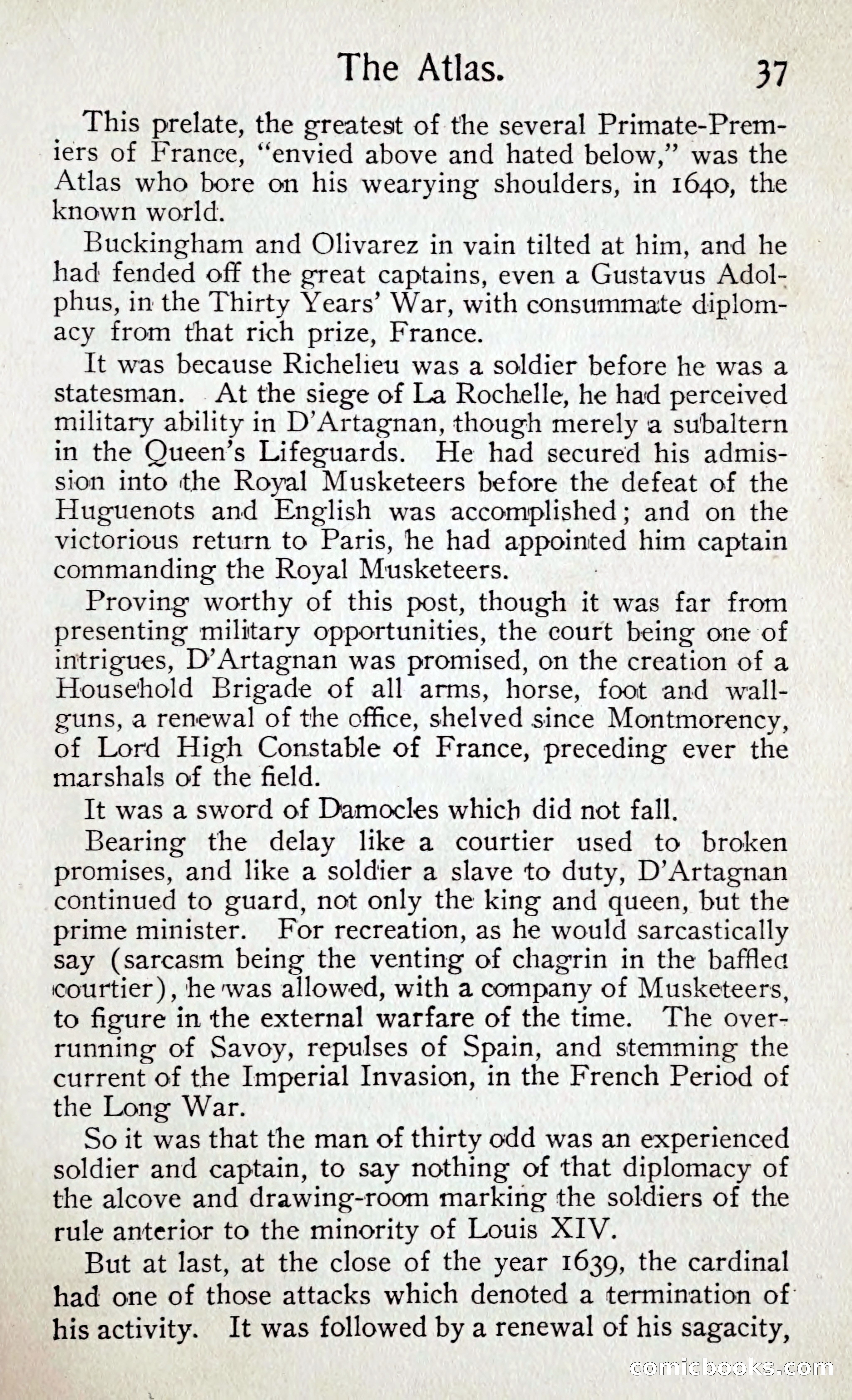
A restored page from Penny Dreadfuls, 1901. Page through the whole issue in the reader above.
📄 Transcribed text from this page (OCR, searchable)
Machine-transcribed from the original scan — historical spelling and the odd misread are preserved.
The Atlas. 37 This prelate, the ereatest of the several Primate-Prem- iers of France, ‘envied above and hated below,” was the Atlas who bore on his wearying shoulders, in 1640, the known world. Buckingham and Olivarez in vain tilted at him, and he had fended off the great captains, even a Gustavus Adol- phus, in the Thirty Years’ War, with consummate diplom- acy from that rich prize, France. It was because Richelieu was a soldier before he was a statesman. At the siege of La Rochelle, he had perceived military ability in D’Artagnan, though merely a subaltern in the Queen’s Lifeguards. He had secured his admis- sion into the Royal “Musketeers before the defeat of the Huguenots and English was accomplished; and on the victorious return to Paris, he had appointed him captain commanding the Royal Musketeers. Proving worthy of this post, though it was far from presenting military opportunities, the court being one of intrigues, D’Artagnan was promised, on the creation of a Household Brigade of all arms, horse, foot and wall- guns, a renewal of the office, shelved since Montmorency, of Lord High Constable of France, preceding ever the marshals of the field. It was a sword of Damocles which did not fall. Bearing the delay like a courtier used to broken promises, and like a soldier a slave to duty, D’Artagnan continued to guard, not only the king and queen, but the prime minister. For recreation, as he would sarcastically say (sarcasm being the venting of chagrin in the bafflea courtier), he was allowed, with a company of Musketeers, to figure in the external warfare of the time. The over- running of Savoy, repulses of Spain, and stemming the current of the Imperial Invasion, in the French Period of the Long War. So it was that the man of thirty odd was an experienced soldier and captain, to say nothing of that diplomacy of the alcove and drawing-room marking the soldiers of the rule anterior to the minority of Louis XIV. But at last, at the close of the year 1639, the cardinal had one of those attacks which denoted a termination of his activity. It was followed by a renewal of his sagacity, GOmMicbdooksace iim