
Penny Dreadfuls, 1901 · page 228 of 324
D'Artagnan, the King Maker — page 228: what you’re looking at
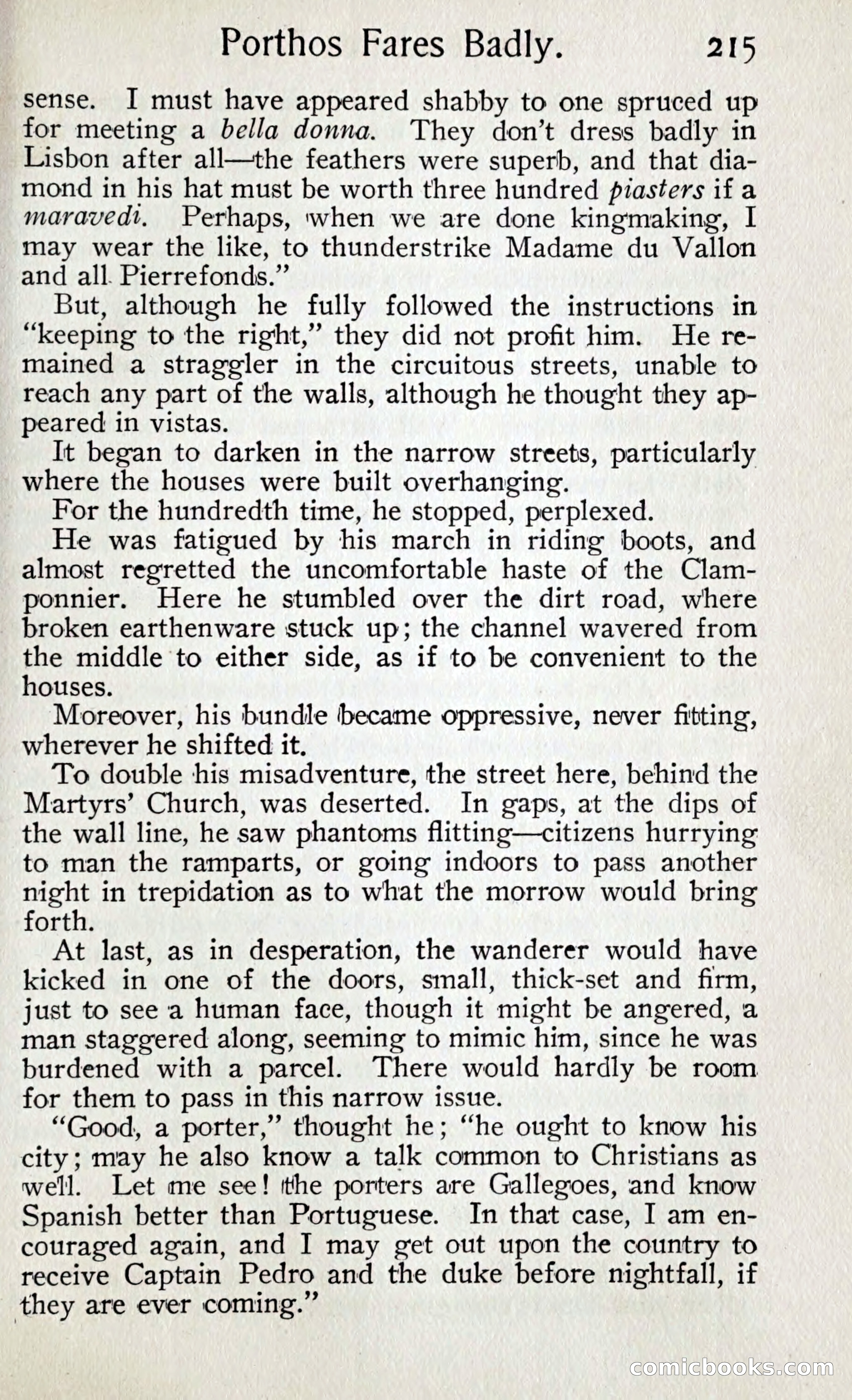
A restored page from Penny Dreadfuls, 1901. Page through the whole issue in the reader above.
📄 Transcribed text from this page (OCR, searchable)
Machine-transcribed from the original scan — historical spelling and the odd misread are preserved.
Porthos Fares Badly. 215 sense. I must have appeared shabby to one spruced up for meeting a bella donna. ‘They don’t dress badly in Lisbon after all—the feathers were superb, and that dia- mond in his hat must be worth three hundred piasters if a maravedt. Perhaps, when we are done kingmaking, I may wear the like, to thunderstrike Madame du Vallon and all Pierrefonds.” But, although he fully followed the instructions in “keeping to the right,” they did not profit him. He re- mained a stragegler in the circuitous streets, unable to reach any part of the walls, although he thought they ap- peared in vistas. It began to darken in the narrow streets, particularly where the houses were built overhanging. For the hundredth time, he stopped, perplexed. He was fatigued by his march in riding boots, and almost regretted the uncomfortable haste of the Clam- ponnier. Here he stumbled over the dirt road, where broken earthenware stuck up; the channel wavered from the middle to either side, as if to be convenient to the houses. Moreover, his bundle became oppressive, never fitting, wherever he shifted it. To double ‘his misadventure, the street here, behind the Martyrs’ Church, was deserted. In gaps, at the dips of the wall line, he saw phantoms flitting—citizens hurrying to man the ramparts, or going indoors to pass another night in trepidation as to what the morrow would bring forth. At last, as in desperation, the wanderer would have kicked in one of the doors, small, thick-set and firm, just to see a human face, though it might be angered, a man staggered along, seeming to mimic him, since he was burdened with a parcel. There would hardly be room for them to pass in this narrow issue. “Good, a porter,” thought he; “he ought to know his city; may he also know a talk common to Christians as well. Let me see! tthe porters are Gallegoes, and know Spanish better than Portuguese. In that case, I am en- couraged again, and I may get out upon the country to receive Captain Pedro and the duke before nightfall, if they are ever coming.” CORNICE OOOKS (C(©) AL