
Penny Dreadfuls, 1858 · page 355 of 400
The Young Duchess; or, Memoirs of a Lady of Quality — page 355: what you’re looking at
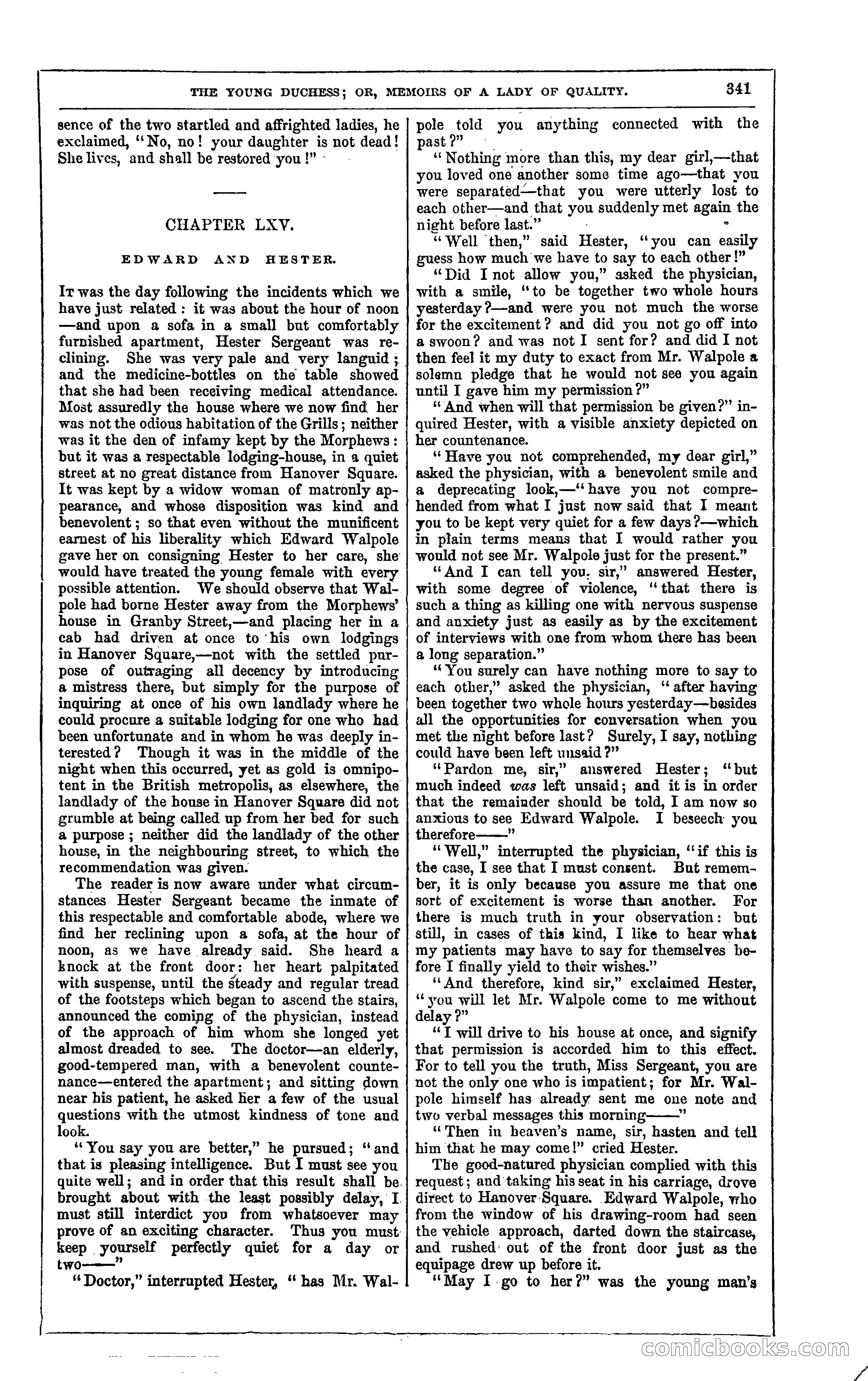
A restored page from Penny Dreadfuls, 1858. Page through the whole issue in the reader above.
📄 Transcribed text from this page (OCR, searchable)
Machine-transcribed from the original scan — historical spelling and the odd misread are preserved.
THE YOUNG DUCHESS; OR, MEMOIRS OF A LADY OF QUALITY. 341 sence of the two startled and affrighted ladies, he exclaimed, ‘‘No, no! your daughter is not dead! She lives, and shall be restored you !” - ————ee CHAPTER LXY. EDWARD AND HESTER. It was the day following the incidents which we have just related: it was about the hour of noon —and upon a sofa in a small but comfortably furnished apartment, Hester Sergeant was re- clining. She was very pale and very languid ; and the medicine-bottles on the table showed that she had been receiving medical attendance. Most assuredly the house where we now find her was not the odious habitation of the Grills ; neither was it the den of infamy kept by the Morphews: but it was a respectable lodging-house, in a quiet street at no great distance from Hanover Square. It was kept by a widow woman of matronly ap- pearance, and whose disposition was kind and benevolent ; so that even without the munificent earnest of his liberality which Edward Walpole gave her on consigning Hester to her care, she would have treated the young female with every possible attention. We should observe that Wal- pole had borne Hester away from the Morphews’ house in Granby Street,—and placing her in a eab had driven at once to his own lodgings in Hanover Square,—not with the settled pur- pose of outraging all decency by introducing a mistress there, but simply for the purpose of inquiring at once of his own landlady where he could procure a suitable lodging for one who had been unfortunate and in whom he was deeply in- terested? Though it was in the middle of the night when this occurred, yet as gold is omnipo- tent in the British metropolis, as elsewhere, the landlady of the house in Hanover Square did not grumble at being called up from her bed for such a purpose ; neither did the landlady of the other house, in the neighbouring street, to which the recommendation was given. The reader is now aware under what circum- stances Hester Sergeant became the inmate of this respectable and comfortable abode, where we find her reclining upon a sofa, at the hour of noon, as we have already said. She heard a knock at the front door: her heart palpitated with suspense, until the steady and regular tread of the footsteps which began to ascend the stairs, announced the coming of the physician, instead of the approach of him whom she longed yet almost dreaded to see. The doctor—an elderly, good-tempered man, with a benevolent counte- nance—entered the apartment 5 and sitting down near his patient, he asked her a few of the usual questions with the utmost kindness of tone and look. ‘““'You say you are better,” he pursued; “and that is pleasing intelligence. But I must see you quite well; and in order that this result shall be. brought about with the least possibly delay, I must still interdict you from whatsoever may prove of an exciting character. keep | yourself perfectly quiet for a day or two-———” “Doctor,” interrupted Hester, ‘has Mr. Wal- Thus you must: pole told you anything connected with the past?” - “Nothing more than this, my dear girl,—that you loved one another some time ago—that you were separated—that you were utterly lost to each other—and that you suddenly met again the night before last.” “Well then,” said Hester, “‘you can easily guess how much we have to say to each other!” “Did Inot allow you,” asked the physician, with a smile, “to be together two whole hours yesterday ?—and were you not much the worse for the excitement? and did you not go off into a swoon? and was not I sent for? and did I not then feel it my duty to exact from Mr. Walpole a solemn pledge that he would not see you again until I gave him my permission ?” ‘And when will that permission be given?” in- quired Hester, with a visible anxiety depicted on her countenance. “Have you not comprehended, my dear girl,” asked the physician, with a benevolent smile and a deprecating look,—‘‘have you not compre- hended from what I just now said that I meant you to be kept very quiet for a few days ?—which in plain terms means that I] would rather you would not see Mr. Walpole just for the present.” “And I can tell you. sir,” answered Hester, with some degree of violence, ‘‘that there is such a thing as killing one with nervous suspense and anxiety just as easily as by the excitement of interviews with one from whom there has been a long separation.” ‘You surely can have nothing more to say to each other,” asked the physician, “ after having been together two whole hours yesterday—besides all the opportunities for conversation when you met the night before last? Surely, I say, nothing could have been left unsaid ?” “Pardon me, sir,” answered Hester; “but much indeed was left unsaid; and it is in order that the remainder should be told, I am now so anxious to see Edward Walpole. I beseech you therefore “Well,” interrupted the physician, ‘if this is the case, I see that I must consent. But remem- ber, it is only because you assure me that one sort of excitement is worse than another. For there is much truth in your observation: but still, in cases of this kind, I like to hear what my patients may have to say for themselves be- fore I finally yield to their wishes.” ‘‘And therefore, kind sir,” exclaimed Hester, “you will let Mr. Walpole come to me without delay ?” ““T will drive to his house at once, and signify that permission is accorded him to this effect. For to tell you the truth, Miss Sergeant, you are not the only one who is impatient; for Mr. Wal- pole himself has already sent me one note and two verbal messages this morning “Then in heaven’s name, sir, hasten and tell him that he may come!” cried Hester. The good-natured physician complied with this request ; and taking his seat in his carriage, drove direct to Hanover: ‘Square. Edward Walpole, who from the window of his drawing-room had seen the vehicle approach, darted down the staircase, and rushed’ out of the front door just as the equipage drew up before it. ‘May I-go to her?” was the young man’s oO COMO SEA FS ret (Oe a RN SSDS DS eA Colin