
Penny Dreadfuls, 1858 · page 345 of 400
The Young Duchess; or, Memoirs of a Lady of Quality — page 345: what you’re looking at
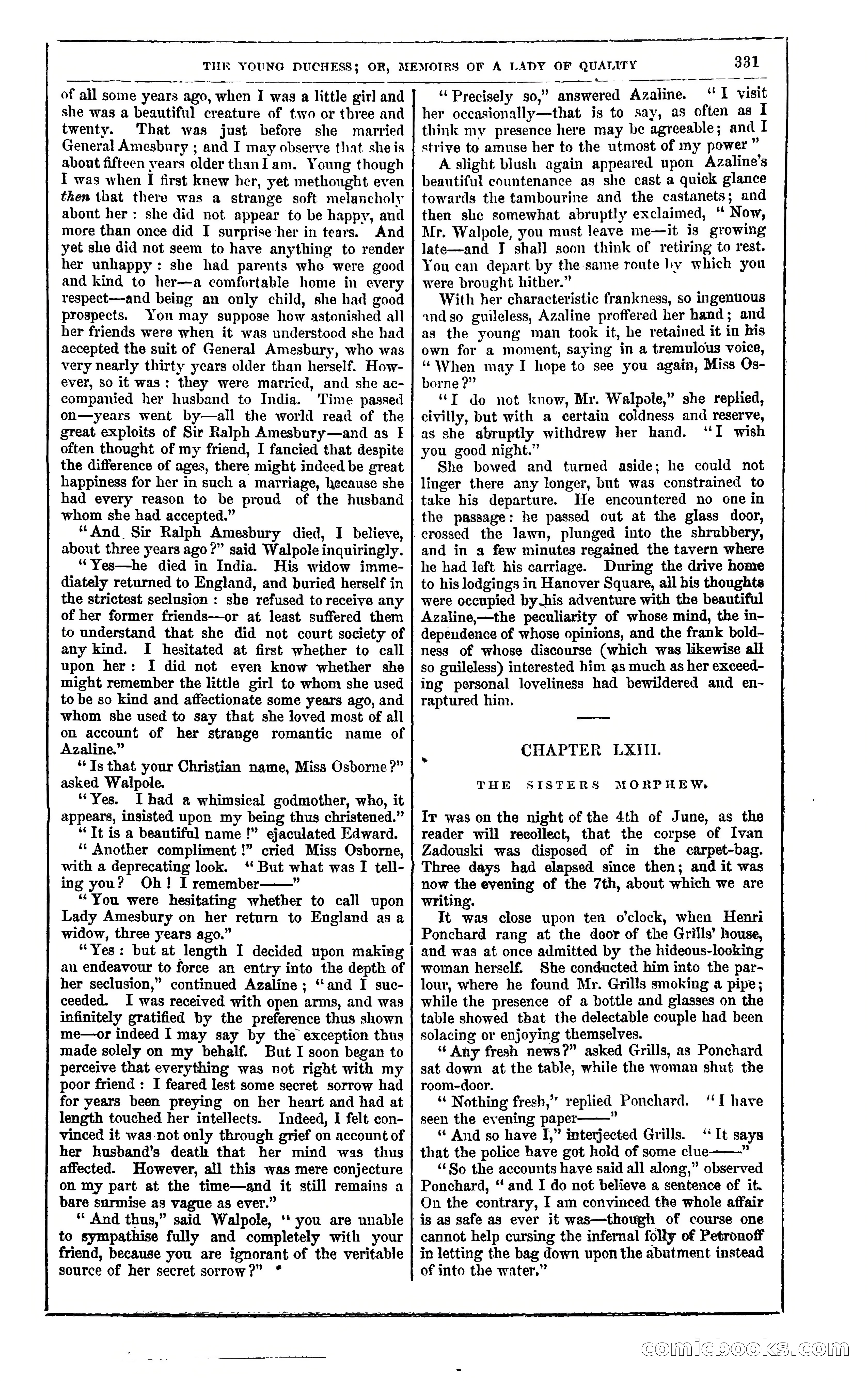
A restored page from Penny Dreadfuls, 1858. Page through the whole issue in the reader above.
📄 Transcribed text from this page (OCR, searchable)
Machine-transcribed from the original scan — historical spelling and the odd misread are preserved.
of all some years ago, when I was a little girl and she was a beautiful creature of two or three and twenty. That was just before she married General Amesbury ; and I may observe that. she is about fifteen years older thanl am. Young though I was when I first knew her, yet methought even then that there was a strange soft melancholy about her: she did not appear to be happy, and more than once did I surprise-her in tears. And yet she did not seem to have anything to render her unhappy: she had parents who were good and kind to her—a comfortable home in every respect—-and being an only child, she had good prospects. You may suppose how astonished all her friends were when it was understood she had accepted the suit of General Amesbury, who was very nearly thirty years older than herself. How- ever, So it was: they were married, and she ac- companied her husband to India. Time passed on—years went by—all the world read of the great exploits of Sir Ralph Amesbury—and as I often thought of my friend, I fancied that despite the difference of ages, there might indeed be great happiness for her in such a marriage, heeause she had every reason to be proud of the husband whom she had accepted.” “And Sir Ralph Amesbury died, I believe, about three years ago?” said Walpole inquiringly. “Yes—he died in India. His widow imme- diately returned to England, and buried herself in the strictest seclusion : she refused to receive any of her former friends—or at least suffered them to understand that she did not court society of any kind. I hesitated at first whether to call upon her: [I did not even know whether she might remember the little girl to whom she used to be so kind and affectionate some years ago, and whom she used to say that she loved most of all on account of her strange romantic name of Azaline.” “‘ Ts that your Christian name, Miss Osborne ?” asked Walpole. ‘Yes. Ihad a whimsical godmother, who, it appears, insisted upon my being thus christened.” “Tt is a beautiful name !” ejaculated Edward. “‘ Another compliment !” cried Miss Osborne, with a deprecating look. ‘ But what was I tell- ing you? Oh! I remember——” ‘““'You were hesitating whether to call upon Lady Amesbury on her return to England as a widow, three years ago.” “Yes: but at length I decided upon making an endeavour to force an entry into the depth of her seclusion,” continued Azaline ; “and I suc- ceeded. I was received with open arms, and was infinitely gratified by the preference thus shown me—or indeed I may say by the exception thus made solely on my behalf. But I soon began to perceive that everything was not right with my poor friend : I feared lest some secret sorrow had for years been preying on her heart and had at length touched her intellects. Indeed, I felt con- vinced it was-not only through grief on account of her husband’s death that her mind was thus affected. However, all this was mere conjecture on my part at the time—and it still remains a bare surmise as vague as ever.” ‘* And thus,” said Walpole, ‘‘ you are unable to sympathise fully and completely with your friend, because you are ignorant of the veritable source of her secret sorrow?” ° THK YOUNG DUCHESS; OR, MEMOIRS OF A LADY OF QUALITY 331 “ Precisely so,” answered Azaline. ‘I visit her occasionally—that is to say, as often as I think my presence here may be agreeable; and I strive to amuse her to the utmost of my power ” A slight blush again appeared upon Azaline’s beautiful countenance as she cast a quick glance towards the tambourine and the castanets; and then she somewhat abruptly exclaimed, ‘‘ Now, Mr. Walpole, you must leave me—it is growing late—and J shall soon think of retiring to rest. You can depart by the-same route hy which you were brought hither.” With her characteristic frankness, so ingenuous andso guileless, Azaline proffered her hand ; and as the young man took it, he retained it in his own for a moment, saying in a tremulous voice, “When may I hope to see you again, Miss Os- borne ?” “YT do not know, Mr. Walpole,” she replied, civilly, but with a certain coldness and reserve, as she abruptly withdrew her hand. ‘I wish you good night.” She bowed and turned aside; he could not linger there any longer, but was constrained to take his departure. He encountered no one in the passage: he passed out at the glass door, e- - -erossed the lawn, plunged into the shrubbery, and in a few minutes regained the tavern where he had left his carriage. During the drive home to his lodgings in Hanover Square, all his thoughts were occupied by his adventure with the beautiful Azaline,—the peculiarity of whose mind, the in- dependence of whose opinions, and the frank bold- ness of whose discourse (which was likewise all so guileless) interested him as much as her exceed- ing personal loveliness had bewildered and en- raptured him. eee CHAPTER LXIII. THE SISTERS MORPHEW. Ir was on the night of the 4th of June, as the reader will recollect, that the corpse of Ivan Zadouski was disposed of in the carpet-bag. Three days had elapsed since then; and it was now the evening of the 7th, about which we are writing. It was close upon ten o’clock, when Henri Ponchard rang at the door of the Grills’ house, and was at once admitted by the hideous-looking woman herself. She conducted him into the par- lour, where he found Mr. Grills smoking a pipe; while the presence of a bottle and glasses on the table showed that the delectable couple had been solacing or enjoying themselves. “ Any fresh news?” asked Grills, as Ponchard sat down at the table, while the woman shut the room-door. ‘“‘ Nothing fresh,” replied Ponchard. ‘‘I have seen the evening paper——” “* And so have I,” interjected Grills. ‘It says vs that the police have got hold of some clue ‘“‘So the accounts have said all along,” observed Ponchard, “and I do not believe a sentence of it. On the contrary, I am convinced the whole affair ‘is as safe as ever it was—though of course one cannot help cursing the infernal folly of Petronoff in letting the bag down upon the abutment instead of into the water,” O COMO ee Colin