
Penny Dreadfuls, 1858 · page 293 of 400
The Young Duchess; or, Memoirs of a Lady of Quality — page 293: what you’re looking at
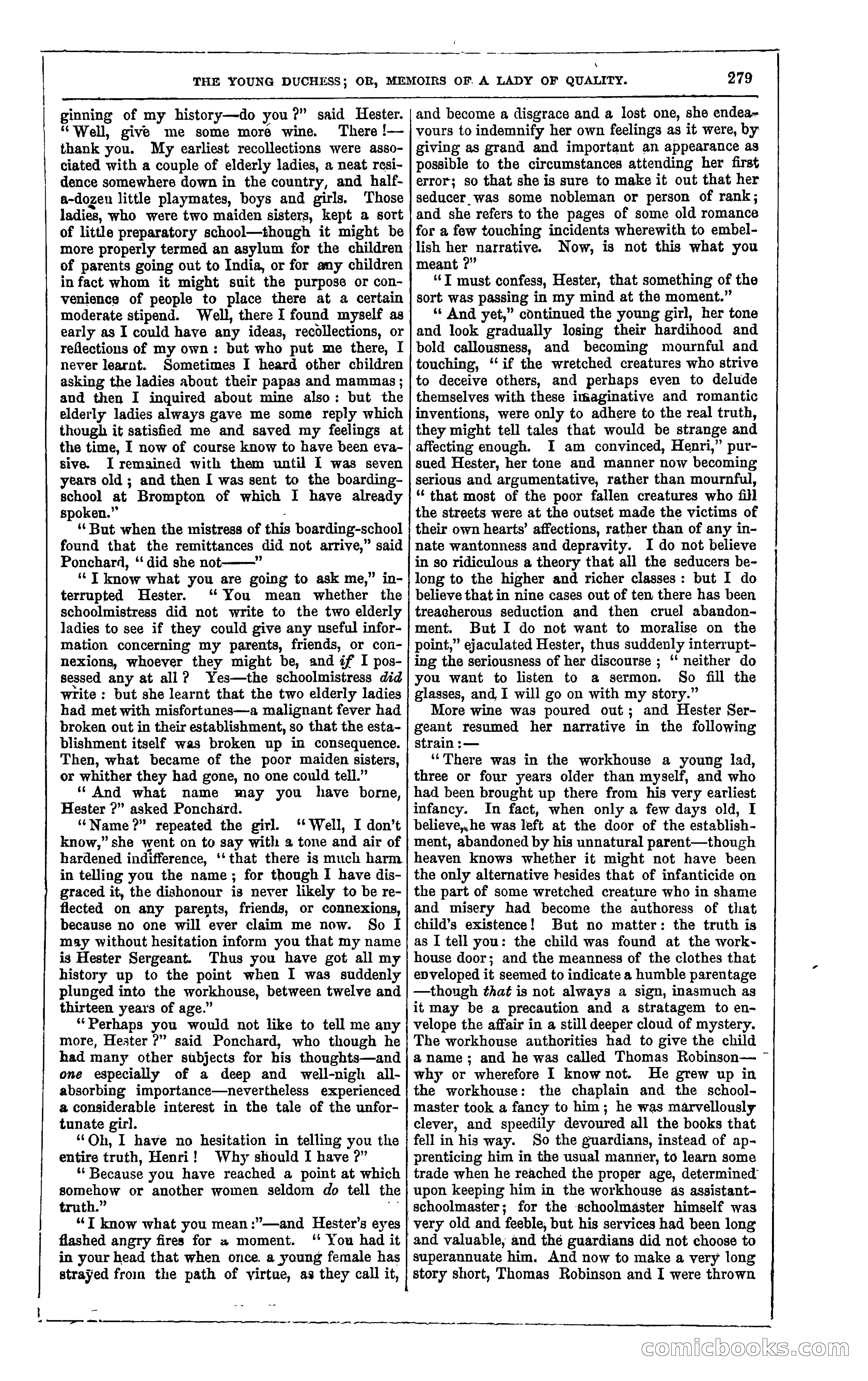
A restored page from Penny Dreadfuls, 1858. Page through the whole issue in the reader above.
📄 Transcribed text from this page (OCR, searchable)
Machine-transcribed from the original scan — historical spelling and the odd misread are preserved.
: THE YOUNG ee) Oe ee OR, MEMOIRS OF A LADY OF QUALITY. ginning of my history—do you?” said Hester. “Well, give me some more wine. There !— thank you. My earliest recollections were asso- ciated with a couple of elderly ladies, a neat resi- dence somewhere down in the country, and half- a-dozen little playmates, boys and girls. Those ladies, who were two maiden sisters, kept a sort of little preparatory school—though it might be more properly termed an asylum for the children of parents going out to India, or for any children in fact whom it might suit the purpose or con- venience of people to place there at a certain moderate stipend. Well, there I found myself as early as I could have any ideas, recollections, or reflections of my own: but who put me there, I never learnt. Sometimes I heard other children asking the ladies about their papas and mammas ; and then I inquired about mine also: but the elderly ladies always gave me some reply which though it satisfied me and saved my feelings at the time, I now of course know to have been eva-~ sive. JI remained with them until I was seven years old; and then I was sent to the boarding- school at Brompton of which I have already spoken.” ‘* But when the mistress of this boarding-school found that the remittances did not arrive,” said Ponchard, “‘ did she not “y Imow what you are going to ask me,” in- terrupted Hester. ‘“ You mean whether the schoolmistress did not write to the two elderly ladies to see if they could give any useful infor- mation concerning my parents, friends, or con- nexions, whoever they might be, and ir, I pos- sessed any at all? Yes—the schoolmistress did write : but she learnt that the two elderly ladies had met with misfortunes—a malignant fever had broken out in their establishment, so that the esta- blishment itself was broken up in consequence. Then, what became of the poor maiden sisters, or whither they had gone, no one could tell.” ‘‘ And what name may you have borne, Hester 2?” asked Ponchard. ‘‘Name?” repeated the girl. ‘‘ Well, I don’t know,” she went on to say with a tone and air of hardened indifference, ‘‘that there is much harm. in telling you the name; for though I have dis- graced it, the dishonour is never likely to be re- flected on any parents, friends, or connexions, because no one will ever claim me now. So I may without hesitation inform you that my name is Hester Sergeant. Thus you have got all my history up to the point when I was suddenly plunged into the workhouse, between twelve and thirteen years of age.” “Perhaps you would not like to tell me any more, Hester ?” said Ponchard, who though he bad many other subjects for his thoughts—and one especially of a deep and well-nigh all- absorbing importance—nevertheless experienced a considerable interest in the tale of the unfor- tunate girl. ‘‘Oh, I have no hesitation in telling you the entire truth, Henri! Why should I have ?” = Because you have reached a point at which somehow or another women seldom do tell the truth.” ““T know what you mean :”—and Hester’s eyes flashed angry fires for » moment. ‘‘ You had it in your head that when once. a young female has strayed from the path of virtue, as they call it, 0 ee ee ee er \ 279 and become a disgrace and a lost one, Minaing of my history—-do you?” said Bester. and hacome a disgrace and a lost one, she endear endea- vours to indemnify her own feelings as it were, by giving as grand and important an appearance as possible to the circumstances attending her first error; so that she is sure to make it out that her seducer was some nobleman or person of rank; and she refers to the pages of some old romance for a few touching incidents wherewith to embel- lish her narrative. Now, is not this what you meant ?” “T must confess, Hester, that something of the sort was passing in my mind at the moment. ‘“ And yet,” continued the young girl, her tone and look gradually losing their hardihood and bold callousness, and becoming mournful and touching, “if the wretched creatures who strive to deceive others, and perhaps even to delude themselves with these imaginative and romantic inventions, were only to adhere to the real truth, they might tell tales that would be strange and affecting enough. I am convinced, Henri,” pur- sued Hester, her tone and manner now becoming serious and argumentative, rather than mournful, “* that most of the poor fallen creatures who fill the streets were at the outset made the victims of their own hearts’ affections, rather than of any in- nate wantonness and depravity. I do not believe in so ridiculous a theory that all the seducers be- long to the higher and richer classes: but I do believe that in nine cases out of ten there has been treacherous seduction and then cruel abandon- ment. But I do not want to moralise on the point,” ejaculated Hester, thus suddenly interrupt- ing the seriousness of her discourse ; ‘‘ neither do you want to listen to a sermon. So fill the glasses, and, I will go on with my story.” More wine was poured out; and Hester Ser- geant resumed her narrative in the following strain :— ‘“‘There was in the workhouse a young lad, three or four years older than myself, and who had been brought up there from his very earliest infancy. In fact, when only a few days old, I believe,,.he was left at the door of the establish- ment, abandoned by his unnatural parent—though heaven knows whether it might not have been the only alternative hesides that of infanticide on the part of some wretched creature who in shame and misery had become the authoress of that child’s existence! But no matter: the truth is as I tell you: the child was found at the work-~- house door; and the meanness of the clothes that epveloped it seemed to indicate a humble parentage —though that is not always a sign, inasmuch as it may be a precaution and a stratagem to en- velope the affair in a still deeper cloud of mystery. The workhouse authorities had to give the child a name; and he was called Thomas Robinson— ~ why or wherefore I know not. He grew up in the workhouse: the chaplain and the school- master took a fancy to him; he was marvellously clever, and speedily devoured all the books that fell in his way. So the guardians, instead of ap- prenticing him in the usual manner, to learn some trade when he reached the proper age, determined’ upon keeping him in the workhouse 4s assistant- ‘schoolmaster; for the schoolmaster himself was very old and feeble, but his services had been long and valuable, and the guardians did not choose to superannuate him. And now to make a very long story short, Thomas Robinson and I were thrown oO COMO Colin