
Penny Dreadfuls, 1858 · page 284 of 400
The Young Duchess; or, Memoirs of a Lady of Quality — page 284: what you’re looking at
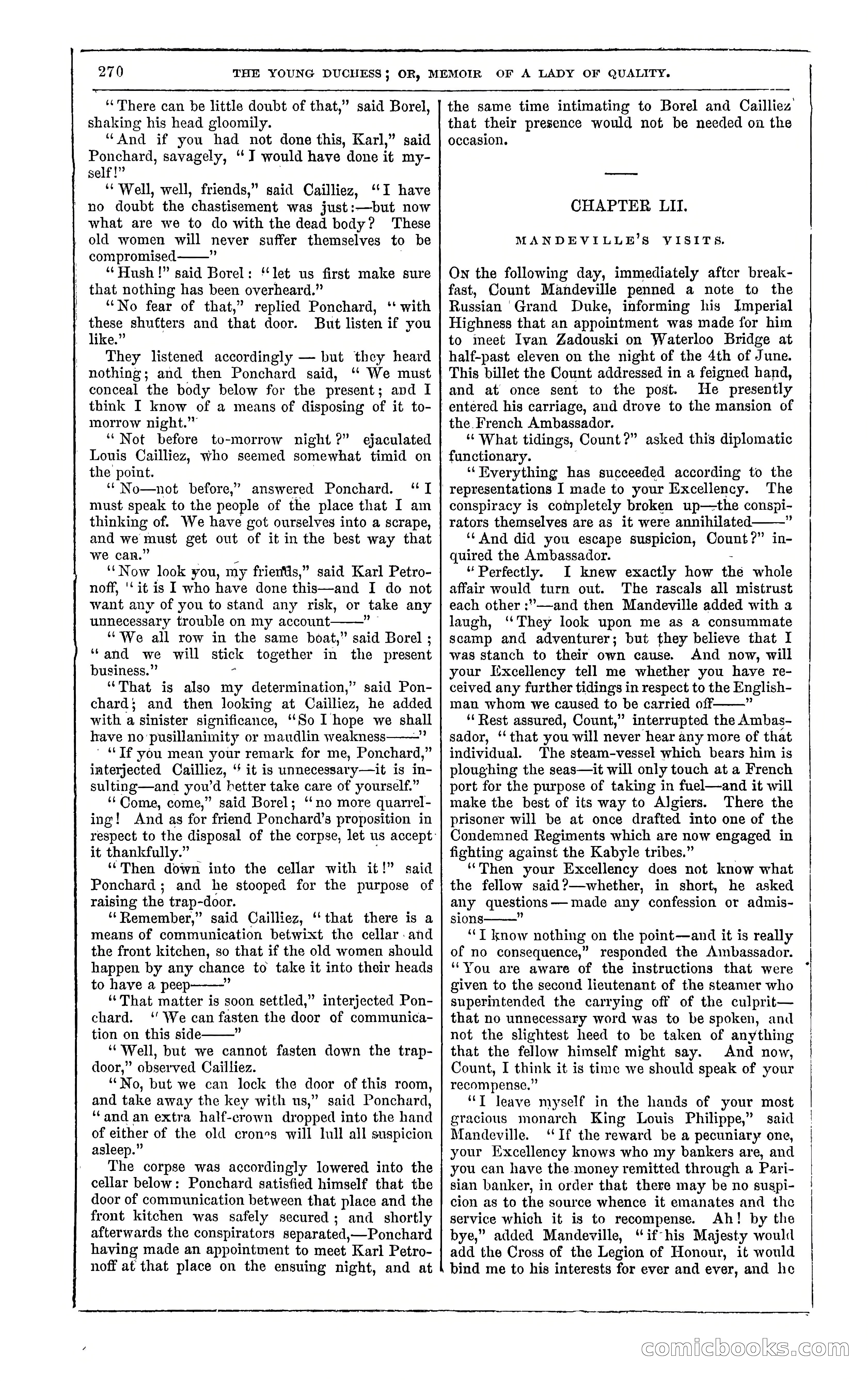
A restored page from Penny Dreadfuls, 1858. Page through the whole issue in the reader above.
📄 Transcribed text from this page (OCR, searchable)
Machine-transcribed from the original scan — historical spelling and the odd misread are preserved.
‘There can be little doubt of that,” said Borel, shaking his head gloomily. “And if you had not done this, Karl,” said Ponchard, savagely, “I would have done it my- self!” ‘“‘ Well, well, friends,” said Cailliez, ‘I have no doubt the chastisement was just:—but now what are we to do with the dead body? These old women will never suffer themselves to be _ compromised ‘“ “‘Hush !” said Borel: ‘let us first make sure | that nothing has been overheard.” | “No fear of that,” replied Ponchard, ‘‘ with ' these shufters and that door. But listen if you _ like.” They listened accordingly — but they heard - nothing; and then Ponchard said, ‘‘ We must conceal the body below for the present; avd I think I know of a means of disposing of it to- morrow night.” ‘““ Not before to-morrow night ?” ejaculated - Louis Cailliez, who seemed somewhat timid on the point. ‘* No—not before,” answered Ponchard. “I must speak to the people of the place that I am thinking of. We have got ourselves into a scrape, and we must get out of it in the best way that we can.’ ‘Now look you, my fries,” said Karl Petro- noff, '‘ it is I who have done this—and I do not want any of you to stand any risk, or take any unnecessary trouble on my account a “We all row in the same boat,” said Borel ; “and we will stick together in the present business.” “That is also my determination,” said Pon- chard; and then looking at Cailliez, he added with a sinister significance, ‘So I hope we shall have no’pusillanimity or maudlin weakness——” ' “Tf you mean your remark for me, Ponchard,” interjected Cailliez, “ it is unnecessary—it is in- sulting—and you'd hetter take care of yourself.” ‘‘ Come, come,” said Borel; ‘‘no more quarrel- ing! And as for friend Ponchard’s proposition in respect to the disposal of the corpse, let us accept: it thankfully.” “Then down into the cellar with it!” said Ponchard ; and he stooped for the purpose of raising the trap-door. ‘“‘Remember,” said Cailliez, ‘that there is a means of communication betwixt the cellar and the front kitchen, so that if the old women should happen by any chance to take it into their heads to have a peep ” “That matter is soon settled,” interjected Pon- chard. ‘ We can fasten the door of communica- tion on this side , “Well, but we cannot fasten down the trap- door,” observed Cailliez. ‘No, but we can lock the door of this room, and take away the key with us,” said Ponchard, ‘and an extra half-crown dropped into the hand of either of the old crones will lull all suspicion asleep.” ' The corpse was accordingly lowered into the cellar below: Ponchard satisfied himself that the door of communication between that place and the front kitchen was safely secured ; and shortly afterwards the conspirators separated,—Ponchard having made an appointment to meet Karl Petro- noff at that place on the ensuing night, and at THE YOUNG DUCHESS; OR, MEMOIR OF A LADY OF QUALITY. -——— the same time intimating to Borel and Cailliez that their presence would not be needed on the occasion. ——— CHAPTER LII. MANDEVILLE’S YISITS. On the following day, immediately after break- fast, Count Mandeville penned a note to the Russian ‘Grand Duke, informing his Imperial Highness that an appointment was made for him to meet Ivan Zadouski on Waterloo Bridge at half-past eleven on the night of the 4th of June. This billet the Count addressed in a feigned hand, and at once sent to the post. He presently ' entered his carriage, and drove to the mansion of the. French Ambassador. “What tidings, Count?” asked this diplomatic -functionary. “Everything has succeeded according to the ‘representations I made to your Excellency. The conspiracy is completely broken up—the conspi- rators themselves are as it were annihilated. ‘‘ And did you escape suspicion, Count?” in- quired the Ambassador. “Perfectly. I knew exactly how the whole affair would turn out. The rascals all mistrust each other :”—and then Mandeville added with a laugh, ‘‘They look upon me as a consummate scamp and adventurer; but they believe that I was stanch to their own cause. And now, will your I’xcellency tell me whether you have re- ceived any further tidings in respect to the English- man whom we caused to be carried off. ‘Rest assured, Count,” interrupted the Ambas- sador, “that you will never hear any more of that individual. The steam-vessel which bears him is ploughing the seas—it will only touch at a French port for the purpose of taking in fuel—and it will make the best of its way to Algiers. There the prisoner will be at once drafted into one of the Condemned Regiments which are now engaged in fighting against the Kabyle tribes.” “Then your Excellency does not know what the fellow said?—-whether, in short, he asked any questions —made any confession or admis- sions " “‘T know nothing on the point—and it is really of no consequence,” responded the Ambassador. “You are aware of the instructions that were given to the second lieutenant of the steamer who superintended the carrying off of the culprit— that no unnecessary word was to be spoken, and not the slightest heed to be taken of anything that the fellow himself might say. And now, Count, I think it is time we should speak of your recompense,” “T leave myself in the hands of your most gracious monarch King Louis Philippe,” said Mandeville. ‘If the reward be a pecuniary one, your Excellency knows who my bankers are, and you can have the money remitted through a Pari- sian banker, in order that there may be no suspi- cion as to the source whence it emanates and the service which it is to recompense. Ah! by the bye,” added Mandeville, “if-his Majesty would add the Cross of the Legion of Honour, it would bind me to his interests for ever and ever, and he COMO YN Wn) Colin