
Penny Dreadfuls, 1858 · page 267 of 400
The Young Duchess; or, Memoirs of a Lady of Quality — page 267: what you’re looking at
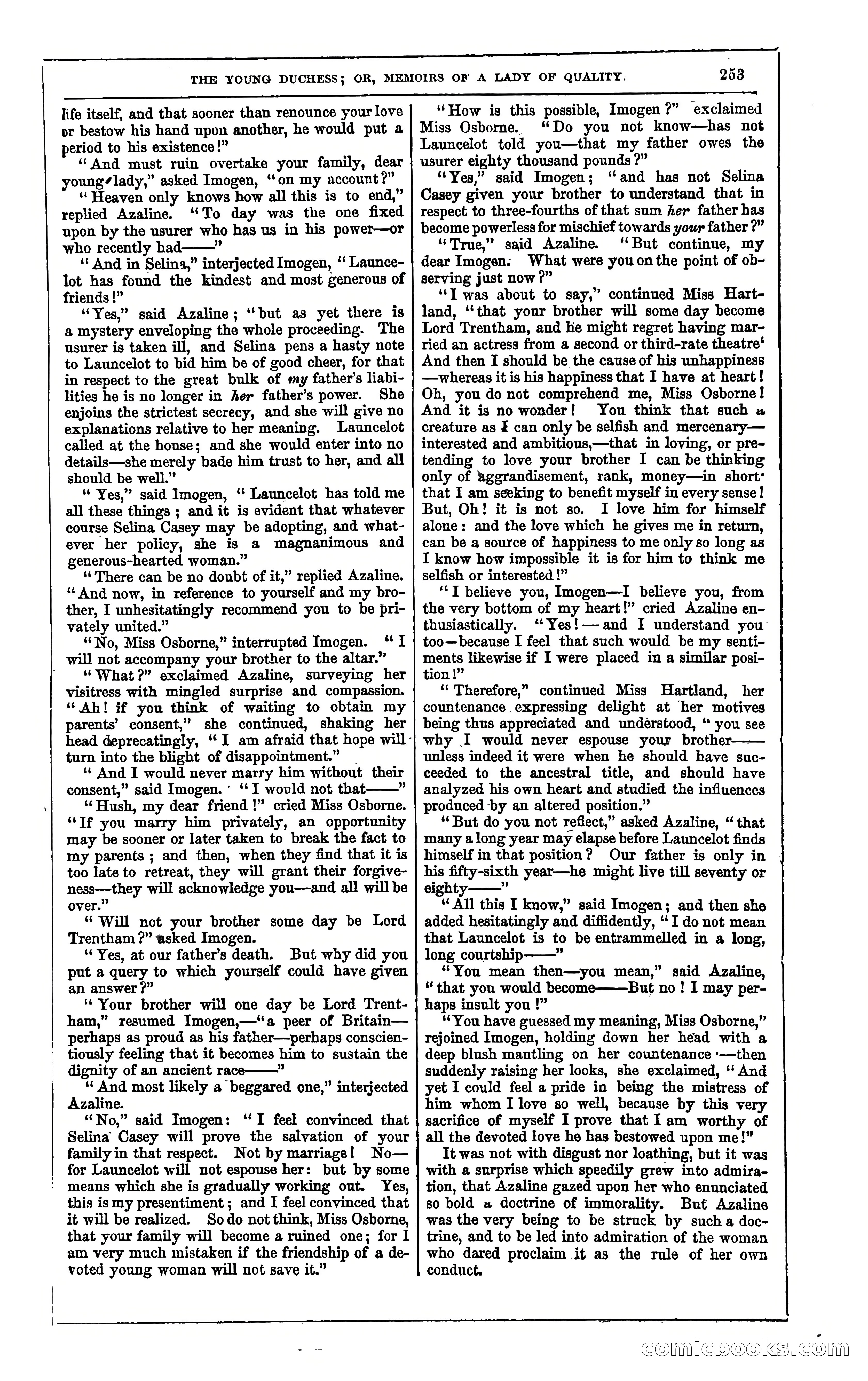
A restored page from Penny Dreadfuls, 1858. Page through the whole issue in the reader above.
📄 Transcribed text from this page (OCR, searchable)
Machine-transcribed from the original scan — historical spelling and the odd misread are preserved.
Cc THE YOUNG DUCHESS; OR, MEMOIRS OF A LADY OF QUALITY, 253 ee life itself, and that sooner than renounce your love or bestow his hand upon another, he would put a period to his existence!” ‘And must ruin overtake your family, dear young/lady,” asked Imogen, ‘on my account?” “Heaven only knows how all this is to end,” replied Azaline. “To day was the one fixed upon by the usurer who has us in his power—or who recently had ” “ And in Selina,” interjected Imogen, ‘‘ Launce- lot has found the kindest and most generous of friends !” “Yes,” said Azaline; ‘but as yet there is a mystery enveloping the whole proceeding. The usurer is taken ill, and Selina pens a hasty note to Launcelot to bid him be of good cheer, for that in respect to the great bulk of my father’s liabi- lities he is no longer in her father’s power. She enjoins the strictest secrecy, and she will give no explanations relative to her meaning. Launcelot called at the house; and she would enter into no details—she merely bade him trust to her, and all should be well.” “Yes,” said Imogen, ‘* Launcelot has told me all these things ; and it is evident that whatever course Selina Casey may be adopting, and what- ever her policy, she is a magnanimous and generous-hearted woman.” ‘There can be no doubt of it,” replied Azaline. “ And now, in reference to yourself and my bro- ther, I unhesitatingly recommend you to be pri- vately united.” ‘No, Miss Osborne,” interrupted Imogen. “I will not accompany your brother to the altar.” ‘“ What?” exclaimed Azaline, surveying her visitress with mingled surprise and compassion. “ Ah! if you think of waiting to obtain my parents’ consent,” she continued, shaking her head deprecatingly, “I am afraid that hope will- turn into the blight of disappointment.” _ “© And I would never marry him without their consent,” said Imogen.‘ ‘I would not that id ‘Hush, my dear friend !” cried Miss Osborne. “If you marry him privately, an opportunity may be sooner or later taken to break the fact to my parents ; and then, when they find that it is too late to retreat, they will grant their forgive- ness—-they will acknowledge you—and all will be over.” ‘ Will not your brother some day be Lord Trentham ?” asked Imogen. ‘‘ Yes, at our father’s death. But why did you put a query to which yourself could have given an answer ?” ‘‘ Your brother will one day be Lord Trent- ham,” resumed Imogen,—“a peer of Britain— perhaps as proud as his father—perhaps conuscien- tiously feeling that it becomes him to sustain the dignity of an ancient race——” ‘And most likely a beggared one,” interjected Azaline. “No,” said Imogen: ‘I feel convinced that Selina Casey will prove the salvation of your family in that respect. Not by marriage! No— for Launcelot will not espouse her: but by some means which she is gradually working out. Yes, this is my presentiment ; and I feel convinced that it will be realized. Sodo not think, Miss Osborne, that your family will become a ruined one; for I am very much mistaken if the friendship of a de- voted young woman will not save it.” “How is this possible, Imogen?” exclaimed Miss Osborne. “Do you not know—has not Launcelot told you—that my father owes the usurer eighty thousand pounds ?” “Yes,” said Imogen; “and has not Selina Casey given your brother to understand that in respect to three-fourths of that sum her father has become powerless for mischief towards your father ?” “True,” said Azaline. ‘But continue, my dear Imogen: What were you on the point of ob- serving just now ?” - “YT was about to say,” continued Miss Hart- land, ‘“‘that your brother will some day become Lord Trentham, and he might regret having mar- ried an actress from a second or third-rate theatre‘ And then I should be the cause of his unhappiness —whereas it is his happiness that I have at heart! Oh, you do not comprehend me, Miss Osborne! And it is no wonder! You think that such a creature as £ can only be selfish and mercenary— interested and ambitious,—that in loving, or pre- tending to love your brother I can be thinking only of ’ggrandisement, rank, money—in short’ that I am seeking to benefit myself in every sense ! But, Oh! it is not so. I love him for himself alone: and the love which he gives me in return, can be a source of happiness to me only so long as I know how impossible it is for him to think me selfish or interested !” ‘IT believe you, Imogen—I believe you, from the very bottom of my heart!” cried Azaline en- thusiastically. too—because I feel that such would be my senti- ments likewise if I were placed in a similar posi- tion !” ‘“‘ Therefore,” continued Miss Hartland, her countenance expressing delight at her motives being thus appreciated and understood, “ you see why I would never espouse your brother— unless indeed it were when he should have suc- ceeded to the ancestral title, and should have analyzed his own heart and studied the influences produced by an altered position.” ‘But do you not reflect,” asked Azaline, “ that many along year may elapse before Launcelot finds himself in that position? Our father is only in . his fifty-sixth year—he might live till seventy or eighty ” “All this I know,” said Imogen; and then she added hesitatingly and diffidently, “I do not mean that Launcelot is to be entrammelled in a long, long courtship-———” “You mean then—you mean,” said Azaline, “that you would become——But no ! I may per- haps insult you !” ‘You have guessed my meaning, Miss Osborne,” rejoined Imogen, holding down her head with a deep blush mantling on her countenance -—then suddenly raising her looks, she exclaimed, ‘“‘ And yet I could feel a pride in being the mistress of him whom I love so well, because by this very sacrifice of myself I prove that Iam worthy of all the devoted love he has bestowed upon me!” It was not with disgust nor loathing, but it was with a surprise which speedily grew into admira- tion, that Azaline gazed upon her who enunciated so bold « doctrine of immorality. But Azaline was the very being to be struck by sucha doc- trine, and to be led into admiration of the woman who dared proclaim it as the rule of her own conduct. conniclooolk ““Yes!— and I understand you’ ON Wn) Colin