
Penny Dreadfuls, 1858 · page 232 of 400
The Young Duchess; or, Memoirs of a Lady of Quality — page 232: what you’re looking at
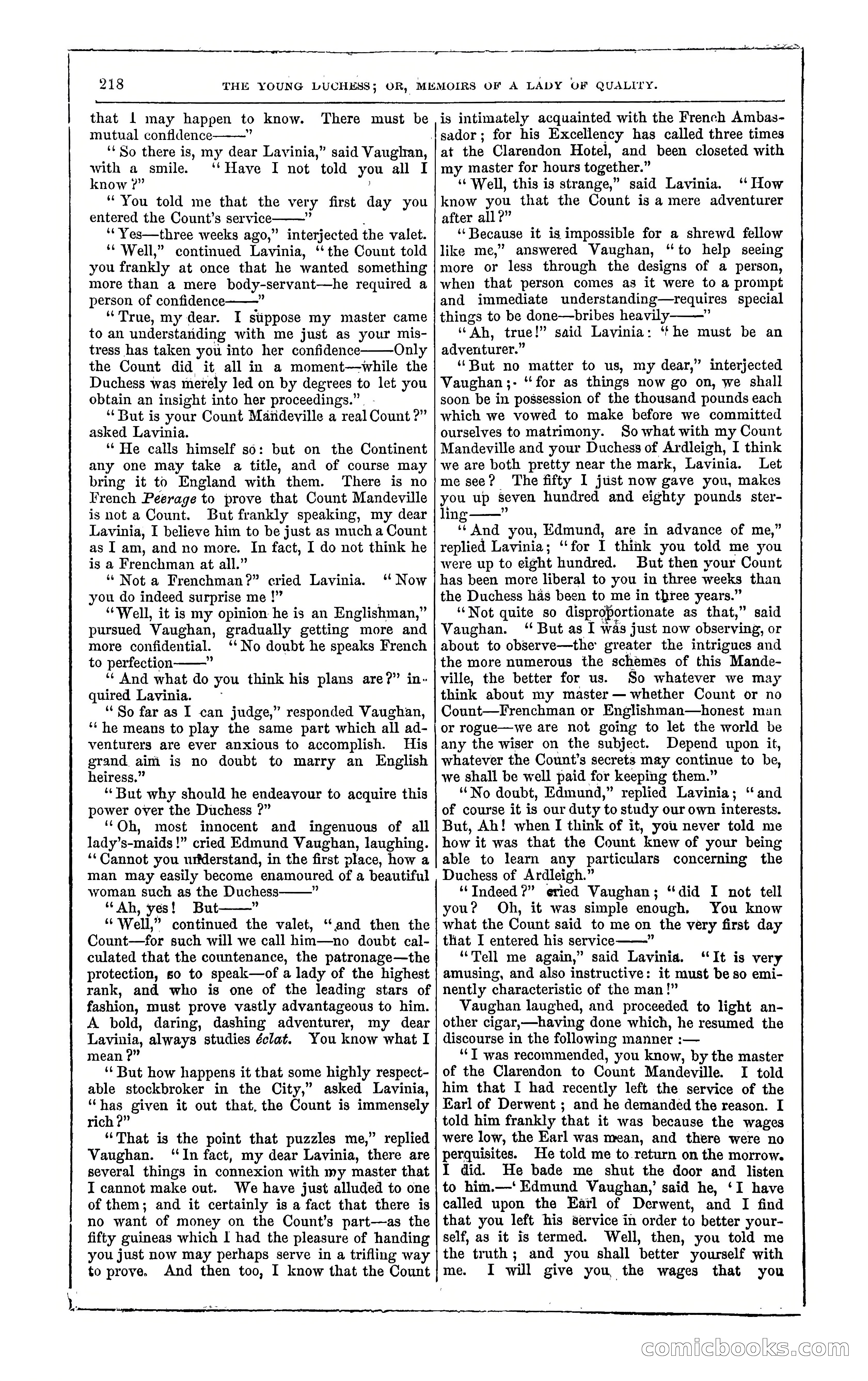
A restored page from Penny Dreadfuls, 1858. Page through the whole issue in the reader above.
📄 Transcribed text from this page (OCR, searchable)
Machine-transcribed from the original scan — historical spelling and the odd misread are preserved.
| * an? 218 THE YOUNG LUCHESS; gp tty Fe OR, MEMOIRS OF A LADY OF QUALITY. that | may happen to know. There must be mutual confldence , ‘* So there is, my dear Lavinia,” said Vauglran, with a smile. ‘‘Have I not told you all I know ?” “You told me that the very first day you entered the Count’s service , ‘* Yes—three weeks ago,” interjected the valet. ** Well,” continued Lavinia, “the Count told you frankly at once that he wanted something more than a mere body-servant—he required a person of confidence ‘ “True, my dear. I stppose my master came to an understanding with me just as your mis- tress has taken you into her confidence Only the Count did it all in a moment—while the Duchess was merely led on by degrees to let you obtain an insight into her proceedings.” “But is your Count Mandeville a real Count ?” asked Lavinia. ‘“‘ He calls himself so: but on the Continent any one may take a title, and of course may bring it to England with them. There is no French Peerage to prove that Count Mandeville is not a Count. But frankly speaking, my dear Lavinia, I believe him to be just as much a Count as I am, and no more. In fact, I do not think he is a Frenchman at all.” ““ Not a Frenchman?” cried Lavinia. you do indeed surprise me !” “Well, it is my opinion he is an Englishman,” pursued Vaughan, gradually getting more and more confidential. ‘‘No doubt he speaks French to perfection ‘“¢ And what do you think his plans are?” in quired Lavinia. ‘““So far as I can judge,” responded Vaughan, ‘‘ he means to play the same part which all ad- venturers are ever anxious to accomplish. His grand aimi is no doubt to marry an English heiress.” ‘“‘But why should he endeavour to acquire this power over the Duchess ?” ‘‘Oh, most innocent and ingenuous of all lady’s-maids!” cried Edmund Vaughan, laughing. ‘Cannot you urtderstand, in the first place, how a man may easily become enamoured of a beautiful woman such as the Duchess i “Ah, yes! But ee Weli, ” continued the valet, “and then the Count—for such will we call him—no doubt cal- culated that the countenance, the patronage—the protection, so to speak—of a lady of the highest rank, and who is one of the leading stars of fashion, must prove vastly advantageous to him. A bold, daring, dashing adventurer, my dear Lavinia, always studies éclat. You know what I mean ?” ‘* But how happens it that some highly respect- able stockbroker in the City,” asked Lavinia, “has given it out that, the Count is immensely rich ?” “That is the point that puzzles me,” replied Vaughan. ‘In fact, my dear Lavinia, there are several things in connexion with my master that I cannot make out. We have just alluded to one of them; and it certainly is a fact that there is no want of money on the Count’s part—as the fifty guineas which I had the pleasure of handing you just now may perhaps serve in a trifling way to prove. And then too, I know that the Count “ Now ” is intimately acquainted with the French Ambas- |gador; for his Excellency has called three times at the Clarendon Hotel, and been closeted with my master for hours together.” ‘‘ Well, this is strange,” said Lavinia. ‘ How know you that the Count is a mere adventurer after all?” ‘Because it is impossible for a shrewd fellow like me,’ answered Vaughan, “to help seeing more or less through the designs of a person, when that person comes as it were to a prompt and immediate understanding—requires special things to be done—bribes heavily ‘i “Ah, true!” said Lavinia: ‘‘he must be an adventurer.” “But no matter to us, my dear,” interjected Vaughan ;- “for as things now go on, we shall soon be in possession of the thousand pounds each which we vowed to make before we committed ourselves to matrimony. So what with my Count Mandeville and your Duchess of Ardleigh, I think we are both pretty near the mark, Lavinia. Let me see? The fifty I just now gave you, makes you up seven hundred and eighty pounds ster- ling ——” if And you, Edmund, are in advance of me,” replied Lavinia; ‘for I think you told me you were up to eight hundred. But then your Count has been more liberal to you. in three weeks than the Duchess has been to me in three years.” ‘Not quite so dispro ortionate as that,” said Vaughan. “ But as I was just now observing, or about to observe—the greater the intrigues and the more numerous the schemes of this Mande- ville, the better for us. So whatever we may think about my master — whether Count or no Count—FIrenchman or Englishman—honest man or rogue—we are not going to let the world be any the wiser on the subject. Depend upon it, whatever the Count’s secrets may continue to be, we shall be well paid for keeping them.” “No doubt, Edmund,” replied Lavinia; “and of course it is our duty to study our own interests. But, Ah! when I think of it, you never told me how it was that the Count knew of your being able to learn any particulars concerning the Duchess of Ardleigh.” ‘Indeed ?” eried Vaughan; “did I not tell you? Oh, it was simple enough. You know what the Count said to me on the very first day that I entered his service——” “Tell me again,” said Lavinia. “It is very amusing, and also instructive: it must be so emi- nently characteristic of the man!” Vaughan laughed, and proceeded to light an- other cigar,—having done which, he resumed the discourse in the following manner :— ‘“‘T was recommended, you know, by the master of the Clarendon to Count Mandeville. I told him that I had recently left the service of the Karl of Derwent ; and he demanded the reason. I told him frankly that it was because the wages were low, the Earl was mean, and there were no perquisites. He told me to return on the morrow. I did. He bade me shut the door and listen to him.—‘ Edmund Vaughan,’ said he, ‘I have called upon the Earl of Derwent, and I find that you left his service in order to better your- self, as it is termed. Well, then, you told me the truth; and you shall better yourself with me. I will give you the wages that you COMO YN Wn) 1 ~ ad i er i aR Colin