
Penny Dreadfuls, 1858 · page 213 of 400
The Young Duchess; or, Memoirs of a Lady of Quality — page 213: what you’re looking at
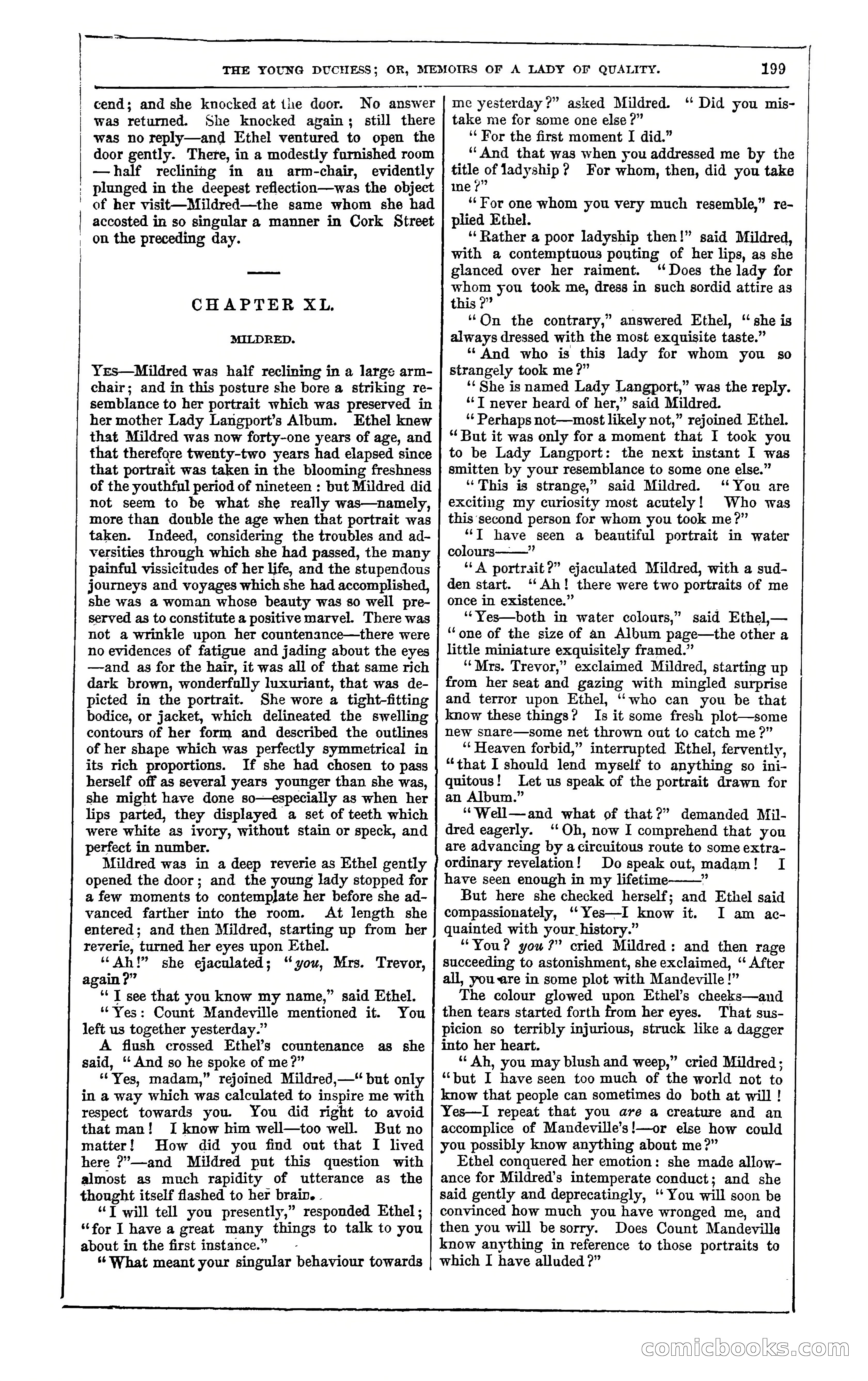
A restored page from Penny Dreadfuls, 1858. Page through the whole issue in the reader above.
📄 Transcribed text from this page (OCR, searchable)
Machine-transcribed from the original scan — historical spelling and the odd misread are preserved.
cend; and she knocked at the door. No answer was returned. She knocked again; still there was no reply—and Ethel ventured to open the door gently. There, in a modestly furnished room —half reclining in an arm-chair, evidently ; plunged in the deepest reflection—was the object of her visit—Mildred—the same whom she had accosted in so singular a manner in Cork Street | on the preceding day. CHAPTER XL. MILDRED. YEs—Mildred was half reclining in a large arm- chair; and in this posture she bore a striking re- semblance to her portrait which was preserved in her mother Lady Langport’s Album. Ethel knew that Mildred was now forty-one years of age, and that therefore twenty-two years had elapsed since that portrait was taken in the blooming freshness of the youthful period of nineteen : but Mildred did not seem to be what she really was—namely, more than double the age when that portrait was taken. Indeed, considering the troubles and ad- versities through which she had passed, the many painful vissicitudes of her life, and the stupendous journeys and voyages which she had accomplished, she was a woman whose beauty was so well pre- served as to constitute a positive marvel. There was not a wrinkle upon her countenance—there were no evidences of fatigue and jading about the eyes —and as for the hair, it was all of that same rich dark brown, wonderfully luxuriant, that was de- picted in the portrait. She wore a tight-fitting bodice, or jacket, which delineated the swelling contours of her form and described the outlines of her shape which was perfectly symmetrical in its rich proportions. If she had chosen to pass herself off as several years younger than she was, she might have done so—especially as when her lips parted, they displayed a set of teeth which were white as ivory, without stain or speck, and perfect in number. Mildred was in a deep reverie as Ethel gently opened the door; and the young lady stopped for a few moments to contemplate her before she ad- vanced farther into the room. At length she entered; and then Mildred, starting up from her reverie, turned her eyes upon Ethel. “Ah!” she ejaculated; “you, Mrs. Trevor, again ?” “ T see that you know my name,” said Ethel. “Yes: Count Mandeville mentioned it. You left us together yesterday.” A flush crossed Ethel’s countenance as she said, “‘ And so he spoke of me?” “Yes, madam,” rejoined Mildred,—“ but only in a way which was calculated to inspire me with respect towards you. You did right to avoid that man! I know him well—too well. But no matter! How did you find out that I lived here ?”—and Mildred put this question with almost as much rapidity of utterance as the thought itself flashed to her brain. . “T will tell you presently,” responded Ethel; “for I have a great many things to talk to you about in the first instance.” —- ‘‘ What meant your singular behaviour towards THE YOUNG DUCHESS; OR, MEMOIRS OF A LADY OF QUALITY. 199 me yesterday?” asked Mildred. ‘ Did you mis- take me for some one else 2?” ‘For the first moment I did.” ‘“‘And that was when you addressed me by the title of ladyship? For whom, then, did you take me?” “For one whom you very much resemble,” re- plied Ethel. ‘‘Rather a poor ladyship then!” said Mildred, with a contemptuous pouting of her lips, as she glanced over her raiment. “Does the lady for whom you took me, dress in such sordid attire as this ?” “On the contrary,” answered Ethel, “ she is always dressed with the most exquisite taste.” ‘And who is this lady for whom you so strangely took me?” ‘‘ She is named Lady Langport,” was the reply. ‘““T never heard of her,” said Mildred. ‘* Perhaps not—most likely not,” rejoined Ethel. “But it was only for a moment that I took you to be Lady Langport: the next instant I was smitten by your resemblance to some one else.” “This is strange,” said Mildred. ‘You are exciting my curiosity most acutely! Who was this ‘second person for whom you took me?” ““T have seen a beautiful portrait in water colours——” “‘A portrait?” ejaculated Mildred, with a sud- den start. “‘ Ah! there were two portraits of me once in existence.” ‘““Yes—both in water colours,” said Ethel,— “one of the size of an Album page—the other a little miniature exquisitely framed.” ‘Mrs. Trevor,” exclaimed Mildred, starting up from her seat and gazing with mingled surprise and terror upon Ethel, ‘‘who can you be that know these things? Is it some fresh plot—some new snare—some net thrown out to catch me ?” ‘Heaven forbid,” interrupted Ethel, fervently, “that I should lend myself to anything so ini- quitous! Let us speak of the portrait drawn for an Album.” ‘'Well—and what of that?” demanded Mil- dred eagerly. ‘Oh, now I comprehend that you are advancing by a circuitous route to some extra- ordinary revelation! Do speak out, madam! I have seen enough in my lifetime——” But here she checked herself; and Ethel said compassionately, ‘““Yes—I know it. I am ac- quainted with your history.” “You? you?” cried Mildred: and then rage succeeding to astonishment, she exclaimed, “ After all, you are in some plot with Mandeville!” The colour glowed upon Ethel’s cheeks—and then tears started forth from her eyes. That sus- picion so terribly injurious, struck like a dagger into her heart. “Ah, you may blush and weep,” cried Mildred; “but I have seen too much of the world not to know that people can sometimes do both at will ! Yes—I repeat that you are a creature and an accomplice of Mandeville’s!—or else how could you possibly know anything about me?” Ethel conquered her emotion: she made allow- ance for Mildred’s intemperate conduct; and she said gently and deprecatingly, ‘“‘ You will soon be convinced how much you have wronged me, and then you will be sorry. Does Count Mandeville know anything in reference to those portraits to which I have alluded ?” a TS LIC I CE tC SS pe een re COMO YN Wn) Colin