
Penny Dreadfuls, 1858 · page 201 of 400
The Young Duchess; or, Memoirs of a Lady of Quality — page 201: what you’re looking at
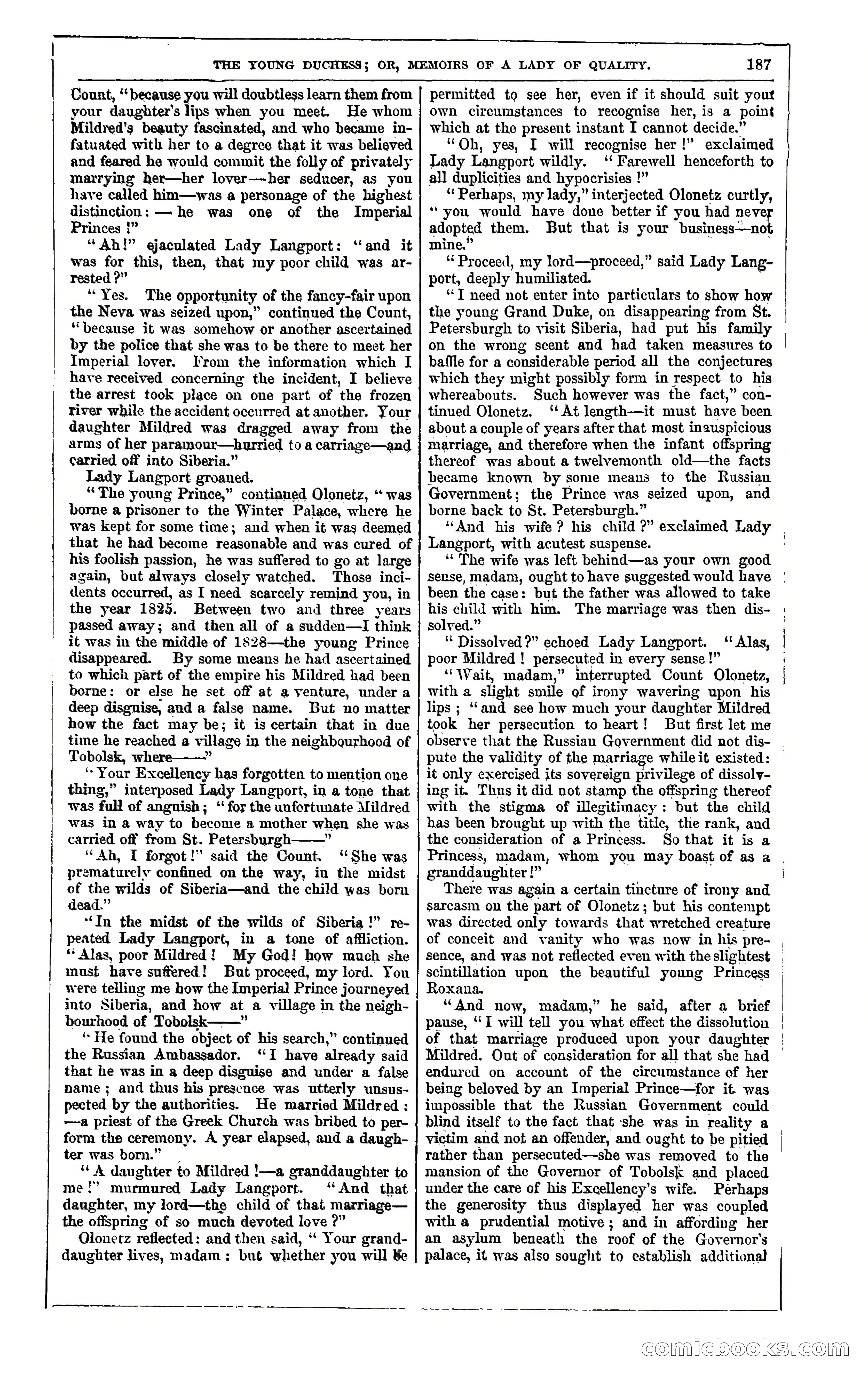
A restored page from Penny Dreadfuls, 1858. Page through the whole issue in the reader above.
📄 Transcribed text from this page (OCR, searchable)
Machine-transcribed from the original scan — historical spelling and the odd misread are preserved.
THE YOUNG DUCHESS; OR, MEMOIRS OF A LADY OF QUALITY. Count, “because you will doubtless learn them from your daughter's lips when you meet. He whom Mildred's beauty fascinated, and who became in- fatuated with her to a degree that it was believed and feared he would commit the folly of privately marrying her—her lover—her seducer, as you have called him—was a personage of the highest distinction: — he was one of the Imperial Princes !” “Ah!” ejaculated Lady Langport: ‘and it was for this, then, that my poor child was ar- rested ?” “Yes. The opportunity of the fancy-fair upon the Neva was seized upon,” continued the Count, “because it was somehow or another ascertained by the police that she was to be there to meet her Imperial lover. From the information which I have received concerning the incident, I believe the arrest took place on one part of the frozen river while the accident occurred at another. Your daughter Mildred was dragged away from the arms of her paramour—hurried to a carriage—and carried off into Siberia.” Lady Langport groaned. “The young Prince,” continued Olonetz, “was borne a prisoner to the Winter Palace, where he was kept for some time; and when it was deemed that he had become reasonable and was cured of his foolish passion, he was suffered to go at large again, but always closely watched. Those inci- dents occurred, as I need scarcely remind yon, in the year 1823. Between two and three years passed away; and then all of a sudden—JI think it was in the middle of 1828—the young Prince disappeared. By some means he had ascertained to which part of the empire his Mildred had been borne: or else he set off at a venture, under a deep disguise, and a false name. But no matter how the fact may be; it is certain that in due time he reached a village in the neighbourhood of Tobolsk, where——” ‘* Your Excellency has forgotten to mention one thing,” interposed Lady Langport, in a tone that was fall of anguish; ‘for the unfortunate Mildred was in a way to become a mother when she was carried off from St. Petersburgh “Ah, I forgot!” said the Count. ‘She was prematurely confined on the way, in the midst of the wilds of Siberia—and the child was born dead.” “In the midst of the wilds of Siberia!” re- peated Lady Langport, in a tone of affliction. ** Alas, poor Mildred! My God! how much she must have suffered! But proceed, my lord. You were telling me how the Imperial Prince journeyed into Siberia, and how at a village in the neigh- bourhood of Tobolsk-——” ‘He found the object of his search,” continued the Russian Ambassador. “1 have already said that he was in a deep disguise and under a false name ; and thus his presence was utterly unsus- pected by the authorities. He married Mildred : —a priest of the Greek Church was bribed to per- form the ceremony. A year elapsed, and a daugh- ter was bom.” | ‘‘ A daughter to Mildred !—a granddaughter to me!” murmured Lady Langport. ‘And that daughter, my lord—the child of that marriage— the offspring of so much devoted love ?” Qlonetz reflected: and then said, ‘‘ Your grand- daughter lives, madam: but whether you will Be 187 permitted to see her, even if it should suit yout own circumstances to recognise her, is a point which at the present instant I cannot decide.” “Oh, yes, I will recognise her!” exclaimed Lady Langport wildly. ‘‘ Farewell henceforth to all duplicities and hypocrisies !”’ ‘Perhaps, my lady,” interjected Olonetz curtly, ‘‘you would have done better if you had neve ‘ adopted them. But that is your business—no mine.” ‘Proceed, my lord—proceed,” said Lady Lang- port, deeply humiliated. “T need not enter inte particulars to show how the young Grand Duke, on disappearing from St. Petersburgh to visit Siberia, had put his family on the wrong scent and had taken measures to baffle for a considerable period all the conjectures which they might possibly form in respect to his whereabouts. Such however was the fact,” con- tinued Olonetz. ‘At length—it must have been about a couple of years after that most inauspicious marriage, and therefore when the infant offspring — thereof was about a twelvemonth old—the facts became known by some means to the Russian Government; the Prince was seized upon, and borne back to St. Petersburgh.” “And his wife? his child ?” exclaimed Lady Langport, with acutest suspense. ‘“ The wife was left behind—as your own good sense, madam, ought to have suggested would have | been the case: but the father was allowed to take his child with him. The marriage was then dis- solved.” ‘Dissolved ?” echoed Lady Langport. “Alas, poor Mildred ! persecuted i in every sense !” “Wait, madam,” interrupted Count Olonetz, with a slight smile of irony wavering upon his lips ; ‘“‘and see how much your daughter Mildred took her persecution to heart! But first let me observe that the Russian Government did not dis- pute the validity of the marriage while it existed: it only exercised its sovereign privilege of dissolv- ing it. Thus it did not stamp the offspring thereof with the stigma of illegitimacy : but the child has been brought up with the title, the rank, and the consideration of a Princess. So that it is a Princess, madam, whom you may boast of as a granddaughter |” There was again a certain tincture of irony and sarcasm on the part of Olonetz; but his contempt was directed only towards that wretched creature of conceit and vanity who was now in his pre- sence, and was not reflected even with theslightest | scintillation upon the beautiful young Princess Roxana. ‘““And now, madam,” he said, after a brief pause, ‘I will tell you what effect the dissolution | of that marriage produced upon your daughter | Mildred. Out of consideration for all that she had | endured on account of the circumstance of her being beloved by an Imperial Prince—for it was impossible that the Russian Government could blind itself to the fact that she was in reality a victim and not an offender, and ought to be pitied rather than persecuted—she was removed to the mansion of the Governor of Tobolsk and placed under the care of his Excellency’s wife. Perhaps the generosity thus displayed her was coupled with a prudential motive ; and in affording her an asylum beneath the roof of the Governor's palace, it was also sought to establish additional COMO oO Colin