
Penny Dreadfuls, 1858 · page 20 of 400
The Young Duchess; or, Memoirs of a Lady of Quality — page 20: what you’re looking at
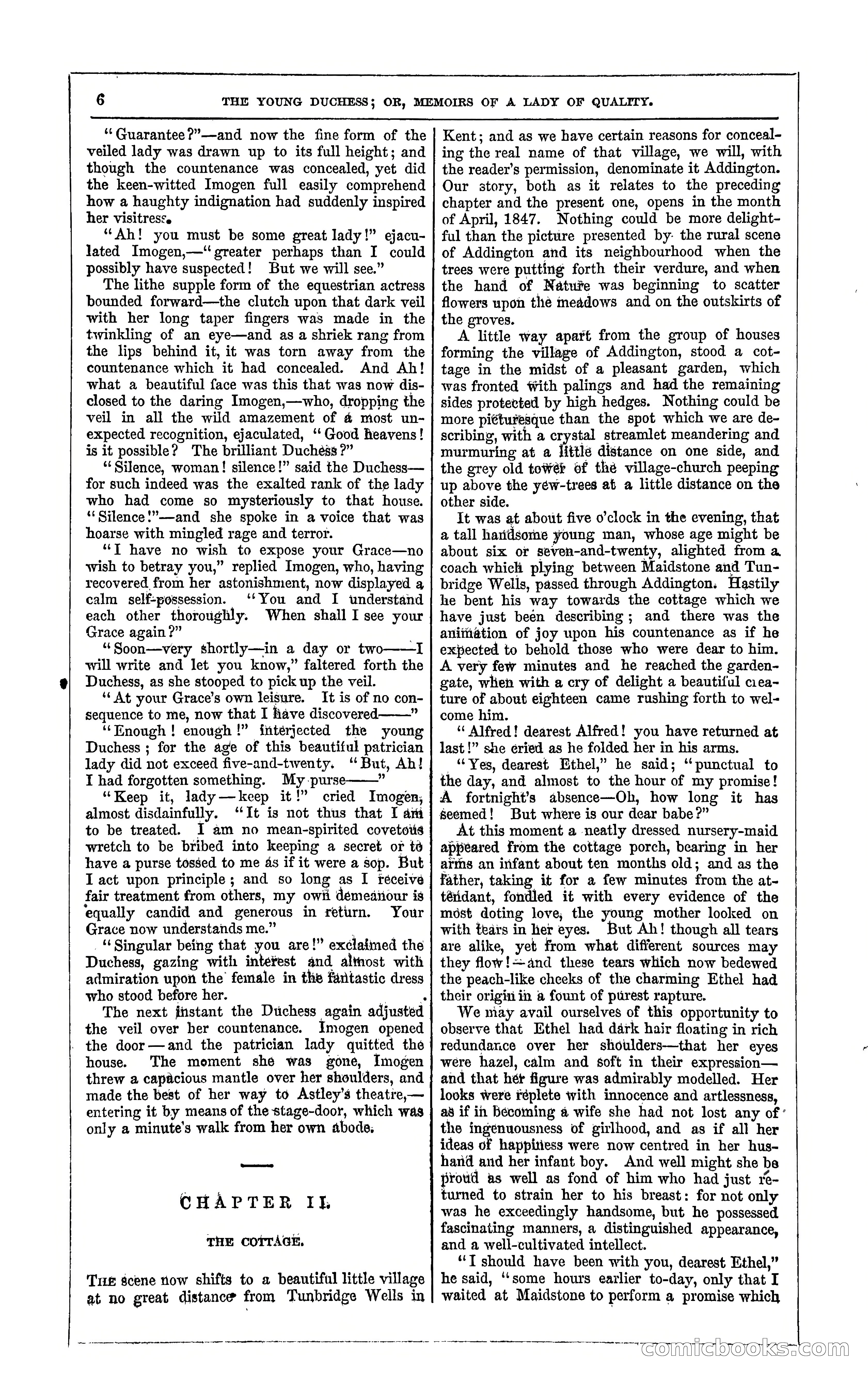
A restored page from Penny Dreadfuls, 1858. Page through the whole issue in the reader above.
📄 Transcribed text from this page (OCR, searchable)
Machine-transcribed from the original scan — historical spelling and the odd misread are preserved.
6 THE YOUNG DUCHESS; OR, MEMOIRS OF A LADY OF QUALITY. ‘“‘ Guarantee ?”—-and now the fine form of the veiled lady was drawn up to its full height; and though the countenance was concealed, yet did the keen-witted Imogen full easily comprehend how a haughty indignation had suddenly inspired her visitresc. “Ah! you must be some great lady!” ejacu- lated Imogen,—‘“ greater perhaps than I could possibly have suspected! But we will see.” The lithe supple form of the equestrian actress bounded forward—the clutch upon that dark veil with her long taper fingers was made in the twinkling of an eye—and as a shriek rang from the lips behind it, it was torn away from the countenance which it had concealed. And Ah! what a beautiful face was this that was now dis- closed to the daring Imogen,—who, dropping the veil in all the wild amazement of & most un- expected recognition, ejaculated, ‘‘Good heavens! is it possible? The brilliant Duchess ?” ** Silence, woman! silence!” said the Duchess— for such indeed was the exalted rank of the lady who had come so mysteriously to that house. ‘‘Silence!”’—and she spoke in a voice that was hoarse with mingled rage and terror. “T have no wish to expose your Grace—no wish to betray you,” replied Imogen, who, having recovered from her astonishment, now displayed a calm self-possession. ‘‘You and I understand each other thoroughly. When shall I see your Grace again ?” “ Soon—very shortly—in a day or two——I will write and let you know,” faltered forth the Duchess, as she stooped to pick up the veil. ‘‘ At your Grace’s own leisure. It is of no con- sequence to me, now that I ave discovered ——” “Tnough ! enough !” interjected the young Duchess ; for the age of this beautiful patrician lady did not exceed five-and-twenty. “But, Ah! I had forgotten something. My-purse——” “Keep it, lady—keep it!” cried Imogen, almost disdainfully. “It is not thus that I aii to be treated. I am no mean-spirited covetous wretch to be bribed into keeping a secret or td have a purse tossed to me 4s if it were a sop. But I act upon principle; and so long as I feéceive fair treatment from others, my owt démeaiiour is equally candid and generous in return. Your Grace now understands me.” “Singular being that you are!” exclaimed the Duchess, gazing with interest and altnost with admiration upon the female in the fantastic dress who stood before her. . r The next instant the Duchess again adjusted the veil over ber countenance. Imogen opened . the door—and the patrician lady quitted the house. The moment she was gone, Imogen threw a capacious mantle over her shoulders, and made the best of her way to Astley’s theatre,— entering it by means of the stage-door, which was only a minute's walk from her own abode, CHAPTER IL THE COTTAGE, Tue scene tow shifts to a beautiful little village at no great distance from Tunbridge Wells in Kent; and as we have certain reasons for conceal- ing the real name of that village, we will, with the reader’s permission, denominate it Addington. Our story, both as it relates to the preceding chapter and the present one, opens in the month of April, 1847. Nothing could be more delight- ful than the picture presented by- the rural scene of Addington and its neighbourhood when the trees were putting forth their verdure, and when the hand of Natute was beginning to scatter flowers upon the meadows and on the outskirts of the groves. A little way apart from the group of houses forming the village of Addington, stood a cot- tage in the midst of a pleasant garden, which was fronted ‘ith palings and had the remaining sides protected by high hedges. Nothing could be more piéturesque than the spot which we are de- scribing, with a crystal streamlet meandering and murmuring at @ fhitle distance on one side, and the grey old towér of thé village-church peeping up above the yéw-trees ab a little distance on the other side. It was at about five o’clock in the evening, that a tall haridsome young man, whose age might be about six or seven-and-twenty, alighted from a coach which plying between Maidstone and Tun- bridge Wells, passed through Addington. Hastily he bent his way towards the cottage which we have just been describing ; and there was the aniiiation of joy upon his countenance as if he expected to behold those who were dear to him. A very few minutes and he reached the garden- gate, when with a cry of delight a beautiful ciea-~ ture of about eighteen came rushing forth to wel- come him. “ Alfred! dearest Alfred! you have returned at last!” she eried as he folded her in his arms. “Yes, dearest Ethel,” he said; ‘punctual to the day, and almost to the hour of my promise! A fortnight’s absence—Oh, how long it has seemed! But where is our dear babe?” At this moment a neatly dressed nursery-maid appeared from the cottage porch, bearing in her arms an infant about ten months old; and as the father, taking it for a few minutes from the at~ téridant, fondled it with every evidence of the most doting love, the young mother looked on with tears in her eyes. But Ah! though all tears are alike, yet from what different sources may they flow!—and these tears which now bedewed the peach-like cheeks of the charming Ethel had their origin in a fount of purest rapture. We may avail ourselves of this opportunity to observe that Iithel had dark hair floating in rich redundance over her shoulders—that her eyes were hazel, calm and soft in their expression— and that hét figure was admirably modelled. Her looks were réplete with innocence and artlessness, a8 if in becoming @ wife she had not lost any of’ the ingenuousness of girlhood, and as if all her ideas of happitiess were now centred in her hus- hand and her infant boy. And well might she ba proud as well as fond of him who had just 1%- turned to strain her to his breast: for not only was he exceedingly handsome, but he possessed fascinating manners, a distinguished appearance, and a well-cultivated intellect. “T should have been with you, dearest Ethel,” he said, “‘some hours earlier to-day, only that I waited at Maidstone to perform a promise which CONNIELIOO Socom